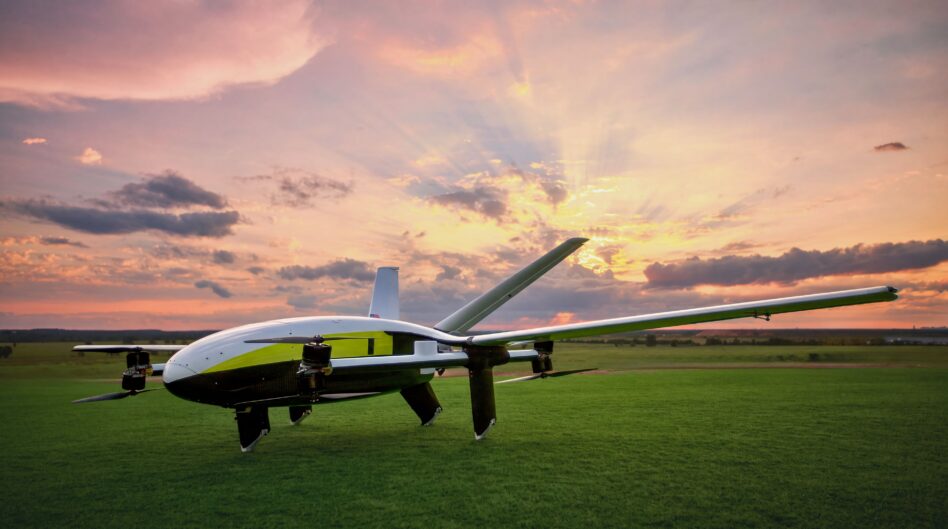
Well, gosh. Y’all really decided to start the week off with a bang, huh?
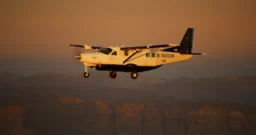
This morning, long-range cargo drone company Skyways unveiled a new version of its VTOL UAV called Skyreach, which packs in 100 lbs of payload, more than 48 hours of flight time, and a 1,300-mile range.
- The new-and-improved drone was developed as the production platform for the company’s $37M STRATFI with AFWERX.
- The company says Skyreach will start flying with “defense and commercial” customers in December 2026.
- They’ll also start phasing out earlier aircraft—namely, the V2—and replace ‘em with this one.
“Skyreach brings the range of a fixed-wing aircraft, the flexibility of a VTOL, and the versatility of a multi-mission platform into one aircraft,” Skyways CEO and Co-Founder Charles Acknin told Tectonic. “You are not going to find this on any other platform.”
Next day delivery: Now, in case you haven’t been paying attention, everyone and their mom is very keen on finding better, safer, and cheaper ways of getting things from one place to another.
- Contested logistics—one of the hottest phrases of the year—was named as one of the Pentagon’s six CTAs (critical technology areas, for the uninitiated) in late 2025, and companies have spent the last year or so finding a ton of different ways to move things around better. After all, logistics win wars (dummy).
- A massive category that’s emerged in this push is cargo drones—essentially big ol’ UAVs that can move critical supplies (blood, food, ammo) around without the risk (or expense) of human-piloted cargo aircraft—especially in massively spread-out places like the Indo-Pacific.
- Plus, these bad boys need to be able to take off and land without runways and make it all the way out (at least in theory) to tiny island chains, say in the South China Sea, or from a carrier to another ship.
Way back when: Skyways started building their solution to this rather thorny problem back when they were founded in 2017.
- Fun fact—the company was part of Y-Combinator’s Summer 2017 cohort. Defense YC companies before it was cool.
- The company was tapped by the US Navy to be part of its Blue Water Maritime Logistics UAS effort in 2019, and worked with the service on things including ship-to-ship cargo delivery from then ’til about 2023. They also flew a simulated 313-mile blood-resupply mission for a Marine Corps requirement in 2024.
- The company officially unveiled its V2 aircraft in 2025 alongside that $37M Air Force award—its most significant award to date.
- They’ve also worked with the Japanese Air Force and ANA (the Japanese airline), as well as a range of commercial customers (including DSV in Denmark).
They also raised about $21M in Series A funding back in December 2021, plus another $5M in financing in 2025.
Big ups: V2 had a payload of 50 lbs and a range of about 300 miles—Skyreach (also called V3) is a whole gosh-darn level up.
- Like V2, the aircraft is a VTOL with a hybrid propulsion system. Electric for when you can use it, and traditional fuel for when you can’t charge.
- It’s also, like V2, autonomous (autonomy stack built in-house). V3, per Acknin, has benefitted from all of the autonomy data collected over eight years flying.
- But it can carry a whole lot more (100 lbs) and travel a whole lot further (1,300 miles at 10 lbs of cargo and 280 miles at 80 lbs of cargo). It’s also got a cargo bay of 7 cubic feet, which Aknin compared to a bathtub. Cute.
- Acknin said the whole thing was about one-tenth the cost of a helicopter—without the need for a skilled pilot or hardcore ground crews.
- Currently, it costs about $300/hour to run, and they’re working to get that down to $100/hour with more and better autonomy.
“Skyreach is really built on the last eight years of flying our V2 platform with customers,” Acknin said. “We’ve learned from our customers that they want to be able to stay up in the air longer, and they want more volume in the cargo bay, and they want the aircraft to be multi-role.”
“V3 [Skyreach] just builds on all those lessons learned from our customers, and builds really just the best platform that we could think of,” he added.
And it’s already flying. Acknin said V3 has been up in the air “for some time now” internally, and that it’ll start flying with customers in December.
Plug and play: While logistics are Skyways bread and butter, Acknin said that they don’t plan to stop here—once they’ve mastered logistics, he said, they can move onto things like ISR. That’s the multi-mission of it all.
“If you start by building a logistics platform, it’ll be relatively easy to do the other use cases,” he said. “I mean, if you want to fly a gimbal camera, if you want to fly a sensor, you will be able to do so relatively easily because you built a platform that could carry a load, by definition, at a significant range. The same is not true the other way around.”
“Like, if you built a highly specialized platform to do ISR, it’ll be very, very difficult to do a lot of other missions, including cargo and logistics missions,” he added.