Hasn’t been a slow year (or week) for Anduril, to say the least, and it’s about to get a whole lot busier.
Yesterday, the US Army announced that it’s selected everyone’s favorite neoprime to lead the common data baseline for its Next-Generation Command and Control (NGC2) effort, tasking the company with making sure all of the service’s software, hardware, and everything in between talks to each other.
It’s the first major contract awarded to move the effort from prototype to continuous deployment across Army formations. Seems like a big deal.
Under the contract, Anduril will work with Palantir to provide an edge-to-cloud data mesh through the company’s Lattice software and Palantir’s Foundry, and with Raft for data registries, transformation tools, and federation. No dollar figure was given, but it falls under Anduril’s big ol’ $20B, 10-year enterprise agreement with the Army.
- In a statement, Palantir said that “the Army reached this pace by starting with commercial technology and pairing it with a contracting process built to move just as fast.”
- Raft’s Chief Product Officer, Trey Coleman, told Tectonic that they’re “proud to stand alongside the US Army and our industry partners Anduril and Palantir to deliver a best-of-breed common data layer baseline that increases the speed, precision, and lethality of the joint force.”
Race to integrate: We’ve covered it a whole lot, but for the uninitiated, NGC2 is one of the Army’s top modernization priorities and the service’s answer to Joint All-Domain Command and Control (JADC2), the Pentagon’s broader push to fuse information, data, and decision-making across all domains (land, air, sea, space, and cyber) and services.
- Think of NGC2 as a huge, AI-powered brain that could basically keep tabs on and control everything that the Army does—or wants to do—across all of its core warfighting functions, from logistics to intel, fires, and comms.
- That’s a big deal because, right now, the Army’s C2 is a bit of a hot mess of systems and programs that don’t always work together. The Army alone has used a cobbled-together C2 system comprising 17 programs of record.
Friendly competition: NGC2 aims to clean that up, and last year, the Army tapped Anduril and, shortly after, Lockheed to lead two teams tasked with developing prototypes for the program and testing them with the 4th Infantry Division and 25th Infantry Division, respectively.
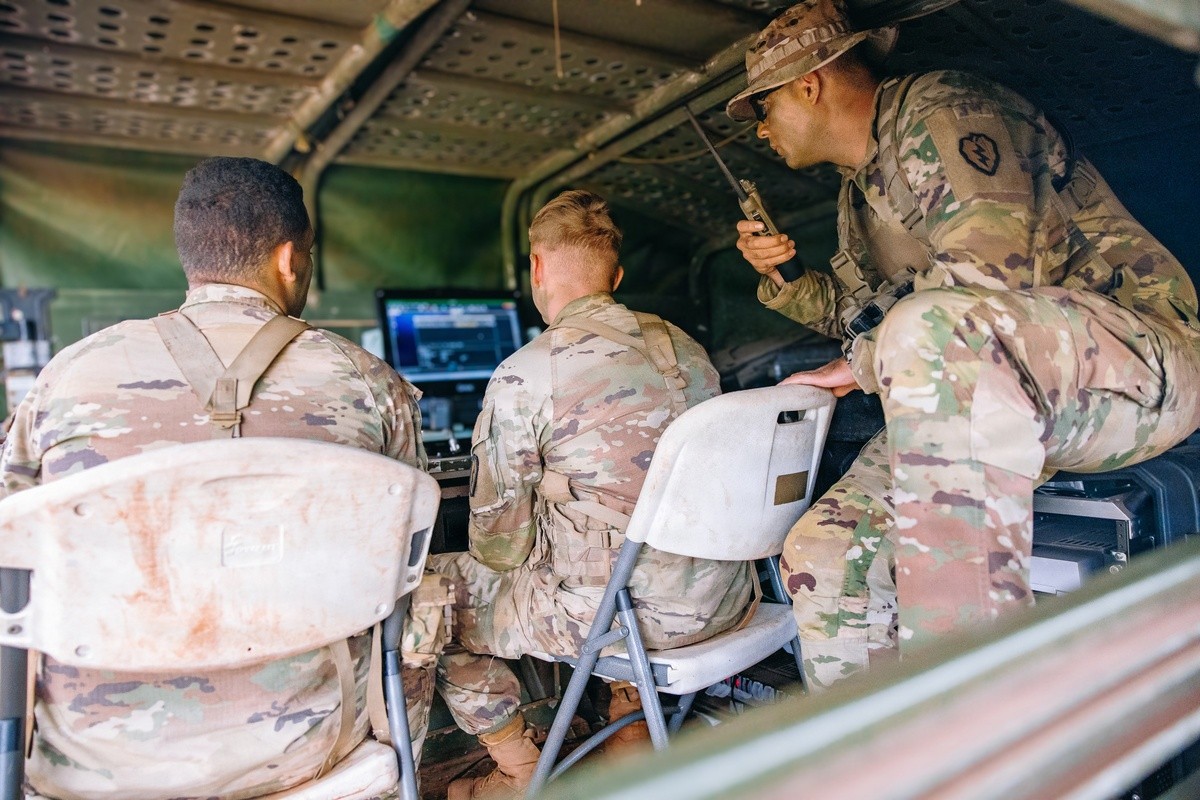
- Team Anduril, which includes Palantir, Govini, Microsoft, Striveworks, Rune, and Shift5, tested the prototype at near-monthly Ivy Sting exercises with the 4th ID at Fort Carson.
- Team Lockheed, meanwhile, features Raft, Amazon Web Services, Rune (again), and others, and has tested their own prototype at the 25th ID’s Lightning Surge exercises in Hawaii.
Ivy League: Last month, Anduril brought together all the different elements of their NGC2 prototype tested at the Ivy Sting exercises for a combined exercise, called Ivy Mass, before the Army’s final Project Convergence Capstone 6 (PCC6) test this summer.
At Ivy Mass, Anduril’s team:
- Boosted the number of soldier-connected devices from 10 at the final Ivy Sting exercise to over 2,500 at Ivy Mass;
- Added 17 new applications and 11 new sensors, bringing the totals to 40 applications, 36 data feeds, and 37 sensors and effectors across nine hardware form factors;
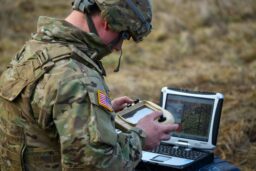
- And raised the number of Tactical Edge Computers (TECs)—deployable compute systems mounted in vehicles, command posts, and unmanned platforms that host Anduril’s Lattice software in the field—from roughly 65 to 130.
Looks like the Army liked what they saw from Team Anduril at Ivy Mass—at least enough to give them the keys to the whole dang thing.
“We are already moving out with the converged data layer architecture,” the Army’s portfolio acquisition executive for Command and Control (C2)/Counter C2, Joseph Welch, said in a statement. “Our vendor partners have demonstrated great teamwork and flexibility in helping us establish this baseline and set the groundwork for rapid scaling.”
Next steps: Up next, Anduril will oversee the integration of the 4th ID and 25th ID’s NGC2 common components and work with all the companies involved—including Lockheed—to get the common data baseline layer ready for Project Convergence.
- In a statement, Lockheed said it’ll continue to play “an integral role as the designated lead driving coordination and implementation with the 25th ID” and “will continue to evaluate other opportunities within the NGC2 ecosystem.”
I guess it’s time to stop calling Anduril a neoprime—they’re clearly well into prime territory.