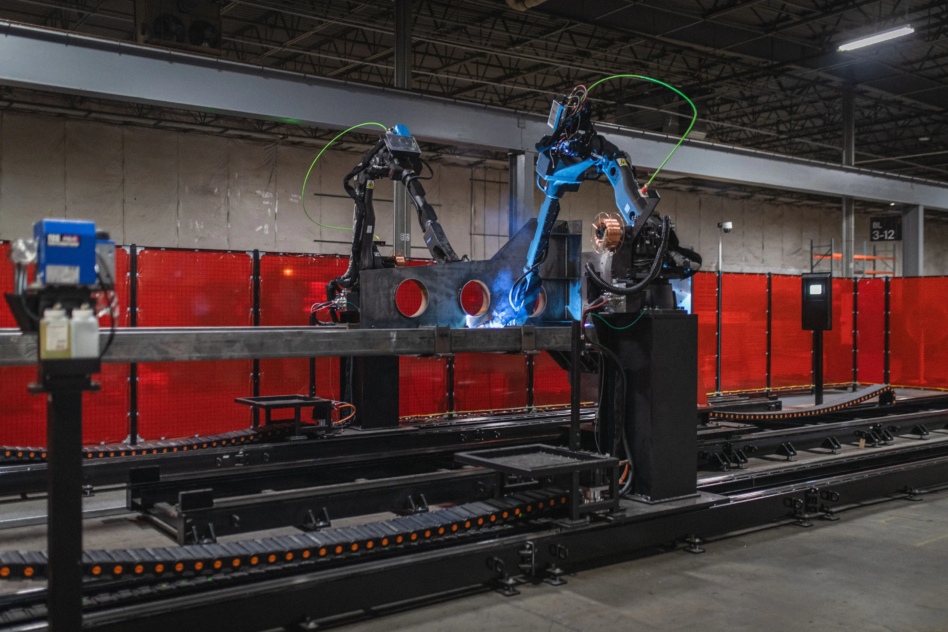
Well, even the big guns are bringing in the robots.
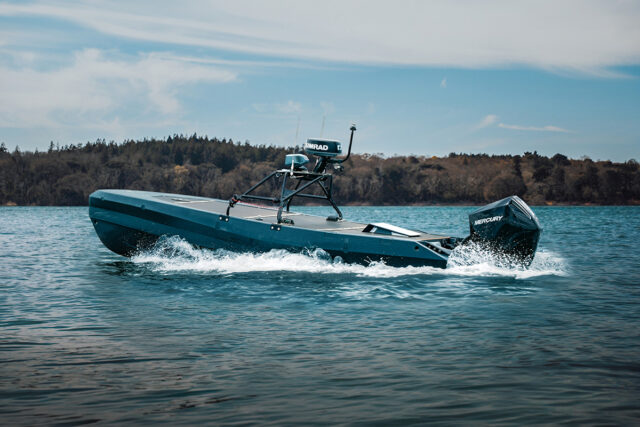
Yesterday, shipbuilding megalith HII (the artist formerly known as Huntington Ingalls Industries) announced that it’s signed agreements with GrayMatter Robotics and Path Robotics to “accelerate the development and deployment of advanced physical AI automation across U.S. Navy shipbuilding programs, including aircraft carriers, submarines, destroyers, amphibious ships, future frigates and unmanned surface vessels.”
The multi-year deal is worth up to a whopping $900M.
“We are committed to making generational investments to develop new shipbuilding capability and to expand capacity,” Eric Chewning, executive vice president of maritime systems and corporate strategy at HII, said in a statement. “This collaboration represents a strategic investment in the future of American shipbuilding — strengthening industrial base resilience, expanding distributed shipbuilding capacity, feeding critical materials to our shipyards and workforce, and unlocking new production efficiencies essential to delivering the Navy’s growing fleet.”
“This is a monumental moment for US shipbuilding,” GrayMatter Robotics CEO and co-founder Ariyan Kabir told Tectonic. “We have a major backlog when it comes to shipbuilding in the US and US allies. Historically, we have this massive capacity constraint due to a lack of skilled workers, and this production agreement essentially changes that dynamic.”
Shipping out: Now, HII should need no introduction—big ships, legacy company, largest military shipbuilder in the US, $12.6B market cap, etc.
But the company is squarely on the more traditional side of things. GrayMatter and Path are not—they’re both robotics companies, basically trying to use machines to do the niche, difficult, and often dangerous tasks to build things like subs and warships.
Grey area: GrayMatter combines an autonomous intelligence layer with COTS robots to do the “last-minute,” often super-precise parts of the manufacturing process. Think sanding, grinding, coating, and inspection.
- Basically, their software (the family is called SCAN&) scans a part with 3D sensors, creates a digital model, and figures out what finishing steps need to be done—then programs a robot to do them.
- That saves operators hours on reprogramming robots every time the geometry of a ship or part changes. Their setup is very helpful for high-mix, high-variability stuff—like a shipyard.
- And it’s not just talk—they’ve raised $68.7M (most recently a $45M Series B in 2024), according to PitchBook data.
- They’ve also worked on everything from trucks to airplane parts to football helmets.
On the warpath: If GrayMatter does the finishing, Path is one step before—they build autonomous welding robots that can also work on a variety of parts without being reprogrammed.
- Traditional robotic welding requires engineers to manually teach the robot the exact weld path. That works well when you’re building thousands of identical parts, but not so well when you mix it up.
- Path has built a physical AI model it calls Obsidian that scans parts with cameras and sensors, identifies where a weld should go, and then assigns robots to do it automatically. It also tests weld quality as it works.
- And they’re a pretty heavy hitter in the VC world—the company’s raised a total of $341M, most recently a $50M Series D2 last fall. Cash money.
Worth noting: Both companies launched the High-Yield Production Robotics (HYPR) program with HII to “rapidly accelerate advanced, adaptive automation solutions in the fabrication process of both crewed and uncrewed naval platforms” earlier this year. Sounds like it’s going well.
“For years, we’ve believed physical AI could fundamentally change manufacturing,” Andy Lonsberry, CEO and co-founder of Path Robotics, said in a statement. “HYPR is a powerful validation of our vision — that physical AI can scale shipbuilding capacity in one of the world’s most demanding production environments.
Hype man: These new agreements are structured in two stages, per HII.
- The first is a “Navy-grade development stage,” where “both companies will partner with HII to develop, validate and qualify high-precision production techniques for autonomous welding, grinding, blasting, painting, assembly, inspection and other fabrication processes, then integrate them into an autonomous production line.”
- Then, if all goes well, in the “delivery stage,” HII will begin building ships off of the new, autonomous line. All in all, the companies could win up to $900M worth of work.
- This is all part of a push by HII to, put simply, do more work outside of the shipyard. The company says that it plans to outsource 2.5 million hours of shipbuilding work this year with partner companies like Path and GrayMatter, “enabling more work to be completed outside the shipyards before final assembly.”
“Instead of injecting some of this technology in existing shipyards, we’re taking a ground-up approach, a greenfield approach,” Kabir said. “[We’re creating] a completely end-to-end, rapidly reconfigurable and redeployable shipyard.”