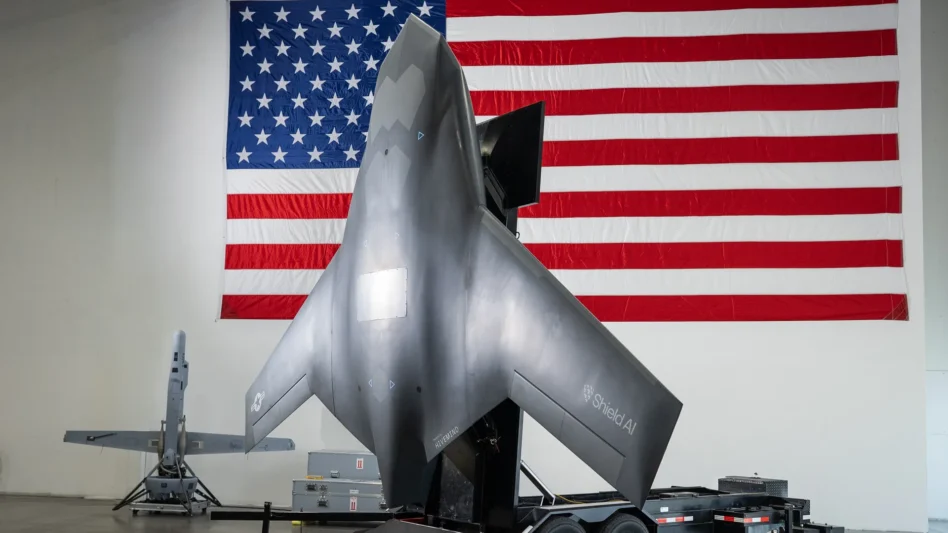
The mini-fighter-drone competition is (quite literally) heating up.
This morning, Shield AI and GE Aerospace announced that they’ve “successfully completed integration, actuation, and engine light-off testing of the advanced Axisymmetric Vectoring Exhaust Nozzle (AVEN) for Shield AI’s X-BAT aircraft,” which they call a “critical milestone in the program’s path to vertical flight.”
“X-BAT is designed to take off and land vertically from anywhere — no airbase, no runway — and that capability lives or dies with propulsion,” Armor Harris, senior vice president of aircraft engineering at Shield AI, said in a statement. “The AVEN is what makes vertical flight possible on a platform this size and this capable.”
Per the two companies, engineers modified the AVEN (introduced in the 1990s) to fit into GE Aerospace’s F110-GE-129E engine, then “completed functional checkouts and engine light-off to verify system performance” at a GE test site in Ohio.
“We’re applying [AVEN] differently than it was ever used before,” Harris added. “Vertical flight requires fast gimbaling to maintain attitude control, a demand the original program never had to meet. Taking hardware with a flight-proven track record and adapting it for that mission has let us move through development at an incredible pace instead of starting from zero.”
Let the rise of the drone-plane continue. Who’s got their popcorn ready?
Small(ish) but mighty: First, a primer on X-BAT for those who haven’t been paying attention. The minifighter-slash-megadrone was first unveiled last October—back then, Shield said it would be long-range, jet-powered, and capable of carrying some massive payloads.
- The aircraft is about 26 feet long and has a 39-foot wingspan—big for a wingman—but the company says it offers the same capabilities as a manned fighter in a smaller package.
- It’s also, erm, fairly pricey—CNBC reported that the drones will come in at about $27M a pop. For context, an F-15 comes in anywhere from $30-110M (depending on configuration and age), and an F-35 at about $83-110M.
- The drone will have a 1,000 nautical mile combat range and at launch Harris said it would have a service ceiling of 50,000 feet. For what it’s worth, an F-15’s service ceiling is about 60,000 feet.
- The X-BAT concept also has “2,000-pound class internally in each bay, with bays comparable in size to the F-35’s.” It can also generate “80 kilowatts of electrical power, enough to run electronic warfare suites…along with intelligence, surveillance, and reconnaissance (ISR) payloads and active and passive radar modes.”
- The whole thing will run on Shield AI’s Hivemind software—the autonomy brain. At launch, the Shield team said that X-BAT would be able to both act as part of a swarm in connected environments and “hunt on its own” when comms are jammed.
Back in November, Shield inked a Memorandum of Understanding with GE stating that “the F110-GE-129 engine, featuring the advanced Axisymmetric Vectoring Exhaust Nozzle (AVEN)” would power the X-BAT. Seems—given this test—the partnership is working out.
- Worth noting that this engine (and the oomph it provides) puts X-BAT in a totally different category than other CCAs. The F110-GE-129 engine famously powers both the F-15 and the F-16 and has been flown since the late 1980s.
- It’s the workhorse of modern fighter engines—it can provide up to 30,000 pounds of thrust, which for something like X-BAT will mean serious acceleration, speed, and maneuverability.
- The engine is also digitally controlled with FADEC (Full Authority Digital Engine Control), which means a computer constantly tweaks fuel flow and airflow.
- The idea behind integrating AVEN is that it can provide “thrust vectoring capability for vertical flight and enhance maneuverability in horizontal flight,” according to Shield.
- The engine is also (in technical terms) freaking huge—it’s about the size of a small car and weighs about 3,800 pounds. That might explain why X-BAT is not so tiny.
This engine test seems to be proof that the whole “integrate AVEN to make the GE engine work for X-BAT” concept might just be a go.
“The integration of AVEN into our F110-GE-129E engine and a successful light off represents a full-circle moment for our GE Aerospace team,” Doogie Russell, vice president of Edison Works at GE Aerospace, said in a statement. “By combining our proven experience in developing propulsion systems with Shield AI’s next-generation vehicle development, we are integrating the best of past, present, and future products to create a revolutionary aircraft.”
The company expects to begin flight testing later this year.