Everyone really is on the non-kinetic-weapon hype train right now, aren’t they?
This morning, high-powered-microwave (HPM) giant Epirus announced that they’ve been awarded an $11M contract by the US Marine Corps for the High-power Microwave Autonomous Vehicle Operational Capability (HAVOC) program.
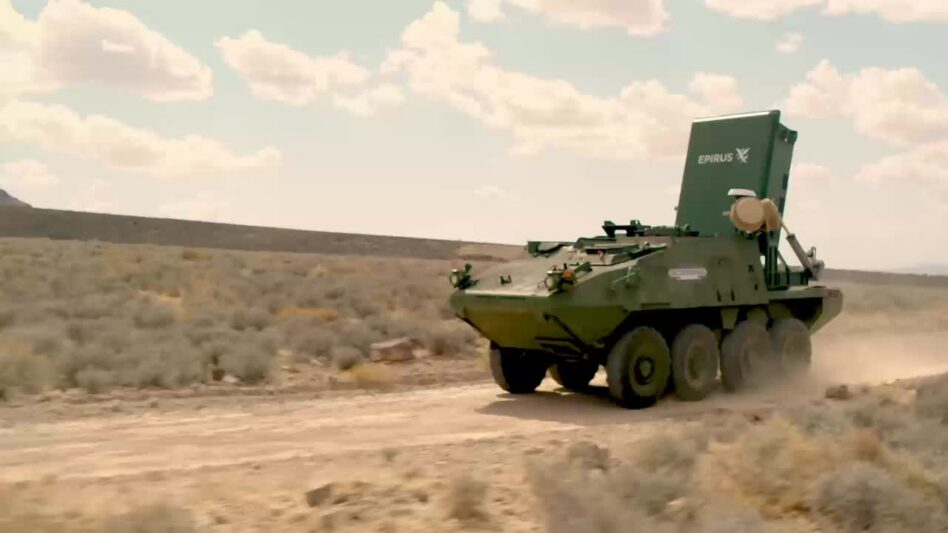
Under the contract, Epirus will deliver “its latest high-power microwave (HPM) system for counter-UAS and counter-swarm point defense.” The platform is equipped with a universal sled mount, which means it can be strapped on “across the Marine Corps’ manned and unmanned ground vehicle fleets,” per the company.
“The HAVOC system is smaller than [the one] the Army’s been messing around with, and it’s built for the Marines,” Epirus CEO Andy Lowery told Tectonic. “We’ve put it on a universal sled, so you can mount it on a JLTV or an autonomous vehicle. This might be an unmanned ground vehicle, loyal companion type thing that would be an automated part of a layered defense and integrated into the overall [Marine Air Defense Integrated System] architecture.”
Now, if you read Tectonic, you know Epirus. The company builds—put extremely simply—machines that zap drones with a super-powerful microwave beam, frying from the inside out.
- The company’s flagship platform is called Leonidas, a vehicle-mounted HPM directed energy system that projects that intense microwave energy at nearby drones, disabling their electronic components and dropping them out of the sky.
- In terms of form-factor, think a giant microwave-producing mattress perched on a truck.
- Its software-defined design allows Leonidas to alter waveforms, adjust energy output, define safe zones, and update the system in the field.
- And the company’s like, actually scored contracts for this stuff—the Army has awarded Epirus over $120M in contracts for Leonidas under the Integrated Fires Protection Capability High-Power Microwave (IFPC-HPM) program since 2023, including a $43.5M contract last summer.
- Plus, they’ve got a pretty sweet pile of cash to build these mighty microwave weapons. They’ve raised a total of over $540M in funding, according to Pitchbook data, most recently a $250M Series D led by 8VC.
Giddy up: And this ain’t Epirus’ first rodeo with the Marines, either. The company delivered a prototype of an “Expeditionary Directed Energy Counter-Swarm (ExDECS) system” (Read: A Leonidas variant) to Naval Surface Warfare Center Dahlgren to support the U.S. Marine Corps last year.
Per the company, this new HAVOC contract is the “autonomy-enabled evolution” of that system and “will introduce significant gains in electronic lethality, reliability and operational efficiency.” Plus, they say it will “also expand coverage and power output while enabling continuous software-driven tuning.”
- Lowery said Epirus has “nearly tripled the effective radiation power density” in the new Leonidas system, compared to the first generation, which “significantly increases the range.”
- “The more power we can put in a smaller and smaller package, the more range and the more lethal you are,” he added.
The idea is to “extend the counter-UAS line of defense to protect ground-based air defense assets, refueling points, radars, communications, power equipment and other forward-deployed assets” from nasty low-altitude threats.
This contract is for a prototype of the HAVOC system, but Lowery is confident the Marine Corps will be back for more.
“I’m not saying it’s guaranteed, but I’m hopeful that we’ll get the nod to go straight to production and become an integrated system for operational units,” he said. “This particular HAVOC system is built to production standards. It’s not a prototype any longer, and we’ve got all the production standards dialed in.”