Turns out that a whole lot of global instability is blowing the IPO window wide open for defense companies, and Lyntris is striking while the iron’s hot.
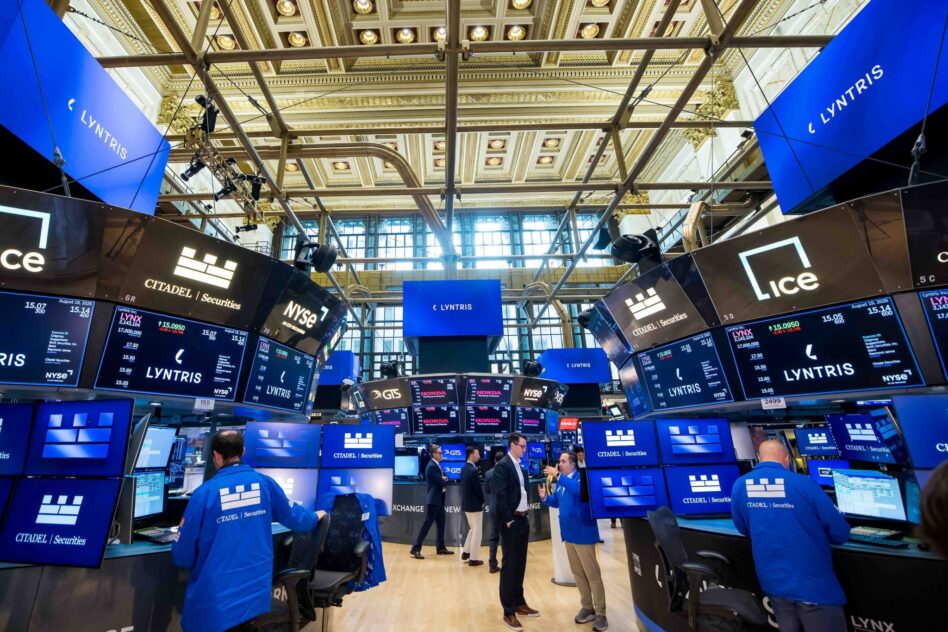
The private-equity-backed, Virginia-based defense sensing software and hardware company went public on the NYSE yesterday, raising roughly $300M in a downsized IPO and joining a string of defense public market debuts over the past few months.
Shares in Lyntris started trading yesterday at $15.50 and closed at $15.01. That slid further to $14.75 in pre-market trading.
- Lyntris initially planned to offer 24M shares priced between $19 and $22, but scaled down to 17M shares at $17.50 a pop shortly before the IPO. Trive Capital, Lyntris’ PE backer, sold roughly 11M shares to distribute to its limited partners, which analysts say contributed to the slide.
- The decision to cut back on the IPO, CEO Brian Morrison told Tectonic in an interview, partially reflected “that this sector of the market has had a tough week or two,” but that they “were able to enter this process with the right kind of investors who understand the national security imperative and the durability of these growth markets.”
- “I think our IPO investors have come in at a really great price point, and they have plenty of room to run on this journey with us,” he added.
On a Roll-Up: Lyntris is a new name but an old hat in the defense world. The company, the product of a Trive Capital buy-and-build strategy, rebranded as Lyntris in May after the merger of C2 software company Accelint and sensing hardware manufacturer Vitesse Systems.
- The company today is the result of a dozen or so acquisitions in the sensing and C2 software and hardware world since 2018. Lyntris’ tech includes antenna and radar hardware, sensor-control software, and higher-level C2 and data-fusion software.
All that fun stuff is split between three domains across the “sense, make sense, act chain,” Morrison said:
- Maritime Domain Awareness, which accounted for roughly 47 percent of revenue for the first half of 2026 and 40 percent of 2025 revenue, according to the company’s S-1. Lyntris says they “expect robust growth within this mission as the maritime domain continues to evolve in data transmission complexity and scale.”
- Air & Missile Defense, which represented 29 percent of our revenue for the six months of the year and 35 percent of 2025. Lyntris is betting that “the continued expansion of the US Golden Dome missile defense and space surveillance architecture” will help fuel growth in this subsector (which is, um, a big question mark right now).
- Space ISR & Resilient Communications, which brought in about a quarter of its revenue in H1 2026 and FY 2025. A whole lot of satellite launches over the next few years are gonna make this an even bigger focal point for the company.
“We’ve chosen those three mission areas because we believe that they’re durable growth areas over a pretty extended period of time, because those are areas the country and our allies have to invest [in],” Morrison said. “I think that over time, I’ll look for relative parity between those three mission areas. Not a rigid adherence to a ratio, but nor are we looking to consolidate on one, because we think that mission diversification is what the customer needs.”
Going wide: Morrison thinks that diversified revenue stream across the three “mission areas” could also help keep things steady in the public market.
According to the S-1, Lyntris “supported more than 200 DoW and allied nation programs with no program accounting for more than 7% of our total revenue” (which came in at $241M for the first half of the year, with a net loss of $13M).
“That diversification certainly helps us to perform in a more predictable way, which, of course, the markets look for,” he said. “It really springs from the fact that we come to the market not as a company trying to be a prime, but rather a company that exists to be, in many respects, a merchant supplier serving both legacy primes and disruptive primes.”
Growing up and out: Coming out of the IPO with a bunch of cash, Morrison says Lyntris keeping the M&A ball rolling will be “the first and most likely use of capital.”
“We have a robust pipeline of companies we’re looking at, and what we’re looking for is differentiated technologies that help us to drive the department in that ‘sense, make sense, act’ chain,” Morrison said. “That might be new sensor phenomenologies; it might be other things in that sense-to-act chain. As long as it’s something that’s a differentiated technology that gives us another node on that sense-to-act chain, we’re interested.”
“Entry into the public markets really gives us, frankly, the most powerful tool in the American economy to give us the capital to invest, and that’s what we intend to do,” he added.
We’re getting the sense that the much-anticipated defense tech roll-up is starting to heat up.