Well, if you’re going to go cross-domain, might as well do it with a splash.
(Sorry.)
Late yesterday, European autonomy giant Quantum Systems announced that it is officially launching a maritime business with two autonomous maritime vehicles—Seavex and Subvex.
- The company kicked things off in the air, then expanded into ground autonomy last year.
- As their names might suggest, Seavex is a USV (on-surface), while Subvex is a UUV (sub-surface).
“We started in the air, expanded to land, and now we are going to sea. But the real step forward is not adding another domain. It is connecting them,” QS Co-CEO and Founder Florian Seibel said in a statement. “With Seavex and Subvex integrated into MOSAIC UXS, we are building one autonomous system across air, land and sea.”
Single-domain is soooo 2025.
Alles gut: Now, you should probably know about Quantum Systems by now. For the uninitiated among us:
- The company was founded in Germany back in 2015 and—at least initially—set out to build drones that could “redefine how aerial data is collected, analysed, and turned into action.” (Read: ISR.)
- But since then, they’ve, erm, expanded. Beyond their initial ISR drone offering (including Vector, Trinity, Twister, and Reliant), they’ve pushed into the interceptor game in the past year through a partnership with Ukrainian company WIY Drones. They’ve also got their own model called Jager.
- They’ve also made moves into the ground domain—they acquired autonomous trucking company FERNRIDE last December, and have partnerships with Ukrainian UGV producer Tencore and trucking giant Daimler.
And they’re doing this all with a pretty dang full piggy bank—the company closed a $1.2B Series D at an $8B valuation back in July, and has raised a total of $1.94B, according to PitchBook data.
Real talk: These two new boats—and Quantum’s whole maritime push—aren’t just an “in theory thing.” They, like, actually exist and are gearing up for a “major NATO maritime exercise” in Portugal (we’re guessing REPMUS).
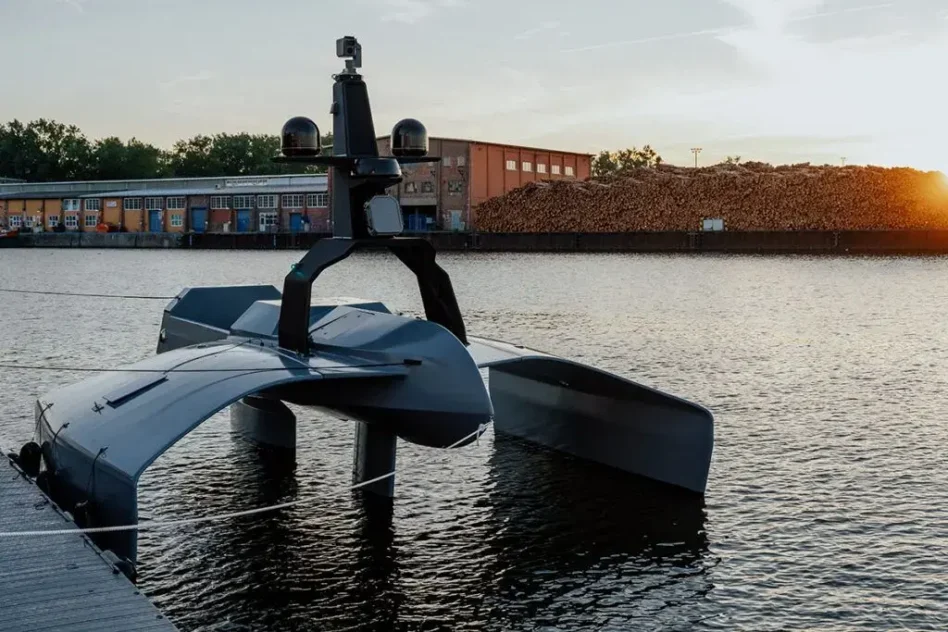
Here’s what (the very futuristic-looking) Seavex USV is packing:
- Per QS, it’s “a long-endurance unmanned surface vehicle (USV) designed for persistent maritime ISR missions.”
- The vessel has an endurance of up to two months and “includes surveillance radar, counter-drone radar and electro-optical sensors with onboard AI processing.”
- Per the whole integration thing, it’s also designed to launch and recover UAVs and retrieve mission data from UUVs (it can also recharge them).
Subvex is basically a supercharged USV also designed for autonomous ISR.
- Per Quantum Systems, the subsea drone is “missions at depths of up to 6,000 metres” and is “equipped with sonar and acoustic sensors as well as onboard edge processing.”
- It can stay in “active movement” for four days and on the “seabed in passive surveillance mode for persistent underwater monitoring for weeks.”
- These mini-subs will be able to charge and launch off Seavex(es). Motherships for the win.
Knit together: Both systems (integrated into MOSAIC, Quantum’s flagship mission software) provide “extend[ed] reconnaissance from the surface into the deep sea and support missions including the protection of critical maritime infrastructure, maritime border security, anti-submarine surveillance and blue-water surveillance,” the company said.
- They will both be tested and validated (presumably as part of REPMUS) in the coming weeks.
“Maritime operations have a fundamental challenge: the areas are vast, while crews and assets are limited,” Dirk Zademack, VP Quantum Maritime at Quantum Systems, said in a statement. “In the air and on land, we have built an ecosystem in which unmanned systems operate together rather than individually. We are now applying the same principle at sea with Seavex and Subvex: extending collaborative presence on the water and below the surface and compiling the information for the operator.”