Dominion Dynamics is assembling the Avengers of the Great North to get Canada’s collaborative combat aircraft in the air.
This morning, the Canadian defense tech startup announced a consortium of a dozen suppliers—including Pratt & Whitney Canada, Thales, and Telesat—that’ll contribute to the company’s development (and ultimately, production) of Canada’s very own collaborative combat aircraft, called Scout.
Arctic Anduril: Dominion Dynamics, put simply, is taking a page out of the Anduril playbook: the company is on a mission to become Canada’s first neo-prime, CCA and all. Fitting, given that Dominion founder and CEO Eliot Pence previously led Anduril’s international business.
The company, which emerged from stealth last October and raised a $139M CAD ($100M USD) Series A in June, has rolled out a slew of products through some speedy internal R&D:
- AuraNet: A distributed software platform that connects sensors, autonomous systems, and operators into a shared operating picture in low- or no-connectivity environments. This is the backbone that everything plugs into—Dominion’s take on Lattice, designed very specifically for zero-connectivity environments like the Arctic.
- Taku: An autonomous surveillance tower for persistent sensing and communications. Think Sensor Tower, but Canadian.
- Echo: An under-ice sensing tower/hydrophone system designed to pick up sneaky things like Russian subs.
- Specter: A tethered aerostat/balloon that (there’s a theme here) provides higher-altitude sensing and communications.
- Warden: An autonomous ground vehicle (UGV) for remote operations and sensing.
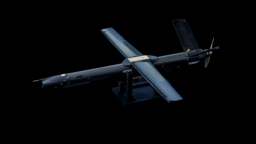
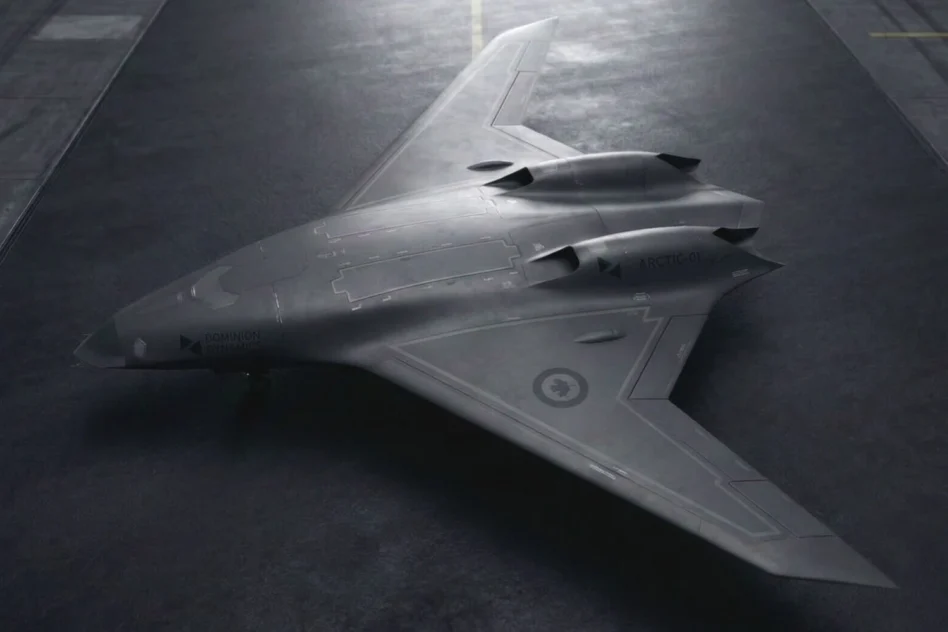
Scout, Dominion’s bid for Canada’s Autonomous Collaborative Platform (similar to CCA) program, is the company’s big swing on the R&D front. Plans for the aircraft were unveiled in March, and Dominion is investing $50M CAD ($37M USD) to kickstart development.
- The company is also currently under contract to build the simulation/digital environment for what the system could look like for the Canadian government.
Winter Soldier: But what Dominion has cooking will look a little different from the CCAs under development south of the border, especially since “there’s broad recognition [within the Canadian government] that none of the existing CCA platforms really fit the CONOP of the Canadian context,” Pence told Tectonic. “The Arctic range needs substantially more ruggedization…so there’s a broad recognition that Canada needs to acquire its own.”
- Another key difference is that it’s designed less as a loyal wingman for the F-35s Canada recently placed a big order for or the Saab Gripen fighters they’re eyeing and more as a “multi-custodian asset” that can be operated by a broader range of airborne and ground-based command systems.
- “I think most of the industry has over-rotated on loyal wingman, and we’re trying to say, ‘Actually, let’s take a step back. What is the future of air dominance?’ It’s multi-custodial, not simply just for the F-35 or Gripen or whatever,” Pence said. “That was a deliberate design decision that is reflected in the hardware and software.”
Big team: It’s an ambitious project, but Dominion is assembling a team of Canada’s finest to get Scout flying. The consortium announced today includes most, if not all, of the aircraft’s key suppliers, from the engine (Pratt & Whitney’s commercial-off-the-shelf, Canadian-built PW300) to comms (with Telesat) and other subcomponents.
- Other companies on Team Scout include Thales Canada, Top Aces, ITPS Canada, PV Labs, SRC Can, Altitude Aerospace, Groupe DCM, HSB Solutions, North Aircraft Industries, and RAMPF Composite Solutions.
Put simply, Dominion is taking the lead as the prime and getting all subcontractors on the same page before Scout enters production and formally competes for the ACP program in two years.
“What we are doing with this consortium is proving that Canada actually does have the industry that is able to coalesce around a big project like Scout, and so it reflects roughly 10,000 employees across seven provinces,” Pence said. “This is us saying, look, if there’s going to be a Canadian participant in that [ACP] procurement, we need to start now.”
“The question has been: Does the country have the companies to actually deliver it, and do we have a prime willing to put everything together?” he added. “That’s really what we’re answering here: Yes, we do, and this consortium reflects it.”
Now that they’ve built the team around Scout, Dominion plans to lock the final design early next year, order tooling and parts shortly after, and build five demonstrator aircraft ahead of a first flight in 2028, with low-rate initial production expected to kick off in 2030.
Don’t sleep on our friendly neighbors to the north.