Seasats is bringing the heat to the high seas with a little help from their friends at Anduril.
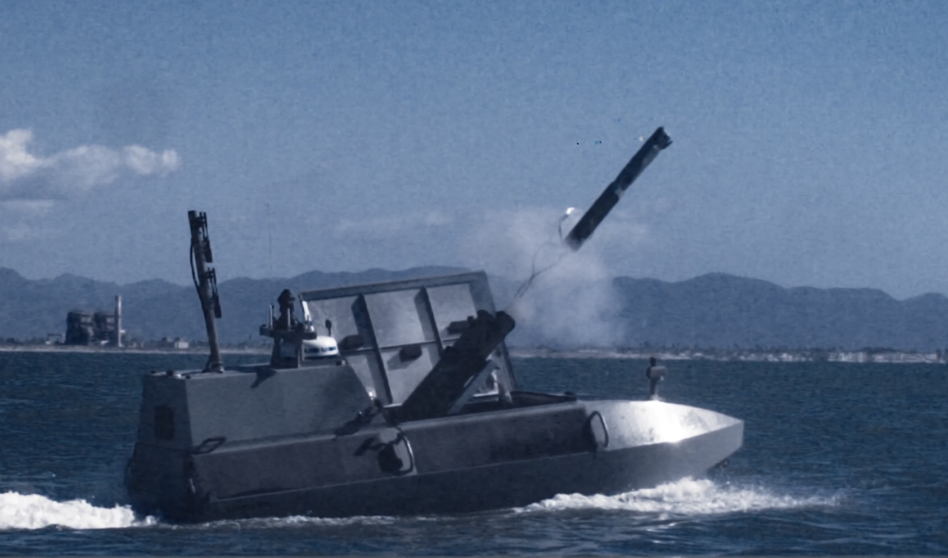
This morning, the splashy San Diego-based unmanned surface vessel startup announced it has integrated and launched Anduril’s best-selling Altius-600M loitering munition from its Quickfish USV, aiming to equip the go-fast drone boat “with long-range strike capability against higher-end maritime targets.”
- The announcement comes a week after the company integrated Neros’ Archer Strike and Archer AI FPV drones onto the Quickfish. We love when all our friends play nice.
Fishy business: Seasats is best known for its headline-snatching flagship small USV, the Lightfish, which has developed quite the knack for running into Chinese warships during long-distance voyages in the Pacific over the past year, snagging some big-time US Navy orders along the way.
While the main payloads on the smaller Lightfish are ISR and sensing capabilities, the Quickfish—unveiled last October—is designed as a “rapid response” USV for missions focused on deterrence, interdiction, and kinetic strikes (read: go boom). Hence, the partnerships with Anduril and Neros.
- The Quickfish is 17 feet long and weighs 1,600 pounds, a big step up from the 11-foot-long and 340-pound Lightfish while still fitting into the small USV category.
- Despite its relatively small form factor, it boasts multi-week at-sea endurance and a top speed of up to 40 knots, powered by both hybrid-electric and combustion engines.
- The Quickfish is also built to carry a range of payloads in its stealthy UAV launch bay, which protects aerial drones from detection and the elements. As Seasats CEO Mike Flanigan put it, “You can’t tell what’s in it when the hatch is shut…There’s a deterrent value to not knowing what payload a USV is carrying.”
- The USV is now in low-rate production and “already generating revenue on contract,” he added. “We have several customers, and yeah, the Quickfish is getting its feet wet.” (We love a good pun around here, even though fish don’t have feet.)
Boom and zoom: Much like how Ukraine has adapted its USVs to carry and launch aerial drones in the Black Sea, adding Neros’ Archer FPV drone and Anduril’s Altius-600M loitering munition to the Quickfish is all about turning the platform into a sort of teeny-tiny aircraft carrier, able to launch a range of UAS while keeping the operator far away.
Anduril’s Altius-600, with a 233-mile range (100 miles with a warhead), is a clear match for what Seasats has in mind for the Quickfish. The loitering munition is in high-rate production, on big contracts with the US and allied militaries (including Taiwan, which is buying more than 2,000 of ‘em), and can be adapted for both ISR and strike missions.
“The USV is modular, but the UAS is modular, too, since you can put different payloads onto the Neros Archer and onto the Altius-600 system,” Flanigan said. “It’s configurable based on what the operation calls for.”
And since the Quickfish can stay out at sea for up to a month, it “gives you the ability to respond with one of these aerial payloads at pretty much a moment’s notice,” he added.
Eyes on the prize: The integrations with Anduril and Neros’ UAVs aren’t just for fun. These team-ups are pretty much exactly what the Navy is looking for.
Last month, the DIU, in partnership with the Direct Reporting Portfolio Manager for Unmanned Systems (DRPM UxS), posted a solicitation for the Suitable Warfighting Adaptive Payloads (SWAP)-USV prize challenge, seeking “production-ready USV and effector platforms with demonstrated integration, active manufacturing capability, and verifiable production capacity.”
Flanigan couldn’t comment on whether Seasats has tossed its hat in the ring for the program, but having already integrated and demonstrated two different USV-UAV integrations in two weeks shows that the Quickfish is ready to roll, whenever, wherever, and with whoever.
And as Flanigan put it, “the integrations won’t stop.”