Looks a heck of a lot like the Ukrainians are coming, y’all.
Late Friday, the US Army announced that it had awarded the US arm of Ukrainian drone company Skyeton a $10.64M fixed-price contract for its Raybird ISR drones (and all the fun associated hardware and services).
The contract was awarded by US Army Contracting Command in Redstone Arsenal, AL, and work will be completed before the end of the year. This is the company’s first publicly disclosed US contract.
Fun fact: Apparently, bids “were solicited via the internet with one received,” per the Pentagon. Pays to be super online, as it turns out.
Ultralight: Now, despite what you might assume, Skyeton isn’t one of the many Ukrainian defense companies founded in the country since Russia’s full-scale invasion back in 2022.
- It’s ancient, by defense tech standards—the company was set up all the way back in 2006 in Kyiv, initially as a light aircraft shop.
- The company pivoted to fixed-wing drones around 2014 (wonder why), and flew Raybird in 2017. The drone (we’ll get into deets in a bit) went into service with the Ukrainian military in 2018.
- Initially, Skyeton made a dual-use play—their drones could be used for everything from mapping, to infrastructure inspection, border monitoring and disaster response.
- But after 2022, they went pretty hardcore on defense—both in Ukraine and abroad. The company says it now employs 500+ people, including 100+ R&D engineers, and produces in Ukraine and Slovakia (with plans for the UK and US).
- Plus, they’ve raised some VC funding to boost those wartime sales—the company closed a $15.71M Series A in late 2024, bringing total funding to over $19M, according to PitchBook data.
And they’ve made some high-flying friends along the way. The company has inked partnerships with a whole range of defense heavy-hitters, including Harmattan, Helsing, Prevail Partners (UK), and INTEC (Germany).
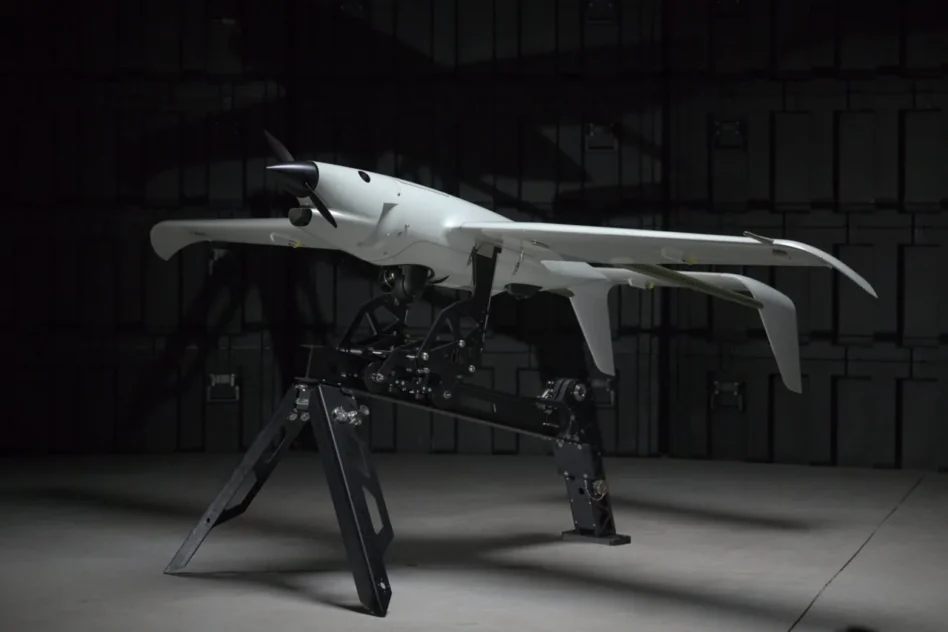
It’s a bird, it’s a plane: Raybird is by far and away the company’s flagship platform. Here’s what it’s packing:
- It’s a long-endurance ISR drone with a 23kg max takeoff weight, a 6kg payload, and a 3-4m wingspan. So, small-ish footprint, and the company says it can putter along for over 24 hours of surveillance at altitudes of up to 5,500 meters (18,000 feet).
- It can also go, like, quite far—it’s got a max flight range of 2,500 km (for standard line-of-sight datalink, it’s about 200km). The company has also integrated satellite communications into some models for BLOS operations.
- Speaking of comms—the whole thing is designed to be very resilient in jammed/EW-heavy environments.
- And it’s, like, proven—Raybird has notched over 350,000+ combat flight hours in Ukraine, according to the company.
- In a comment to Defence Blog, Skyeton said it would be integrating a bunch more (US-developed) edge compute, sensors, and autonomy onto the Army-bound Raybirds for “autonomous search, detection, classification, tracking, targeting, and collaborative multi-platform operations across large areas of interest.”
Between this and Ukrainian firms (and companies born there) stacking the Drone Dominance leaderboard, it does sound a whole heck of a lot like the Ukraine-to-the-West defense tech wave is really kicking off.