It’s really a big week around here for the nuts and bolts of defense tech, huh?
But lock in. Because this one is super interesting. (At least we think so).
This morning, quantum sensing startup Mesa Quantum revealed in an exclusive release to Tectonic that it’s raised $11.8M in funding led by Playground Global, bringing total funding to nearly $16M.
- DCVC and J2 Ventures also joined the round.
Mesa Co-Founder and CEO Sristy Agrawal said the company will use the funding to scale up development and production of its chip-scale quantum sensors, designed to secure everything from navigation to timing to synchronization without GPS.
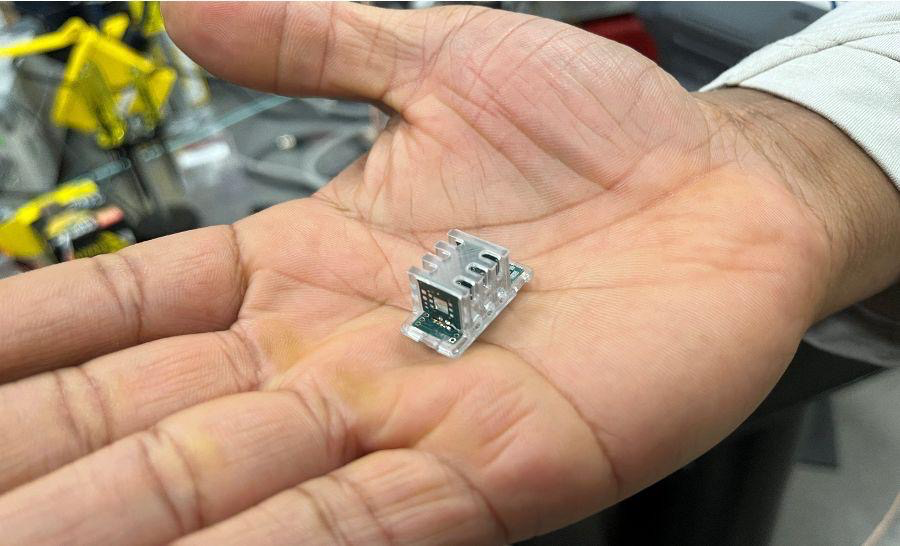
- The company is particularly focused on building quantum sensors that are small enough (and cheap enough) that they can go on things like drones.
- And they’re already working with the government—per Mesa, “U.S. government agencies, including SpaceWERX, have…granted Mesa Quantum more than $5 million in non-dilutive awards.”
“We have an early prototype where we’ve shown research demonstrations, but what this enables is to field that prototype, get customer validation, and build the value proposition,” Agrawal told Tectonic. “Quantum is in that early stage where there is industry and its needs, and then quantum and its capabilities, and this is about tying it together and figuring out the different applications that it can enable.”
Absolutely buzzing: If you’re sitting there pretending that you understand quantum sensing, no, you don’t. But we’re here to help (or, to do our best).
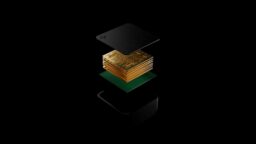
- The core tech that Mesa is building is a tiny “vapor cell.” Basically, it’s a microscopic glass chamber containing a cloud of atoms. The company shines a laser through those atoms and measures what comes out the other side.
- The thing is, atoms are incredibly predictable—and sensitive. Acceleration, rotation, magnetic fields, and the like subtly change their quantum state. By measuring how the atoms interact with the laser, Mesa can calculate exactly what happened to the sensor—for example, how it moved or what magnetic field it encountered.
- One application Mesa is working on is a tiny atomic clock, which measures time based on the (very predictable) oscillation of atoms. That gives platforms a very accurate internal clock even when they lose GPS.
So, why do we care? Well, if GPS disappears, a good atomic clock lets a system maintain precise timing for much longer. Pair that with quantum inertial sensors that precisely measure motion and rotation, and a system can keep estimating its position even when those pesky GPS signals go down.
Teeny tiny: Mesa’s real breakthrough is bringing all of this down to, like, chip scale.
“We need to make our infrastructure resilient to any GPS losses, and that can happen through [building and miniaturizing] those atomic clocks into these tiny systems, [so] you can embed them everywhere,” Agrawal said.
“The core thesis when you think about laser quantum is about enabling quantum sensors and quantum timing solutions to get deployed at scale,” CTO and co-founder Wale Lawal added. “The way you do that is…to find ways to miniaturize the package, the form factor…But then, once you do that, then they have to be manufacturable. You’ve got to be able to produce tens of thousands, if not hundreds of thousands, of them. [Before us], that just didn’t exist.”
While the company is still fairly early days (as, to be fair, is quantum), it’s got a whole lot of potential applications, including:
- Drone swarms: Keeps distributed drones tightly synced when GPS is jammed or spoofed—important for coordinating targeting and fusing sensor data across the swarm.
- LEO constellations: Gives satellites an ultra-precise onboard clock for alternative PNT, reducing their dependence on GPS for timing.
- Military GPS receivers: Helps M-Code receivers hold accurate time—and therefore maintain better positioning—when GPS signals are degraded or under electronic attack.
- Critical infrastructure: Brings resilient timing to data centers, telecom networks, and power grids when GPS is unavailable, whether from jamming or simply being indoors, underwater, or surrounded by buildings.
- Lawal also said that, in the future, these sensors could be used for super-precise detection of things like incoming enemy threats—like drones, planes, or tanks. The atoms would react with the metal in these devices, then tip you off.
“The cool thing about quantum devices is essentially they’re just the most sensitive things out there,” he added. “Atoms are very bougie. They’re very, very bougie. If, you know, you change, you turn a little bit, they’re like, ‘Oh, what’s going on?’”
Basically, anywhere you use GPS (or a mobile signal) for timing or positioning, you can use a quantum sensor instead.
“All of our consumer devices, like our phones, are synchronized to a wireless signal. These chip-scale quantum devices, like a chip-scale atomic clock, provide an alternative signal that’s inside of your hardware,” Lawal said. “In the future…when we’re able to get this small enough that it goes inside your phone, then you would be able to essentially maintain [the same] level of engagement with the folks around you and maintain the use of your phone without connecting to GPS.”
Trippy.
Big ups: From here, the goal is to take things out of the lab and bring it all to market.
- The company already has a facility in Boulder, but this will “significantly expand Mesa Quantum’s footprint in New Mexico, positioning the company as a key contributor to the state’s emerging quantum technology ecosystem and America’s domestic manufacturing capabilities.” Both Playground and J2 are New Mexico-linked baddies, after all.
- They’re also teaming up with Sandia National Laboratories on “advanced designs for Vertical-Cavity Surface-Emitting Lasers (VCSELs) and Photonic Integrated Circuits (PICs)… optimizing components for performance and manufacturability.”
- The funding will also “support the final product assembly, system optimization, and early deployment of fully ruggedized, field-ready systems to defense and commercial customers.”
“We’re very excited to kind of be on the frontier of pushing this new type of quantum sensing technology to the broader markets that didn’t have access to them…because they weren’t manufacturable, they weren’t small enough, and they didn’t have the right price point attached to them,” Lawal said.