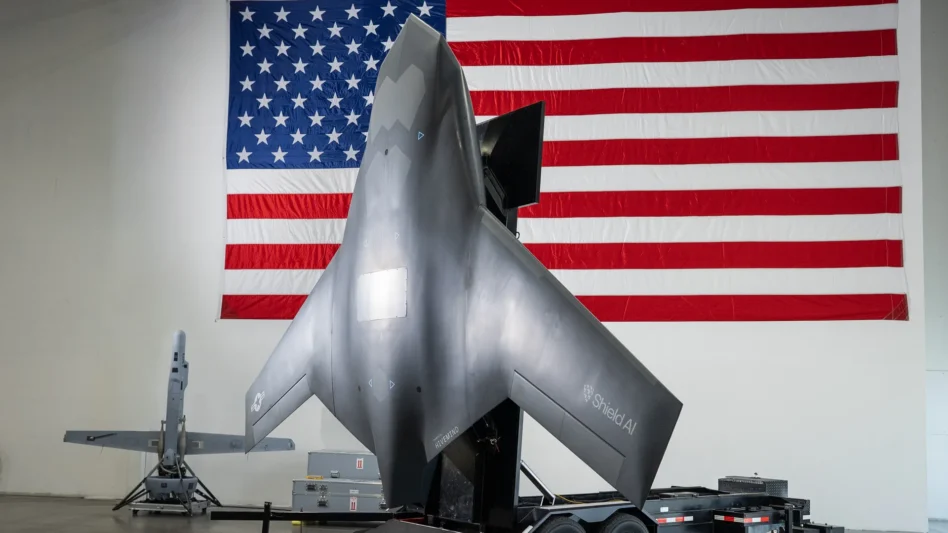
Since its unveiling last year, we’ve known that Shield AI is taking its X-BAT autonomous fighter jet pretty seriously. Turns out that the US Navy is too.
This morning, the autonomy hotshot announced that the Navy is tripling down on X-BAT with a $150M modification to a $50M award made in August. Shield AI is matching that with $150M of its own cash, bringing the total public and private funding for the program to a cool $400M.
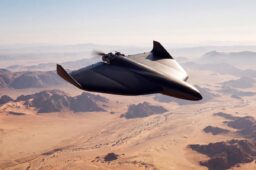
Super drone: As a quick refresher, X-BAT is Shield AI’s fighter drone, but it’s a little different from the collaborative combat aircraft we know and love. The company calls it the “world’s first true standalone autonomous fighter jet” with way more range, payload capacity, multi-mission capability, and power than anything on the market, plus its flagship Hivemind autonomy software at the wheel.
- For one, the aircraft is a big ‘ol thing. At 26 feet long with a 39-foot wingspan (roughly double Anduril’s FQ-44 Fury CCA wingspan), X-BAT is billed as less of a “loyal wingman” and more of an autonomous fighter capable of delivering similar capabilities as a manned one, but with a third of the footprint.
- It runs on a GE F110-GE-129 engine, which famously powers both the F-15 and the F-16, giving it an expected combat range of 1,000 nautical miles, a service ceiling of 50,000 feet (the F-15’s is about 60,000 feet, for context), and up to 30,000 pounds of thrust. Shield AI successfully tested the engine in X-BAT in July.
- Oh, and it’s designed for vertical takeoff and landing, which will enable it to take off from runway-less locations and Navy ships with smaller flight decks to free up precious real estate on aircraft carriers for manned fighters.
“X-BAT is being built to enhance the lethality, survivability, and combat power of US Naval Aviation,” Shield AI’s head of mission solutions for the US Navy, J.J. “Yank” Cummings, said in a statement. “We are designing it for safe, high-tempo manned-unmanned flight deck operations and integration with the missions and capabilities of the carrier air wing, so X-BAT can add combat power without compromising existing operations.”
Now, all that capability ain’t cheap. The X-BAT is expected to come in at about $27M a pop, which is cheaper than exquisite manned fighters but pricier than other CCAs on the market. With a $200M investment in the aircraft’s development—counting the initial $50M and the $150M modification—the Navy’s betting that X-BAT can fill that middle ground between the two.
Speedy quick: So far, both the government and Shield AI’s faith in what the X-BAT could deliver is looking well-placed.
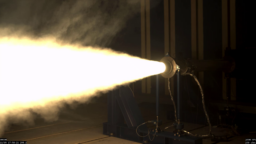
The aircraft was unveiled publicly last October, and Shield AI has since hit milestone after milestone in its development, including the successful integration, actuation, and engine light-off testing of the advanced Axisymmetric Vectoring Exhaust Nozzle (AVEN) in July, which it called a “critical milestone in the program’s path to vertical flight.”
Now, Shield AI says the “X-BAT is scheduled to begin flight testing later this year”—just two and a half years after the company first started developing it—and that it’s expected to “begin production in 2029 and reach full rate in the early 2030s.”
Aggressive timeline, but with at least $400M in total capital committed to the program and over $3B raised to date (not counting a new funding round that would reportedly take the company’s valuation from $12.7B to over $20B), Shield AI should have plenty of runway to get X-BAT in the air, even if the aircraft won’t need one.