In case you didn’t know, building a plane isn’t the easiest undertaking in the world. And if you’re trying to make it, like, the fastest plane in a generation on a truly breakneck timeline, all the trickier.
So, makes a whole heck of a lot of sense to team up with one of the biggest in the game to ever do it.
Yesterday, hypersonic aircraft startup Hermeus announced that it’s officially teamed up with Northrop Grumman to integrate the prime’s “mission systems design, development, integration, and sustainment” into Hermeus’ super-speedy unmanned planes.
- Hermeus CEO Zach Shore told Tectonic that the two companies have actually been working together for about four years, but this makes the team-up, like, publicly official.
- And this isn’t the company’s only prime partnership—they’re backed by RTX Ventures, and the company uses (and produces) Pratt & Whitney engines for their planes. They’ve also built Anduril software onto their aircraft.
“If you go into heavy aircraft manufacturing and think you’re going to build every component of your system, you’re kidding yourself,” Shore told Tectonic. “We have the partnership with Pratt and Whitney on the engines. There’s the partnership with Anduril on mission autonomy. We see this partnership with Northrop as one of the final major legs for the core systems on the aircraft.”
“Northrop’s mission capabilities are well-respected, and they sit on some incredibly relevant platforms that are currently in play right now,” he added.
It’s a bird, it’s a plane: Now, Hermeus (and Northrop, for that matter) should be no stranger to readers of Tectonic. The company was founded in Atlanta back in 2018 (they’ve since expanded to California) and set out to build lower-cost, ultra-ultra-speedy aircraft.
- The ultimate goal is to get a plane flying at hypersonic speeds—or as close to it as possible.
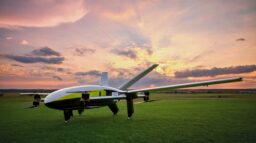
- The company’s aircraft series is called the Quarterhorse. They kicked things off with the Quarterhorse Mk 0 for ground testing back in 2024, and have scaled things up to the Mk 2.1 as of earlier this year. The unmanned Mk 2.1 has already hit supersonic.
- The next model—Mk 2.2—is in production and will fly at speeds “well over supersonic” later this year, Shore told Tectonic in September.
- Even at current speeds—about Mach 3—Shore says the planes have lots of mission applications, including for low-cost, long-range strike.
“Our ability to offer an affordable, scalable, useful unmanned aircraft is very compelling for long-range strike, for high-endurance operations, for fighter jet-like operations,” he said. “It’s a very flexible platform.”
Minting: And they’ve got a heck of a lot of cash money to keep them on that path to hypersonic.
- The company has raised a grand total of $550M in VC funding, most recently a $350M Series C at a $1B valuation.
- They’ve also got a $219M-ceiling contract with DIU for Quarterhorse—that’s one of the largest ever awarded by the unit.
Friends in high places: So, why team up with Northrop? Well, if you’re gonna pick a partner, pick the best in the game, per Shore.
“It was a natural alignment on the ways our technologies complement each other,” he said. “This gives [Hermeus] the opportunity to go to market and say, ‘Hey, I’m going to do what I am best at, which is aircraft manufacturing and integrating these really high-speed systems, and I’m going to work with the best in these other areas to bring them along,’” he said.
- For the uninitiated, Northrop’s mission systems are essentially the brains and nervous system of a modern military aircraft.
- That includes everything from radars and sensors, to command and control, to EW capabilities, to the microelectronics powering it all. The things that take a plane from “plane” to military platform.
And, per Shore, this unlocks some exciting (unnamed) contract and program opportunities in the near future. (No, they would not tell us which. Yes, we asked.)
“There are programmatic alignments that I can’t really speak to terribly specifically,” he said. “There’ll be some other contracts that we’ll announce here coming up pretty soon that this will support the development and delivery of.”
It’s all about kitting out Quarterhorse with best-in-class tech to make sure it’s as effective as possible, per Shore.
“As we’ve gotten the aircraft out, the question really becomes, how do you make your aircraft a platform?” he said. “The Department of War doesn’t buy airplanes; they buy platforms…the difference between an airplane and a platform is that an airplane flies, a platform executes useful missions. That requires compute, that requires weapons, that requires comms, that requires classified systems.”