If you thought Anduril was done churning out new platforms, think again.
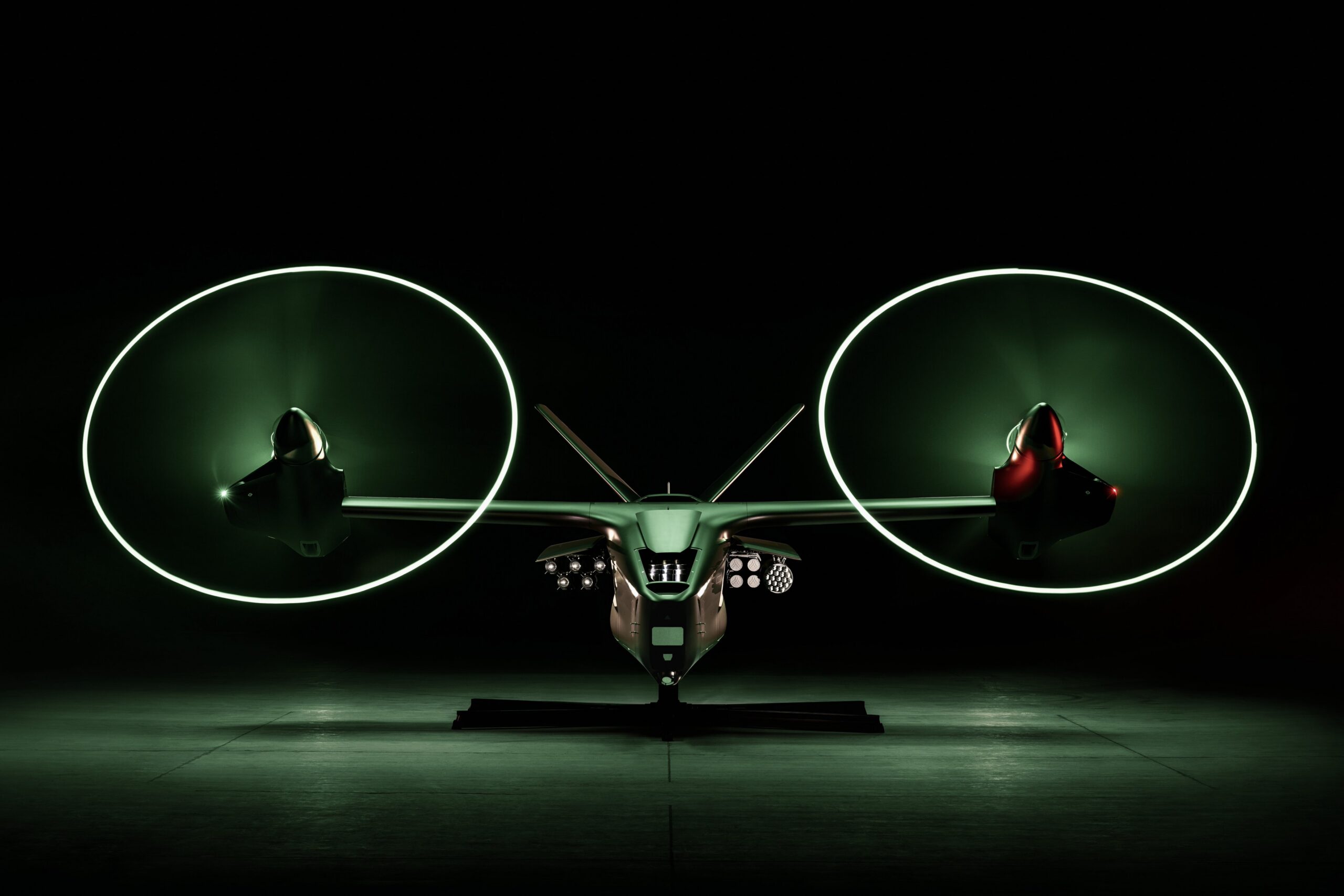
This morning at the Farnborough International Air Show, the defense tech giant unveiled a new Group 5 helicopter-like attack drone called Thunder, “specifically designed to multiply the combat power and increase the survivability of current and next-generation crewed attack and assault aircraft.”
Think of it as CCA, but make it helicopter-y.
“Near-surface flight has become one of the most dangerous places on the battlefield. Man-portable air defense systems, launched munitions, and cheap air defense really all pose a risk to an attack helicopter,” Anduril General Manager for UK and Europe Rich Drake told reporters, including Tectonic. “Their skilled pilots and crews…are too valuable to lose.”
Hence, Thunder.
- Anduril built the aircraft with Archer Aviation (the two first teamed up in December 2024) and a team of UK companies, including GKN Aerospace. Per the company, Thunder is the “defence-specific variant” of the platform—Archer will spearhead the commercial version.
- Worth noting here that Anduril was one of four companies down-selected for the UK MoD’s Project Nyx to develop “loyal wingmen” for Apache attack helicopters back in May. While Thunder, erm, sounds a lot like it could fit the bill, Drake was careful to note that the two projects are separate. (Plus—Nyx is an ongoing competition, and he couldn’t comment on it.)
Anduril told Tectonic that it has already completed a “significant number of test flights of [its] full-scale surrogate vehicle” and that it plans to fly Thunder in 2027.
It’s cute to see all of the different aerial platforms making drone friends.
Holding hands: Y’all know that Anduril has some serious experience in the whole “loyal wingman” game. For context: The company was one of two (alongside General Atomics) tapped to build collaborative combat aircraft (CCA) for fighter jets in the US back in 2024.
- The Air Force officially awarded CCA production contracts to both companies back in June, moving them out of the prototype stage.
- Anduril flew its CCA prototype last November and managed to fire a missile off of it earlier this month.
Round and round: In the UK, the loyal wingman effort has been less focused on fighter jets like the F-35 and more on the attack helicopter side of things—specifically the Apache.
- Here’s the thing—attack helicopters are still very useful, but modern warfare (specifically, things like persistent ISR, drones, and low-cost interceptors and air defense) has made near-surface flight super-duper dangerous.
- And no one wants to lose an Apache—not only are they manned by super-skilled pilots and operators, but they’re also very expensive. Like $32-52M a pop expensive. Plus, the UK only has about 47 of these bad boys, with about 38 active.
The idea underpinning Project Nyx—and a helicopter wingman like Thunder—is to protect and increase the capabilities of an attack helicopter without putting more lives at risk or adding too much extra cost.
- Per the UK MoD, the idea is to “increase lethality and survivability of the Apaches, while reducing risk to personnel” using things like “reconnaissance, precision strike, target acquisition and electronic warfare in contested environments.”
- Four companies—Anduril, BAE, Tekever, and Thales—were tapped to create prototypes for the project in May and given £10M ($13.45M) each for development. Up to two winners will be selected this fall.
With Thunder, though it sounds pretty Nyx-adjacent, Anduril is thinking even bigger. Here’s what the big-boy drone helicopter is packing:
- The unmanned aircraft has a “tiltrotor configuration [that] combines vertical takeoff and landing (VTOL) with efficient wingborne cruise,” per Anduril. That means it doesn’t need a runway to take off, but also has a longer range.
- While Archer’s bread and butter (many of Thunder’s features were taken from the company’s Midnight aircraft) is electric VTOLs, Thunder is hybrid-electric. That increases range to super-long distances “relevant to the Pacific fight,” per Shane Arnott, Anduril’s senior vice president of programs and engineering.
- Speaking of distances, it can travel much faster than an Apache (north of 200 knots) and has a range of “thousands of nautical miles,” he added. That means it can keep up not only with the Apache, but with future long-range attack aircraft like the Cheyenne.
- And here’s where things get cool—the goal is to have Thunder fly super low, fast, and close to the ground so that the manned helicopter doesn’t have to. To make that happen, Anduril has invested heavily in “perception technology” so that the aircraft can “sense the terrain [and] be able to do that in a way that is survivable,” Arnott said.
- It can also carry a pretty mega payload—Arnott said the payload capacity is “similar to an Apache.” There is a main payload bay in the center of the aircraft, room for “ten air-to-ground missiles (e.g., Hellfire, JAGM, Barracuda-100M), sixteen launched effects (e.g., Altius-600), or seventy-six 70mm rockets,” per the company.
- Plus, it’s got a nose payload that can carry up to 12 cUAS interceptors. Helpful when a drone is flying at your swarm.
The idea is that for every manned Apache (or Cheyenne) you have flying, you’d have three to six Thunders flying around it.
- While Anduril didn’t reveal how much each aircraft would cost, Arnott said it would be “a small fraction of the cost of an Apache,” designed to be built and deployed at scale.
- The goal is that Thunder will be able to provide a helicopter pilot with lots of information and increased capability—but without adding lots of extra work. That means a high degree of autonomy, where the human basically jumps in the loop for kinetic strikes and weapons deployment.
- And while the UK is acting as the hub for Thunder’s development, that doesn’t mean it’s only a UK project. Drake said that they’ll build (and sell) where customers want to amp up their close-range attack capability.
“This is a common problem…particularly for near-surface warfighters,” Arnott said.
Drake added that they’re looking at a few different sites for production in the UK (and export to Europe), but that “if the US customer goes first as well, we’ll aim it there.” The goal is to eventually have multiple production lines around the world—like for Barracuda, Arnott added.