For all those saying cheap drones have made old-school artillery obsolete on the modern battlefield, newly minted unicorn Firehawk would like a word—and has $150M to prove you wrong.
This morning, the energetics and rocket motor-maker announced that it’s raised a whopping $150M Series D led by Advent and Rochefort Asset Management at a $1.4B valuation to scale production of propellant for 155mm shells, Hydra-70 rockets, and more, with the goal of turning its Oklahoma facility into the “third largest propellant production facility in the country” by output by the end of next year, CEO Will Edwards told Tectonic.
- The raise is a big jump up from Firehawk’s $60M Series C at a $290M valuation last September.
Feeling hawkish: Firehawk should be a familiar name to Tectonic regulars by now. The Texas-based company, founded by Edwards in 2019, is laser-focused on applying modern manufacturing techniques—like 3D printing—to propellant and motor production.
- Firehawk’s take on propellant manufacturing cuts the typically expensive and time-intensive production down from “a 60-day process down to six hours” through thermoplastics-based 3D printing and super-fast curing, Edwards said, enabling them to make rocket motors and artillery base bleed motors (which boost the flight range of shells by up to 35 percent) much faster than traditional methods.
- That’s earned them contracts to build SRMs for and assemble Hydra-70 rockets, produce 3D-printed propellant, and develop propulsion systems for larger boom-and-zoom platforms with the Army, AFRL, and other customers.
- It’s also made them some friends in high places. Back in May, General Dynamics Ordnance and Tactical Systems (GD-OTS)—the largest artillery producer in the country (in spite of some very public setbacks on that front)—announced a “teaming agreement” with Firehawk focused on ramping up production of 155mm base bleeds.
Boom bucks: With a fresh $150M in the bank and production facilities totaling over 1,000 acres, scaling up output is the name of the game for Firehawk.
“As a company, we have invested a lot of capital into facilities. The Great Plains Arsenal [in Oklahoma], which we’re building up to be the largest artillery motor producer in the world, will produce roughly 3M pounds of propellant annually by the end of next year,” Edwards said. “We also have our Crawford, Mississippi site, which is building all-up rounds, and we’re going to continue to expand on that facility to produce even more Hydra-70s than we’re doing right now.”
- At Firehawk’s missile integration facility in Mississippi, the company has the “capacity for 40,000” Hydra-70 rockets—which the Army buys more than 330,000 of per year—and they “want to grow that to about 10,000 per month,” he added.
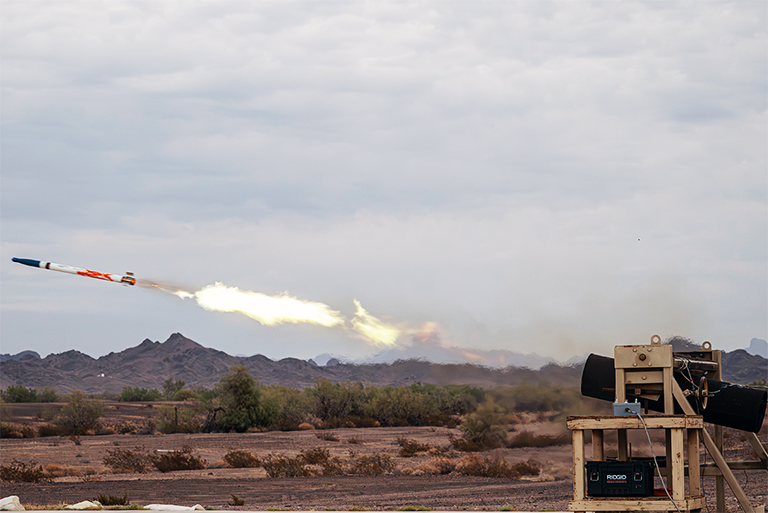
- They’re also on contract with the Army to help diversify the Hydra-70 supply chain, and the rockets they built had a 100 percent success rate during tests at Yuma Proving Ground in August.
All that investment into building out facilities and developing the motors is turning into real cash—Edwards says Firehawk will “do over nine figures [in revenue] next year.” Boom bucks indeed.
Back to the future: As much as we write about drones, robots, and all kinds of fancy new-age tech, Edwards doesn’t see demand for these old-school systems going away anytime soon. In fact, he—alongside a wide range of military officials and analysts—argues that Ukraine’s pivot to low-cost drones was a stopgap solution driven by artillery shortages early in the war.
“If you look at Europe, the most lethal weapon on the battlefield was artillery. They shot 16M [rounds] off in about a year and a half,” he said. “You need artillery when force, range, and speed are required, but at a very low cost point, so it’s one of the most cost-effective systems in the field, [especially] when you have the range with the base bleeds.”
“Drones are great, but artillery is still needed,” he added. “It’s still the king of war.”