Lock in, y’all. We’re getting nerdy today.
This morning, Paris-based Arlequin AI announced that it’s raised a €28M ($32.55M) Series A to scale its AI architecture based on topological neural networks (TNNs)—non-LLM AI models designed to analyze large, interconnected, complex sets of data.
- The round was co-led by redalpine and OTB Ventures, with participation from Bpifrance’s Defence Innovation Fund.
- Existing investors Vsquared Ventures and 10x Founders also increased their stakes in the company.
Arlequin CEO and cofounder Hugo Micheron told Tectonic that the company will use the funding to bring on more engineers, buy the compute necessary to train and scale their models, and deploy with even more customers.
“[With Arlequin’s tech] you move from being blind—or using a ridiculous amount of compute—to maybe find a needle in a haystack, to being able to scan the whole haystack [and find] all the needles,” he said. “[You can just drop data] into the platform…and [you] get all the causality links, all the patterns.”
He added that the platform only takes minutes to do the work it would usually take researchers months to perform.
FWIW: According to the company, their tech is “already being used by governments and large organizations across Western and Eastern Europe.”
To the letter: Now, you might be sitting there thinking, “Why the heck is Tectonic talking about AI? Don’t we get enough of that elsewhere?”
Well, you probably do. But this one is different—and very relevant to the defense and intelligence worlds you all live in.
So, what is a TNN and how is it different from the LLM-based tools (like ChatGPT) you use every day? (Admit it.)
- LLMs are language machines. They’re trained on huge amounts of text to predict what comes next, which makes them very good at generating, summarizing, reasoning over, and interacting through language.
- Topological neural networks are relationship machines. Rather than treating data primarily as sequences of tokens, they’re designed to learn about the shape, structure, and relationships within complex data—think sensor relationships, terrain, trajectories, or even human relationships.
- TNNs can demonstrate how different things (or people, or events) are interrelated even as, say, the battlefield changes or an operation is ongoing.
- These models can also be smaller and more concentrated than LLMs, which is helpful in places (cough, the edge, cough) where compute and bandwidth are limited.
Map it out: In case those gears are slow to kick in today—that ability to analyze relationships is super helpful for defense and intelligence.
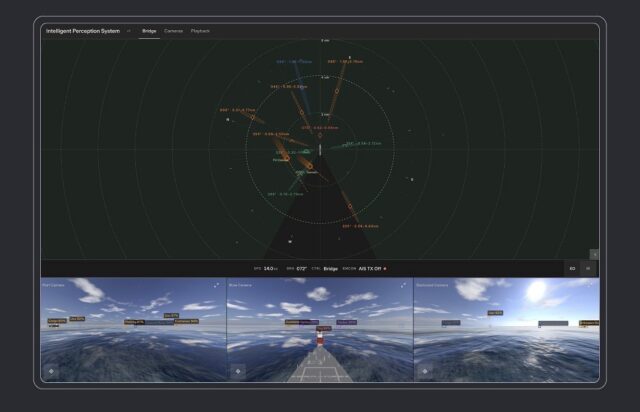
- Let’s take ISR as an example. A TNN can take all of your different data inputs (radars, sensors, drone feeds, etc.) and not only tell you what is out there (let’s say, five vehicles moving towards a target) but also how these vehicles relate to everything around them. For example, the TNN could figure out that the vehicles, combined with a radar emission, actually mean they’re likely part of an air-defense network.
- These models can also be pretty effective for human intelligence. Intelligence agencies collect oodles and oodles of data—meetings, locations, organizations, contacts, financial transactions, and events—that can often be a pain to sift through. While LLMs are good at reading and interpreting written reports, TNNs could be used to sift through all of these disparate data points and figure out, say, where an extremist network is starting to build (or where two extremist groups are starting to converge).
Micheron compared the tool to the classic blackboard in a 1980s detective thriller (or the cork board with the strings on it from It’s Always Sunny, if you’re familiar with the meme).
“You have an investigator looking at a blackboard, and they have pinned a picture…maybe headlines from a newspaper, a phone number, some people, and they are making connections between them with visual links. That’s their investigation. At some point, by connecting all these points, they’re like, ‘Oh, the suspect is that guy,’” he said.
“This is exactly how a TNN works,” he added. “It does that connectivity [piece].”
On the ground: Luckily, Micheron actually has a lot of experience with this kind of work. He’s an expert (like, has a PhD) in extremism and jihadism, and spent years in Syria and France studying terrorist networks.
- His cofounder, Antoine Jardin, is a former CNRS (France’s National Centre for Scientific Research) research engineer specializing in data science and human behavior, which also helps.
While lecturing at Princeton University from 2020 to 2023, as social life transitioned increasingly online and the world experienced a lot of upheaval, Micheron realized that organizations from governments to banks could benefit from a tool that could analyze networks between people—without the bias of LLMs.
Basically, take what he did as a field researcher and supercharge it with AI.
“I realized it applied to every kind of work related to investigation,” he said. “Research, of course, security, and defense…[Anywhere] you need to have evidence…and everything related to the strategic use of information, [with] massive amounts of data that need to be processed.”
With this new cash money, the name of the game (as always) is scale.
- Right now, Micheron said that their revenue is about 50 percent public and 50 percent private across four countries—France, Germany, the UK, and an unnamed Eastern European country.
- They’re looking to expand further—to any industry (cyber, banking, media, etc) or government organization (intelligence, defense, even tax authorities) that does a lot of investigating.
- That means more training of their models, which means more engineers and more compute. That’s where the money is going.