Turns out loyal wingmen aren’t just for fighter jets.
(Though, if they’re on the ground, what should we be calling them? Pls reply with suggestions.)
Yesterday, European UGV darling ARX Robotics (the UK branch) and General Dynamics announced that they’re teaming up to build an autonomous “wingman” capability (again, new naming suggestions welcome) for the British Army’s AJAX program.
- That’s the UK’s new family of heavily armored, tracked reconnaissance vehicles. Think ISR + go boom. Get you a vehicle that can do both.
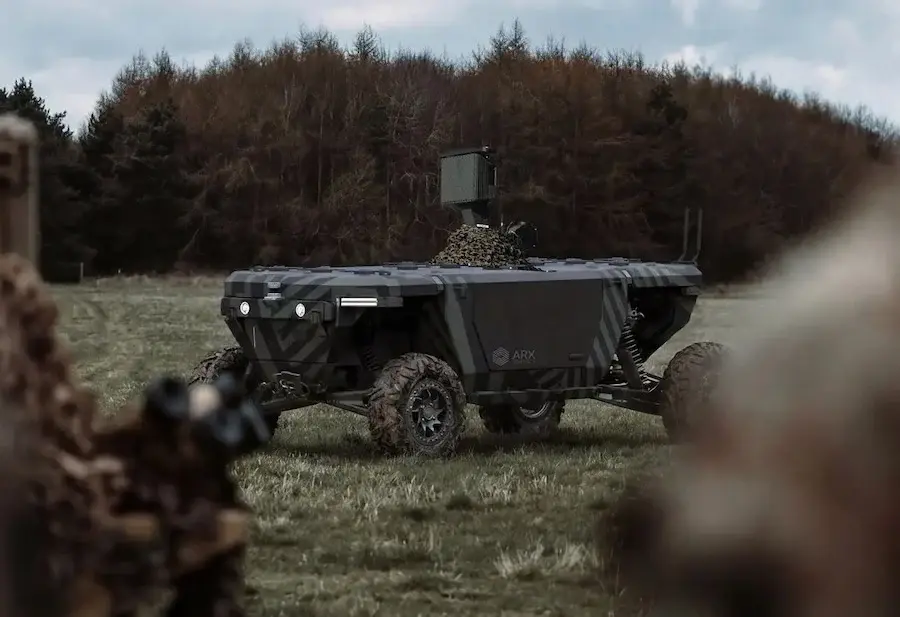
Per ARX, the two companies will “initially focus on integrating ARX Robotics’ Hector uncrewed ground vehicle with AJAX, exploring how autonomous systems can operate alongside crewed fighting vehicles to extend their reach.”
“There’s a lot of press at the moment about uncrewed systems and how they’re going to be the future of warfare [and how] we need to be investing more in them. Of course, I agree with that,” ARX Robotics UK CEO David Roberts told Tectonic. “But there are also situations where there will be a requirement to have the larger, more exquisite platforms like AJAX…we need to make sure that those platforms are suitably protected when they’re on the battlefield.”
“This is about how you take that middle 40—the attritable part—and the first 20—the exquisite part—and make them work together to provide something more than the sum of its parts,” he added.
The two companies will also look into how GDLS-UK could help scale up production of more unmanned vehicles in the UK.
Say it with us: Everyone loves a tiny little…tank?
Track star: Now, a quick primer on AJAX for our friends across the pond (and those of you blessedly unaware of the British Army’s goings-on).
- AJAX is the British Army’s new tracked reconnaissance vehicle family, designed to replace the aging CVR(T)/Scimitar fleet.
- The program dates all the way back to 2010 but initial operating capability wasn’t declared until 2025. Classic.
- General Dynamics UK is under a whopping £5.5B contract for the program, covering 589 vehicles across six variants: AJAX (recon/strike), ARES (personnel carrier), ATHENA (command-and-control), ARGUS (engineer reconnaissance), ATLAS (recovery), and APOLLO (repair).
- The main idea of the whole shebang is to create a scout vehicle with super-advanced optical and thermal sensors (plus enough weaponry to protect itself) for super-charged forward reconnaissance.
- And when we say armed, we mean it: The main AJAX variant carries a 40mm CT40 cannon alongside a 7.62mm machine gun. Go boom, indeed.
- The program has been badly delayed (there have been some serious noise and vibration problems), and, erm, a bit over budget—the initial production back in 2014 was £3.5B for 589 vehicles. £2B over isn’t exactly pocket change.
Rollercoaster ride: Regardless of wobbles and delays, AJAX is now (kind of) ready for deployment.
- The vehicles received IOC in 2025, and by December 2025 the British Army had received some 170 AJAX-family units (about 315 vehicles had reportedly been produced).
- But unfortunately, a bunch of the early vehicles were recalled for upgrades, and deliveries were paused after some noise and vibration issues that were, um, making personnel sick. Acceptance resumed this year. Better late than never, ya know?
- The Army has now resumed trials and training on AJAX. Full delivery (like, the whole 589 vehicles) is expected by 2029.
Dark and swarmy: The initial team-up between GD and ARX will see the start-up’s Hector UGV integrated with AJAX via Generic Vehicle Architecture (GVA).
- Per Roberts, a single vehicle will “be capable of commanding or controlling a number of Hector platforms…we’re envisaging that [as] around four to six.”
- The idea is that a swarm of UGVs could go out in front of (or around) a vehicle and become a kind of attritable shield. After all, the program’s cost puts AJAX at around £9.3M ($12.7M) each.
Out in front: The two companies are still building out the best use cases for the team-up, but Roberts laid out a few for us:
- You could equip the fleet of Hectors with cUAS, for example, to “provide a bubble of protection…you essentially turn the Hector into a sacrificial platform,” Roberts said. (Ouch, but practical.) He highlighted that you could also change and upgrade the defensive systems on the UGV way more quickly than AJAX.
- You could also have the UGVs operating at range—like, carrying out missions tens of kilometers away from AJAX. In this example, the scout (AJAX) actually acts like a control center. Hectors can putter out autonomously into the field (without transmissions) until they detect something they deem important, Roberts said, which they send back to the manned AJAX.
- The operator can “make a decision about what to do about the target that’s being detected,” Roberts said. In other words, whether they should shoot (or zap) or not.
And they’re moving pretty fast, at least by prime standards.
“It’s going to be a long-term partnership in terms of development,” Roberts said. “[For] the first demonstration of it in front of the armed forces, I would anticipate that will take place in the first half of next year…probably towards the first half of next year.”