Happy Monday, y’all. We’re pretty amped up today.
(Please forgive us; It was right there.)
This morning, ruggedized power-for-the-edge company Chariot announced that it’s inked a $7.6M contract with DIU under the Portable Resilient Integrated Storage Module (PRISM) program.
- Under the contract, Chariot will start delivering its “flagship Amphora power systems to U.S. Army brigades this fall.”
- The PRISM contract spans 12 months and the idea is to “target the military’s critical battlefield electric-power crisis.” Seems important.
“Power availability decides what equipment troops get to bring to the fight,” Chariot Founder and CEO Adam Warmoth said in a statement. “We are bringing the commercial power technology revolution directly to defense, enabling operators to run critical systems quietly and reliably, and doing so with a secure supply chain, without dependence on Chinese components.”
Again, seems important.
Power rangers: Now, it’s been a little while since we covered Chariot. The company was founded last summer by Warmoth (an Anduril and Archer alum) with the goal of bringing much-needed power to the most out-there, distributed parts of the battlefield.
- The company came out of stealth with $8M in funding, then raised a whopping $34M Series A led by Andreessen Horowitz earlier this year.
Super edgy: The company’s flagship power system (think ruggedized battery plus smart software) is called Amphora. Here’s how it works:
- The company describes the whole shebang as a “software-defined power layer that senses, prioritizes, and routes power across mission-critical systems in real time, enabling warfighters to operate without interruption, detectable signature, or wasted capacity.”
- Think of it as an ultra-smart battery system. Amphora can be powered by anything from generators to solar power, then store that energy to power things like sensors, drones, and even cUAS systems when needed—all with little noise and basically no heat signature.
- The software layer of the thing is all about optimization—Amphora stores energy and only releases it when needed, rather than keeping a noisy generator running for hours.
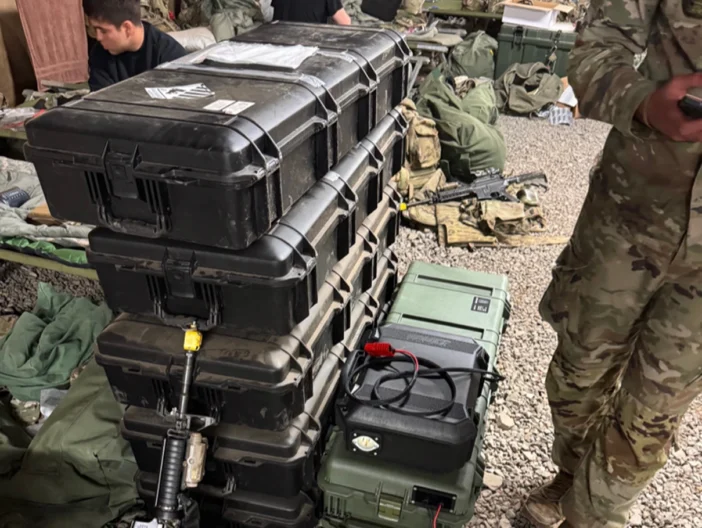
- And the whole thing is designed to be portable—the smaller Amphora 24 (5 kWh) can fit in a Pelican case, while the larger Amphora 400 (315 kWh) can be wheeled out to provide big-boy power (like for EW and C2).
- Per the company, Amphora has “in combat scenarios…demonstrated the ability to reduce fuel consumption by up to 60 percent, extend silent operations up to 36 hours, and report tactical energy data into next-generation command and control networks.”
Put simply: Chariot is building distributed, ruggedized, smart power for a distributed, software-defined era of warfare. After all, all the whizzy, go zap and boom stuff y’all have a penchant for building, like, needs to be powered somehow.
New geometry: Now, you might be sitting there thinking, “Wait, what is this DIU program with a pretty nifty name?”
- The PRISM program was launched back in March ’26 to find solutions that could help power everything from radars to drones, sensors, EW, and comms without hauling a giant (fuel-guzzling) generator everywhere.
- The military has a fairly reasonable number of small batteries (like, 1kWh) and big-boy energy storage systems (like, above 90 kWh), but they lack the stuff in between. That’s where systems like Amphora could be helpful—they pack more of a punch, but without the footprint of a mega-system.
- DIU (and, thus, the Pentagon) wants unit-level systems that can provide power even at the front, without hauling around a bunch of fuel. After all, that’s a pretty major vulnerability.
Scale up: Under the general framework of the program, companies will develop a prototype for 6-12 months (that’s Phase I), then do 6 months of user evaluation (Phase II), then some iterations based on feedback (Phase III), then qualification for bigger programs and wider-scale use for up to a year (Phase IV).
- Worth noting: This isn’t Chariot’s first rodeo with DIU. They were finalists for Project GI in late 2025 and delivered Amphoras to small and disaggregated units at the edge. Sounds like it went pretty well.
“A formation should not have to choose which systems stay powered-up,” Warmoth said. “When that happens, soldiers fight with their hands tied and commanders can’t use the advanced equipment they need to perform their missions. Amphora takes the energy already on the battlefield and puts it under optimized software control, so units run their drones, their EW kit, and their compute from one system seamlessly.”