Well, sounds like at least one service is getting serious about the whole distributed and contested logistics side of things.
Yesterday, heavy-lift drone company Elroy Air announced that it’s won a $46M multi-year contract with the US Army for “the development of an autonomous hybrid-electric vertical take-off and landing (VTOL) uncrewed aircraft system for modular multi-mission payload delivery.”
The company was first awarded a Phase I SBIR with the Army back in 2023 ($235K), then a Phase II ($1.9M) in 2024.
- They’ve been working with the Air Force since 2019—among a bunch of contracts, they’ve got a TACFI ($1.7M), OTA (up to $8.5M), and a SBIR Phase II ($1.7M).
- The company has also signed a CRADA with USSOCOM.
“This contract reinforces the critical role that heavy-lift autonomous hybrid VTOL drones will play in modern defense operations,” Elroy Air CEO Andrew Clare said in a statement. “We are thrilled to expand our partnership with the U.S. Army to bring rapid, autonomous heavy cargo delivery capabilities that increase operational throughput and reduce risk for our troops.”
In the thick(et) of it: Elroy is old hat at the whole autonomous flight thing. The company was founded back in 2016 by Dave Merrill and Clint Cope in San Francisco and set out to build heavy-lift aircraft for “commercial, humanitarian, and defense logistics.”
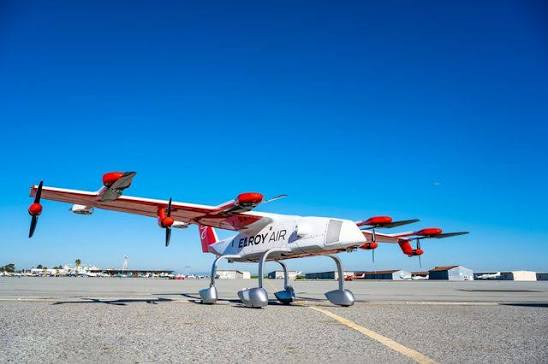
Their flagship cargo drone is a VTOL called Chaparral, which is 22 feet long with a 30-foot wingspan.
- Fun fact: Chaparral is a dense, thorny, shrubby thicket found in California.
- The unmanned aircraft is designed primarily for long-range cargo missions. It has a payload capacity of up to 500+ lbs and can fly over 400 miles at 132mph.
- It features 12 fixed propellers for vertical takeoff and landing, eight for vertical and four for forward propulsion.
- The aircraft features a hybrid-electric architecture. That means that it’s got that big ol’ range (up to 450 miles) and fuel efficiency, but also “50kW of spare power” that effectively makes the drone a “roving [Auxiliary Power Unit] that can provide power where it’s needed out in the battlefield,” Clare told Tectonic earlier this year.
- Important to note that Elroy isn’t manufacturing all of their Chaparrals out of San Francisco themselves—last year, they inked a five-year “exclusive manufacturing agreement” with Kratos, which will manufacture Chaparrals for both Elroy’s defense and commercial customers.
It’s a bird, it’s a plane: And lest you have doubts, Chaparral has, like, actually flown.
- Last year, the aircraft “transitioned from hover to wingborne flights in July, flew with cargo pod attached and payload inside, and executed the first A-to-B delivery in December.”
- The company also completed a 40km flight demonstration for the Japan Ground Self-Defense Force, and flew as part of T-REX earlier this year.
- They were also tapped for the FAA’s eVTOL Integration Pilot Program (eIPP) back in March.
Going green: Especially with the whole “2027 and distributed warfare” thing top of mind, Elroy has been pretty darn popular with investors (and, soon, the public markets).
- Earlier this summer, the company announced plans to go public later this year through a Special Purpose Acquisition Company (SPAC) led by Inflection Point Asset Management. The merger includes over $165M in committed Private Investment in Public Equity (PIPE) capital and values Elroy at $800M pre-money, giving the company an expected $1B valuation when it’s listed on the Nasdaq.
- In 2021, the company raised a $40M Series A from investors including Marlinspike and Lockheed Martin Ventures, then secured an additional $36M in financing from Shield Capital, Marlinspike, Snowpoint, and others in 2022. Get money.
Make it work: This new Army contract “will focus on ensuring the company’s heavy-cargo drone Chaparral can operate alongside service members in contested, austere environments by enhancing its modular multi-mission payload versatility and payload delivery mechanisms.”
- Elroy will also work with the service to “advance key tactical enabling technologies required for the modern battlefield, such as an expeditionary mobile mission planner, cyber-protected communication links, GPS-denied/contested navigation, elevated autonomy, and reliable field operation under military conditions.”
Say it with us, y’all: Everyone really does love a tiny little plane.