Guess who’s back, back again? Erik’s back, tell a friend.
That’s right, folks. Erik Prince is back like he never left. This morning, the completely uncontroversial mercenary launched his latest venture, coming out of stealth with a new startup called Vectus that’s pitching a unique “air defense as a service” model.
Vectus is launching as a partnership with Ukrainian-born, Austin-based swarming software company Swarmer, which has a 20 percent stake in the company.
- Prince, who also owns a hefty stake in Swarmer (like, nearly a million shares at the time of the IPO) and serves as the company’s non-executive chair, owns the other 80 percent of Vectus.
- Vectus couldn’t comment on the dollar figure tied to Swarmer’s 20 percent stake, but told Tectonic that “there are discussions about bringing in a small number of additional investors.”
Fresh Prince of Bel-Air-Defense: Vectus is interesting for a few reasons, aside from the whole Erik Prince thing.
The company is pitching “air defense as a service” (ADaaS?), meaning they’ll “design, integrate and operate complete layered air-defense systems to create an “end-to-end managed service designed around the specific threat environment and operating requirements of each customer,” per the company.
In other words, Vectus is taking “best-in-class, battle-tested” tech across the air defense kill chain—radars, sensors, EW, interceptors, and, apparently, “large-caliber cannons with a high rate of fire”—and packaging them in a custom, layered configuration tailored to customer (both military and private sector) needs and the operational environment.
Anyone want a large-caliber cannon put on their roof?
The thinking behind the “as a service” model is demonstrated “extremely clearly” by Swarmer’s native Ukraine. “Threat systems evolve, speeds change, countermeasures change, and technologies that worked several months ago can become less effective,” Vectus told Tectonic in a statement. “A service model creates an incentive to maintain the effectiveness of the protection rather than simply deliver equipment.”
Buzzy buds: On top of the 20 percent stake, Vectus is launching with Swarmer as a “strategic partner.” You might remember Swarmer from its US subsidiary’s roller-coaster IPO back in March, which saw shares surge 600 percent on its first day of trading.
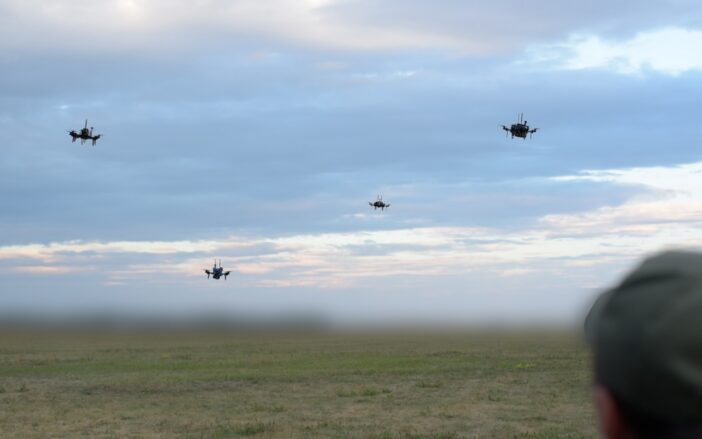
As a quick refresher: The company builds the software brain that allows drones to operate as a swarm.
- The company has a few software products on offer: A swarm management software that coordinates and tasks recon and strike drones (Swarmer UI); a module for collaborative autonomy in denied environments (Swarmer AI); and a UAV operating system layer for secure data storage, streaming, and status updates (Swarmer OS). Creative names, guys.
- Swarmer, according to the company, has flown over 100,000 combat missions in Ukraine, and its software allows a single operator to control nearly 700 drones at once.
Under the strategic partnership with Vectus, the two will “work closely” to develop “advanced counter-UAS capabilities, including drone interceptor swarming technology,” based on Swarmer’s suite of collaborative autonomy software platforms integrated with third-party interceptors.
Mr. Worldwide: Even more interestingly, the introduction of Vectus Air Defense Systems comes after Prince launched his newest private military company, Vectus Global, last year.
The OG Vectus, according to the WSJ, is Prince’s “global brand for a network of companies he established to do security work in Ecuador, the Democratic Republic of the Congo and Haiti,” focused on helping (primarily, um, challenged) states crack down on “rebels and organized crime.”
- In El Salvador, that work included the hiring of mercenaries to help local police “target gangs with off-the-shelf drones loaded with explosives.”
- In the DRC, according to Reuters reporting earlier this year, Prince was hired to deploy a “private security force to operate drones” and help the DRC’s army secure a strategic city and mining operations against Rwanda-backed M23 rebels.
We’re guessing there might be some overlap between the “air defense as a service” Vectus is aiming to provide and the mercenary work the other Vectus is doing, especially given the rise of cartel and insurgent use of drones.
- Officially, however, “Vectus Air Defense Systems and Vectus Global are independent companies that share a founder,” the company told Tectonic. “Any Vectus Air Defense activity would be contracted and operated separately.”
- “Deployment in those markets is possible, as it is elsewhere, but there is nothing to announce today,” Vectus added.
But if Prince’s past globetrotting, gun-toting (and drone-toting) escapades are any indication, it probably won’t be the last we hear of Vectus Air Defense Systems.