The defense tech scene on both sides of the pond is kicking into high gear, and that’s opening up opportunities for some very symbiotic transatlantic collabs.
In an exclusive release in Tectonic this morning, Dutch drone and cruise missile hotshot Destinus and Texas-based software-defined missile startup Aeon announced that they’re teaming up on a co-developed layered interceptor architecture—and that Aeon will manufacture Destinus’ battle-tested Hornet interceptor at its new 145,000-square-foot facility in Texas for the US market.
The team’s interceptor system, called the Adaptive Scalable Tactical Response Architecture (ASTRA), was also selected as one of 10 finalists for the US Army’s xTech|Apex Intercept competition’s Low-Cost Interceptor All Up Round (AUR) and Fire Control category.
- The xTech|Apex Intercept competition is designed to find, and ultimately field, low-cost interceptors that “augment the current PATRIOT Air and Missile Defense mission against Air Breathing Threats (ABT), Cruise Missiles, Close-Range Ballistic Missiles (CRBM), and Short-Range Ballistic Missiles (SRBM),” according to the Army.
- For the competition, Aeon’s putting Destinus’ new Hornet Block 2 interceptor—the outer layer of the APEX architecture—to the test at a demo later this year.
Moving through that competition is nice, but “the bigger story is onshoring production through this license agreement with Destinus,” Aeon’s Chief Growth Officer Wes Shover told Tectonic. “xTech is a place to demonstrate it.”
Dutch drone dawgs: Destinus is one of those companies where once you start looking, you realize they’re everywhere. The company was founded in Switzerland in 2021 and kicked things off in the hydrogen and hypersonic flight game, but relocated to the Netherlands and pivoted hard into drones and cruise missiles (the distinction between those is increasingly blurry).
- They now have operations in the Netherlands, Switzerland, Germany, France, Spain, the UK, and Ukraine. As we said, they’re everywhere.
- Bloomberg reported in May that Destinus is in talks to raise about €200M ($233M) at an over €5B ($5.82B) valuation ahead of a planned IPO. The company’s annual revenue forecast is around €500M ($582M).
- They’ve also teamed up with Shield AI, flying Destinus’ Hornet interceptor drone with Shield AI’s Hivemind software during a test campaign in March, and with Rheinmetall on a new, co-produced long-range deep-strike cruise missile.
Ad ASTRA: With Aeon, Destinus now has a manufacturing partner in the US—and a co-developed interceptor system called ASTRA that brings together Aeon’s flagship fully vertically integrated smart missile, Zeus, with Destinus’ battlefield-proven interceptors, starting with Hornet.
- ASTRA features three interceptor classes in concentric layers: an outer engagement layer (Hornet), a high-speed terminal defense layer for cruise and ballistic missile threats (unspecified, but likely Destinus’ newly unveiled Vorexon interceptor), and a very “short-range ‘defend-the-defender’ layer protecting radars, launchers, and command-and-control nodes” (Aeon’s Zeus missile configured for interceptions).
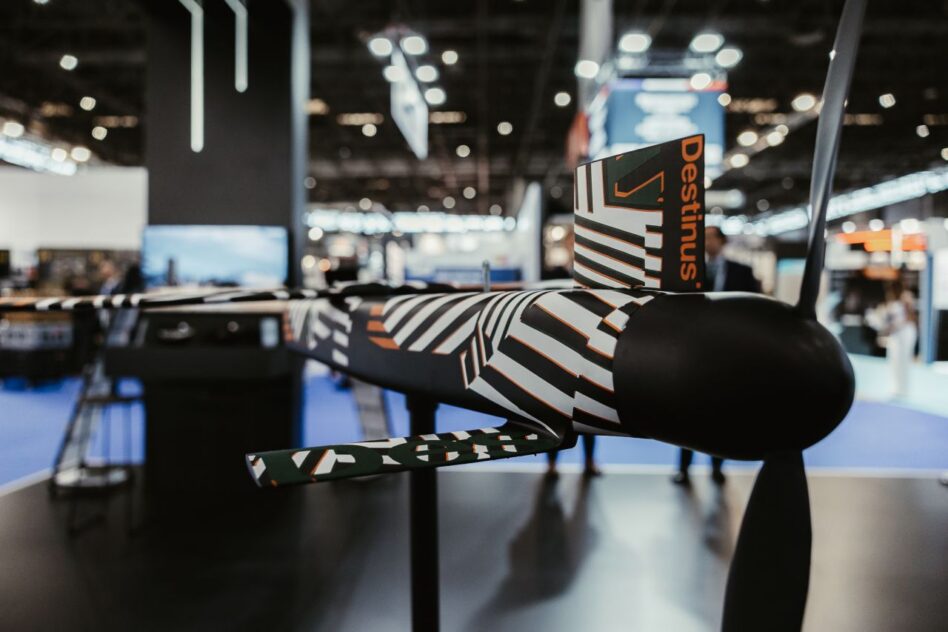
- Hornet has an interception range of 50 to 75 km, and Destinus has already shipped over 1,500 units to customers and is ramping up production quickly. Vorexon, unveiled in July, is still under development, but is designed for speedier threats, with an interception range of 20 km and a top speed of Mach 2.5.
“Our vision is to leverage our vertical integration, our manufacturing space and capabilities, and take lessons learned so we can copy-paste that production schema in Europe here in the United States to quickly fill the gap in our interceptors,” Shover told Tectonic. “The idea is to take something that’s already proven, establish a production line, and as the threat evolves, have an arsenal ready to manufacture.”
- He said that Aeon is aiming to start manufacturing Destinus’ Hornet Block 2 interceptors at Aeon’s new 145,000-square-foot facility in Texas in Q1 or Q2 of next year, targeting 500 units per month.
Layers on layers: The ASTRA layered interception architecture is, put simply, designed to deploy the best-suited countermeasure possible for the threat, especially the jet-powered drones that Russia is devastating Ukraine and its air defense stocks with. That’s pretty much what the Army’s xTech|Apex Intercept competition is all about, too.
“The idea is to demonstrate ASTRA, the C2 system, and the deployable radar solutions so that you can provide a layered threat ring,” Shover said. “The goal is to intercept things that are moving faster than 100 meters per second at a medium range to basically outperform anything that’s on the market today, and jet-powered [drones] are the gap.”
Better together: Aeon and Destinus are betting that that solution—pairing US manufacturing with European battle-proven tech—will be a winner, but they’re also looking at adapting Destinus’ Hornet and, potentially, Vorexon, to more seamlessly integrate with US systems and objectives.
“There’s autonomy already in these systems, but what we want to do with the Department of War is to make these more applicable to US [platforms],” Shover said. “Aeon is the interface between [Destinus] and the Department of War,” and gives Destinus an “easy button” for introducing it to the US market without needing to set up a full US subsidiary and manufacturing footprint.
That deal is pretty good for Destinus and Aeon alike.
“This partnership pairs interceptor know-how developed in Europe with integration and industrial strength in the United States,” Destinus’ VP of US Operations and Business Development, Ron Kavanaugh, said. “Our focus now is on showing the Army that the approach can meet its operational needs, scale affordably, and improve the cost exchange.”
“That is the logic of cost-asymmetric air defense: effective interception at production rates and costs that can keep pace with operational tempo,” he added.