Question: What do you get when you combine “maritime is all the rage” with “unsexy is the new sexy”?
Answer: Bulwark Dynamics, an unmanned surface vessel startup laser-focused on contested logistics. That pitch has caught the eye of some early backers.
This morning, the California-based maritime logistics startup announced $6.8M in seed funding to ramp up production of its super-cheap, super-portable 15-foot autonomous landing craft and to accelerate development of a larger, 35-foot variant.
- Investors include SBI US Gateway Fund LP, Archetype Ventures, Nēnē Ventures, and Japanese shipbuilder Onomichi Dockyard.
- On top of the investment, Onomichi Dockyard also inked a deal with Bulwark to localize production of the vessels in Japan, which is itself kicking off a nascent defense tech renaissance.
Filling the gap: Bulwark’s origin story began in 2025, when CEO and cofounder Nhat Lieu was 19 and looking at the biggest capability gaps in modern military operations (normal stuff, really).
“The problem we [saw] was contested logistics,” he told Tectonic. “Historically speaking, wars are basically decided by logistics. You gotta deliver stuff to the right place on time to sustain the command and the units.”
“But the problem we have today is the logistics connectors were built around World War II and the Cold War, and the number of those vessels is decreasing significantly,” he said. “In 2018, we had more than 140 vessels like logistics connectors, but now, it’s less than 70.”
- Those vessels—like the Navy’s legacy Landing Craft Air Cushion (LCAC) and the Ship-to-Shore Connector (SSC)—are also pretty pricey.
Enter Bulwark Dynamics.
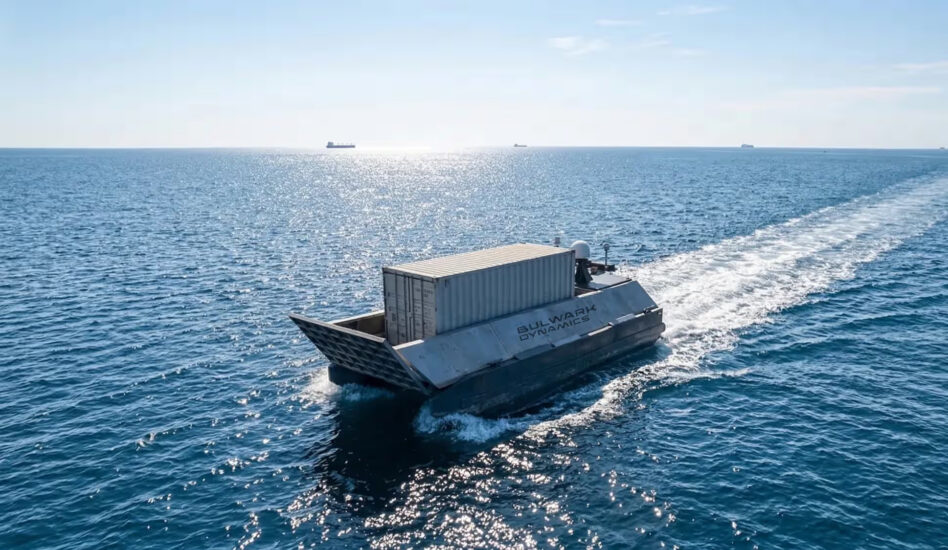
Sea sustainment: The startup’s USVs, named Caravel, are designed for last-mile logistics, especially in shallow littoral waters, and for “production at a [sub-$1M] cost that allows it to be fielded in numbers.” Caravel comes in a few sizes:
- A 15-foot variant that has a 6,600-pound payload capacity, 340 nautical mile range, and is designed to fit in a shipping container and deploy from an aircraft (or larger vessel); and a
- 35-foot variant that’s currently under development, but will have, according to Bulwark, a 23,000-pound payload capacity and 1,700 nautical mile range.
Earlier this year, Bulwark demoed a full logistics mission with a Caravel 15 prototype, including unmanned transit, beaching, cargo offload, and retraction off the beach, all without any human intervention.
- They currently use a third-party autonomy stack, but they’re looking into developing their own.
The $6.8M in seed funding is focused on ramping up production of the 15-foot USV, and getting the larger one ready for production.
Part of that production will take place across the Pacific at Onomichi Dockyard (the Japanese military is a target customer), and the vessels are designed with the Indo-Pacific’s island chains in mind.
In a conflict in the Pacific, China would “launch a lot of missiles targeting logistic connectors, so [the US] is going to want to use a much smaller logistic connector, like what we’re building,” Lieu said. “This vessel can land on the shorelines without any problems, and [users] can offload the cargo without cranes, vehicles, or any external handling equipment. “That’s the CONOPS we’re seeing right now.”
“Building unmanned systems at scale inside the theater, on the industrial base and supply chains an ally already has, does two things at once,” he added. “It solves a problem the people running these missions have today, and it puts decades of allied know-how to work on American reindustrialization.”