Lasers are all the rage right now, but that doesn’t mean the Army’s lost sight of other forms of directed energy.
This morning, Epirus announced it’s secured a $18M contract with the Army’s PAE Fires to make its flagship drone-zapping high-powered microwave (HPM) system, Leonidas, mobile and adaptable to different vehicle platforms.
Fry ‘em: As a little refresher, Epirus builds—put extremely simply—machines that zap drones with a super-powerful microwave beam, frying from the inside out.
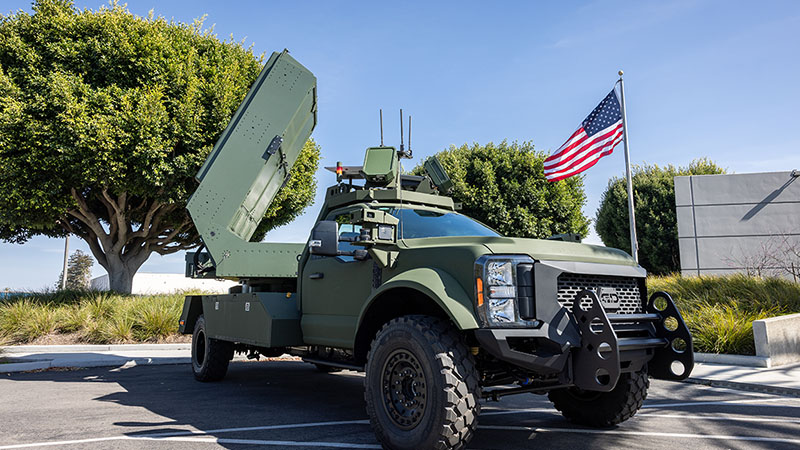
- Leonidas is a vehicle-mounted HPM directed energy system that projects intense microwave energy at nearby drones, disabling their electronic components and dropping them out of the sky.
- In terms of form factor, think a giant microwave-producing mattress perched on a truck.
- Its software-defined design allows Leonidas to alter waveforms, adjust energy output, define safe zones, and update the system in the field.
- And the company’s like, actually scored contracts for this stuff—the Army has awarded Epirus over $120M in contracts for Leonidas under the Integrated Fires Protection Capability High-Power Microwave (IFPC-HPM) program since 2023, including a $43.5M contract last summer.
That $43.5M contract is what this latest deal is building on.
Under the original award from the Army’s Rapid Capabilities and Critical Technologies Office (RCCTO), before it was folded into PAE Fires, Epirus was tasked with delivering two Leonidas units in a fixed-site configuration, but PAE Fires, led by Lt. Gen. Frank Lozano, figured that Leonidas would be more handy on the go, Epirus CEO Andy Lowery told Tectonic.
“[Lozano] looked at Army 2030 and said, ‘I don’t think fixed and semi-fixed directed energy makes sense for my future force,’” Lowery said. “So he rewrote the requirement to say, ‘For 2030, if I’m going to have directed energy as part of the layers within the short-range air defense mission set, it should be mobile.’”
So, that’s what Epirus is doing.
On the move: Under the expanded and restructured contract, the Army and Epirus are transitioning Leonidas into more “adaptable Leonidas form factors” to provide “the Army with a broader range of options for deploying HPM systems across diverse missions and environments,” according to the company.
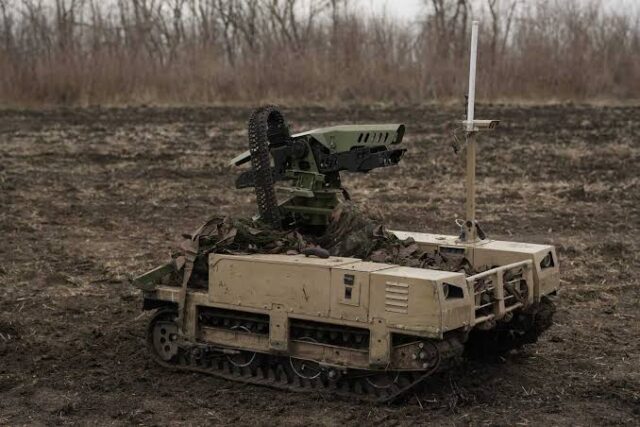
- That’s pretty convenient, because Epirus has already gone all-in on vehicle-based Leonidas. Over the past few years, they’ve partnered up with GD Land Systems to put the system on an F-600 truck, a robotic ground vehicle, and Stryker armored fighting vehicles.
- They also snagged an $11M contract with the Marine Corps in August under the USMC’s High-power Microwave Autonomous Vehicle Operational Capability (HAVOC) program, which’ll put Leonidas on different manned and unmanned ground vehicles for mobile point defense.
Lowery couldn’t say which vehicles his drone-zappers are going on under the restructured contract with the Army, but they’ll deliver a “mix” of large mobile Leonidas Ground Vehicle configurations and Leonidas Medium units, which he said have about a third of the power and range of the large one (but with a smaller, lighter, and more mobile form factor).
Better together: Laser might be snagging the headlines, but Lowery sees plenty of room in the directed energy game for different systems, and he views laser weapons and Leonidas working together as a “spear and shield.”
“It’s not a competitor to lasers—the laser is a spear, and [Leonidas] is the shield, and it works really well in conjunction,” he said. “If [drones] get past the laser, and it’s a big swarm, we can use the HPM.”
It’s all about layers.