Forget about Taco Tuesday. It’s fiber-reinforced composite structures Tuesday.
(Is that a thing? We’re making it a thing.)
This morning, LA-based composites startup Helicon announced in an exclusive release to Tectonic that it’s, well, officially emerged from stealth and raised a cool $16.5M.
- The raise was led by AlleyCorp, with participation from Buckley Ventures and Mike Chalfen.
- Angel investors including Eileen Tanghal, Gokul Rajaram, Lucas Vaz, Frederik Hjelm, Pablo Palafox, and Charlie Songhurst also joined the round.
CEO and co-founder Alex Niehaus told Tectonic that they’ll use the funding to scale up their automated production line for composite structures for UAVs—specifically, Group 1–3 drones (FPVs all the way up to LUCAS).
“The production bottleneck (for composites) has nothing to do with the material,” Niehaus said. “There’s a graveyard of hundreds of companies that try to solve composites…we fundamentally think that they misunderstand that the real bottleneck is extremely highly skilled composite engineers.”
So, they’ve turned to robots and software. Welcome to 2026, y’all.
Old school: Now, we’ve been throwing a lot of nuts and bolts your way lately, but bear with us—nuts and bolts are quite literally what keep this whole defense tech thing together.
(Sorry.)
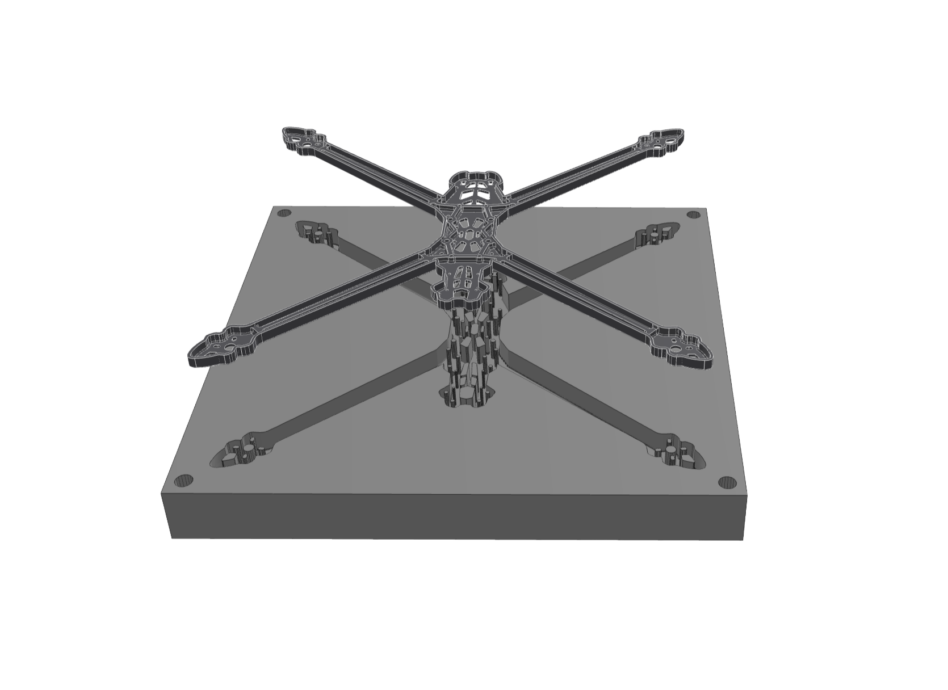
Helicon was set up earlier this year by Niehaus and Edmundo Sanz-Gadea to find a better solution to a rather simple-seeming problem—building composite frames for the gazillions of drones the US (and its allies) want to churn out.
- Drone frames are basically the “skeleton” of any UAV—the thing that holds it together.
- This might not sound sexy, but making a better (or lighter, or stronger) frame can impact everything from speed to range to endurance. Lighter frames can help drones fly further and carry more; stronger frames can withstand greater stresses (like vibrations or rough landings) without exploding into a million little pieces.
- Building frames that are both strong and light often means using fiber-reinforced composites, particularly carbon fiber. But these materials are notoriously tricky to work with.
- Traditional manufacturing involves layering sheets of reinforcing fiber into molds, adding or activating resin, curing the parts, and then trimming and finishing them—a process that’s expensive, labor-intensive, and difficult to scale. That’s fine when you’re building a handful of high-end aircraft, but less ideal when you’re trying to churn out drones in the thousands (or millions).
- Plus, carbon-fiber drone frames have a China problem, too—much of the FPV frame supply chain is concentrated in China.
New kids on the block: This is where Helicon comes in. The company is taking all those fun, new software-driven and automated-slash-robotic production processes we know and love and applying them to the world of fiber-reinforced composites.
- Helicon’s flagship software platform, Argos, takes a component design (like, say, an airframe for an FPV drone) and automates much of the engineering, mold design, simulation, and production planning required to make it.
- Then, robots handle the tricky work of positioning composite materials in molds, extracting finished parts, and trimming them—replacing traditionally labor-intensive (and highly skilled) processes.
- The nice thing about composites is that they’re highly customizable—you can combine different fibers, resins, and material configurations to get the specific balance of strength, weight, and durability you need.
- The production line also includes automated inspection—checks that catch inconsistencies and defects, with the results feeding back into the production process to help improve it.
- And it’s fast—according to the company, each frame takes “5–15 minutes per cycle, versus hours for industry-standard composite processes.”
“We are the first company that will do high mix, high volume manufacturing of composite parts that are not limited by an artisanal workflow, which is how composites—what people simplify as carbon fiber—are today,” Niehaus said.
Custom drop: Per Niehaus, this all “enables organizations to create superior structures for their systems at immense scale while supporting rapid iteration: lighter, stronger, and designed to their requirements.”
- He added that Argos “enables [them] to run 100 times more design variations in the same factory, at automotive throughput, using the same hardware.” That means parts that can be tweaked and perfected to exactly what companies need.
- A few fun facts—per Helicon, its fiber composites are 4–6X stronger than plastic, 2–3X stronger (and about 40 percent lighter) than aluminum, and equally strong (but 80 percent lighter) than steel.
Right now, Helicon has a 36,000-sq.-ft. facility in Torrance, CA, where they’re “ramping up volume,” per Niehaus.
“This place is large enough to make over a million units of, particularly, Group One to Group Two drone frames a year,” he said.
- Currently, they’ve got “less than ten customers” with “extremely high volume requirements” that they are focused on scaling up production for.
- Niehaus couldn’t give us more details on customers but, well, they’re high-volume drone manufacturers. Can make a few educated guesses.
From here, the funding will help them grow the team and build out their production line. Right now, they’ve got a 4–6 [weeks?] lead time for parts—within six months, Niehaus says that’ll be two weeks.
“We’re reducing the barriers to entry to complex geometries of composite parts,” he said. “[We want to enable every mechanical and design engineer that is building any system in the world to actually understand that they can use composites…without a company that you have to send four emails to, or have endless Zoom calls with.”