For a company named after a tree-dwelling animal, Gecko Robotics is spending a whole lot of time out on the water.
This morning, the Pittsburgh-based infrastructure inspection AI and robotics startup announced that the US Navy has quadrupled the ceiling on a $71M IDIQ awarded in March to a cool $300M.
- The initial IDIQ put Gecko’s wall-crawling robo-inspectors on 18 ships in the Naval Surface Force, Pacific (SURFPAC), mainly guided missile destroyers (DDGs) and amphibious assault ships (AAS) stationed at the Pacific Fleet’s Pearl Harbor HQ.
- The expanded contract will put Gecko’s robots and AI-powered inspection software on the Naval Surface Force Atlantic’s (SURFLANT) littoral combat ships (LCS), DDGs, AASs, and more, Gecko President and co-founder Troy Demmer told Tectonic.
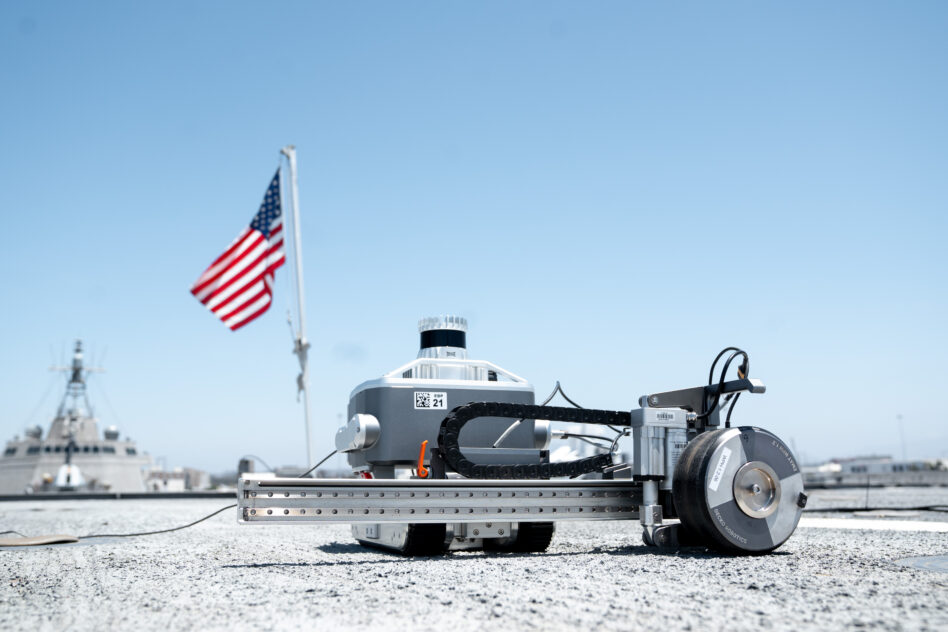
Fast climber: Gecko should be a familiar name for Tectonic regulars, so we’ll keep the background light. Put simply, the company’s robots and AI-powered inspection software analyze the health of critical infrastructure, from aircraft carriers and submarines to power plants and steel mills.
- Those robots use ultrasonic sensors and AI through Gecko’s Cantilever software platform to detect corrosion, cracks, and structural issues before they become problems.
- Cantilever then produces 3D visualizations and maintenance insights that help customers plan repairs, extend asset life, and avoid downtime. Gecko says it can identify structural issues “up to 50 times faster” and more accurately than traditional methods.
- On the Navy side, Gecko has inked deals with major Navy supplier Trident Maritime Systems; BPMI, the prime for the Naval Nuclear Propulsion Program (NNPP); and, most recently, Anduril to make its robots and Cantilever software central to the neo-prime’s $3.7B, 2M-square-foot Arsenal-2 submarine mega-factory.
Fleet weak: One reason that tech has been a big hit with the Navy is that, well, it has a lot of super pricey ships that are super hard to maintain—not to mention all of the shipbuilding and fleet maintenance issues the service is (in)famous for.
“The operational improvements that we’ve been able to demonstrate with our first initial task order with SURFPAC have garnered a lot of interest, and it’s proven itself that this is something that the entire fleet should be able to leverage,” Demmer said. “It’s a good testament to the value creation for the Navy in terms of avoidable maintenance and assurance that their ships are meeting Navy standards.”
Sea legs: SURFPAC has already maxed out the ceiling on Gecko’s initial $71M IDIQ awarded just a few months ago, and “in order to be able to accommodate SURFLANT, the contract grew to the $300M to address those additional ships,” Demmer added.
- On top of Cantilever and their flagship wall-crawling Komodo robots, Gecko is also deploying “robots that fly into some of the tanks and voids, and submersible robots that do the hull.”
- Over the next year, Demmer said he expects Gecko to “roughly double the volume” of the ships they’re on to about 40.
The goal, according to the company, is to help the Navy reach the Chief of Naval Operations’ 80 percent fleet readiness target by 2027, which is a date we’re guessing is circled on a lot of calendars in the Navy (Davidson window, anyone?).
“You can’t defer maintenance indefinitely without paying the bill, and I think what we’ve really seen in the Middle East, especially in the weapons engagement zone, is that you don’t get to do the same routine upkeep,” Demmer said. “Fortunately, we’re beating down the maintenance backlog…while the stakes and the need to do it are growing pretty exponentially.”