If you thought you’d heard the last of the new-age rare earths processing startups, think again.
This morning, a new California-based startup called Maglut Heavy Industries emerged from stealth with $3.1M in pre-seed funding and a goal of developing a “chromatography-based platform to process and refine rare earth elements domestically” in the US.
(We’ll get to what exactly that means in a second.)
“We saw what happened last year in terms of trade actions that China took against the U.S., restricting the export of rare earth materials and other critical minerals, and we were pretty shocked at the vulnerability of American industry,” Co-founder and CEO Curtis Wu told Tectonic. “When we looked into it, we found that the way that we process rare earths and other critical minerals is through solvent extraction, which takes a very heavy toll on labor, on energy, and on the environment. And we thought, what if we could do this better?”
Sticks and stones: Now, we won’t bore you too much by beating a dead horse on the whole rare earths thing. But it’s important to have some context.
- Rare earth magnets are found in everything from F-35s (900 pounds of rare earth materials in each) to nuclear subs (9,000 pounds) and drones because of their magnetic strength, thermal stability, and miniaturization capabilities. For the non-scientifically-minded among us: They take electricity and turn it into motion.
- China controls 60 percent of the mining and processes upwards of 90 percent of the world’s rare earths used in magnets. The country also produces about 90 percent of the world’s rare earth magnets.
- In the 2021 NDAA, Congress prohibited the use of Chinese components in US military equipment (including magnets)—that ban kicks in in 2027.
- As a result (and because of, like, the whole 2027 fear of conflict thing), the Pentagon has rushed to pour funding into rare earths mining and processing companies, including MP Materials and Vulcan Elements.
Trust the process: Now, when we say processing, a big part of that is basically separating rare earths (or other critical minerals) from all the dirt and gunk and other rare earths it lives with. Historically, that’s been done using chemical compounds and solvents that basically bind to the rare earth molecules and pull them out.
- To note: When you pull rare earths out of a mine, they generally come out as a compound that needs to be separated into their pure forms. But, annoyingly, rare earth molecules (neodymium, dysprosium, terbium, etc.) are all very similar, which makes the process rather tedious.
Roy G. Biv: Maglut is taking a different approach. Basically, they’ve taken a fairly old process used in the biotech industry—chromatography—and are applying it to the nasty, tricky, rare earths problem.
- Worth noting: Wu worked for years in biologics purification at biotech giant Amgen.
- Co-founder and COO Azhar Yerzhanova has a background in investment banking and materials/deep tech VC.
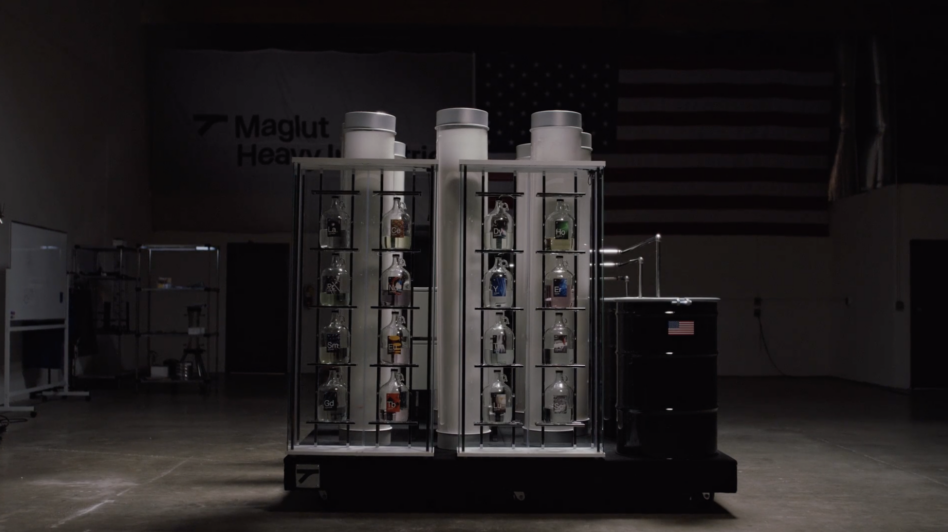
The company’s flagship separating process is called ARC-1, or Advanced Rare Earth Chromatography First Generation (say that five times fast). Here’s how it works:
- Maglut turns the rare earths compound that comes out of a mine into a water-based liquid and runs it through the system. Wu compared it to a Brita filter on steroids.
- Inside ARC-1 are these special resin beads that Maglut produces themselves. Each of these beads are covered with molecules called “ligands”—think of them as tiny chemical hooks.
- Different rare earths stick to those hooks by slightly different amounts. For example, one element might stick more strongly than another, which lets the company separate them.
- The difference in stickiness is what allows Maglut to purify the compound—one rare earth moves through the system faster and comes out first, while another sticks around longer and comes out later.
- In the end, instead of a rare earth soup, you have separate streams of the minerally good stuff.
“The genius of our approach is that it doesn’t just release all the rare earths at the same time; It actually releases them in sequence,” Wu said. “So, lanthanum will come out first, then cerium, then praseodymium. Because they come out at different times, you can just collect them separately, and you can get really high purity and really good separation.”
According to Maglut, the “company has validated its ARC-1 process at pilot scale, separating real-world feedstock into individual rare earth oxides at 99.9% purity and higher.” Now, they just need to scale.
“We think that this has the potential to transform the way that we process rare earths for sure, but we think it has applications for other critical minerals,” Wu said. “We think that our approach is the only approach that can credibly reach cost superiority relative to China. We don’t see anything else out there that we think is credible.”