In case you hadn’t noticed, there is a whole lot of hype around bringing AI into warfighting functions.
Most of what the AI-for-defense nerds focus on is complex, finicky things like autonomous systems, command and control, and targeting. But AI can make a major difference in the more, erm, mundane stuff, too—pen-and-paper mission planning, wargaming, and decision-making. And luckily, bringing these day-to-day tasks into the AI era doesn’t inspire nearly as many conversations about whether we should let robots kill humans.
This kind of AI-for-simulation and planning is exactly what one Atlanta-based startup is bringing to the table (sorry), and it turns out that the Army is pretty jazzed up about it.
This morning, Sandtable announced exclusively to Tectonic that it’s won a five-year, $45.3M US Army IDIQ contract that gives units across the service access to its platform for “integrated mission planning and wargaming support.”
“The speed of conflict is…rapidly increasing, the ubiquity of sensors and capabilities is dramatically increasing, and the complexity is increasing well beyond anything people have seen,” CEO Brian Hamilton told Tectonic. “All these [GWOT-era] processes are still in place, and so we came together to try and [fix it].”
Playing in the sand: Even in the niche world of mission planning software, companies are focusing on a wide array of functions, from the unsexy (but pretty dang important) stuff like logistics and sustainment all the way up to automating targeting and fire control. Sandtable has chosen to focus on wargaming.
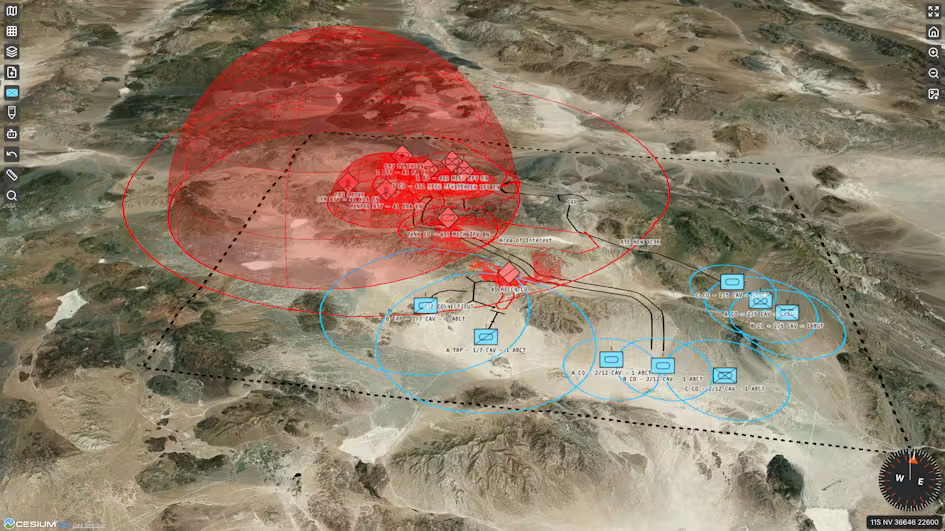
The company’s platform, called Mentat (good Dune/Fallout reference, guys), is built around taking the “horrible, lossy process of words, where I’m shipping out hundreds of pages of documents, and converting that into something that we’ve started calling operational modeling,” Hamilton said. “Understanding what things can do in time and space, what the different permutations about what’s possible are, and then ultimately getting to the optimal outcome as quickly as possible.”
- The model ingests real-time intelligence, geospatial and terrain data, and operational plans to generate and update a digital planning environment that lets commanders and planners plan, wargame, assess threats, test multiple scenarios, and ultimately make decisions faster.
- It can integrate autonomous systems (UAVs, UGVs, sensors, etc) to work as dynamic agents within the model to “explore coordination, timing, and ISR-tasking effects.” This capability is central to their partnership with GPS-free navigation company TERN.
- Sandtable also won a $38M IDIQ with the Army Research Lab last year focused on agentic planning and simulation. They’ve “gotten extensions on original task orders and continue to work on that,” Hamilton said. “To date, we’ve been involved with 12 or 13 different planning exercises, command post exercises, staff exercises at the operational level, anywhere from battalion all the way up to division-level.”
Eye in the sky: The geospatial intelligence part is what Sandtable says sets it apart from others in this space.
“We’re taking in 3D geospatial data, which is key for—and what we’re doing that really nobody else is doing—maneuver planning,” co-founder and COO Brady Moore told Tectonic. “Creating that 3D sandtable that people can actually do maneuver planning on and coordinate all your other warfighting functions on.”
- That includes pulling in data from the Army’s One World Terrain data sets—the service’s next-gen 3D geospatial database and virtual representation of the physical Earth for modeling and simulation software and hardware—and other sources.
Cash money: Under the new $45.3M deal with Army Contracting Command, operational units can use “O&M dollars, not just R&D dollars” to access the platform directly,” Hamilton said. “We have a variety of different deployment methods, but probably our most popular one is the offline capability,” which allows planners to use the model when comms are down.
- He said that they already have a few task orders placed against the IDIQ in the works.
Hamilton added that the company also closed a seed round led by Bonfire Ventures back in April, but didn’t share any numbers.
With that capital and growing demand, “the next most natural step is to get more into air use-cases—we’re getting a lot of feedback right now about integrating planning between ground and air,” he added. “We’ve started off in the Army just because that’s our background, but we strongly believe that this will have applicability across all the forces, as well as NATO and allied countries.”