If you didn’t believe us when we said, “Manufacturing is so hot right now,” well, we’re back with more data to prove our point.
Yesterday, manufacturing startup and MIT spinout Fabri announced that it’s raised a total of $13.5M in funding since it was founded in 2022 from investors including Lavrock Ventures, Balerion Space Ventures, RTX Ventures, Lockheed Martin Ventures, Marlinspike, Tenon Ventures, and SBXi.
Most recently, the company—which specializes in new-age investment casting—announced a $5M seed led by Lavrock Ventures in December 2024, with participation from RTX Ventures, Tenon Ventures, and SBXi. The remaining funding is a mix of debt and equity raised since.
Founder and CEO Steven Davis told Tectonic that though the company is still on its seed round, it’s already shipping out castings—including to those two prime investors, Lockheed Martin and RTX. They’re also setting up a second foundry (they call their first facility an “R&D Foundry”), which they hope to have online at full production capacity by 2027.
Not a bad start.
Moldy: Now, if you’re sitting there thinking, “Wait, what is investment casting?” Don’t worry, we gotchu.
This is how it works—at least traditionally:
- First, you create a wax model of the part that you want. Typically, this process is used for complex parts—like turbine blades or bits of missile engines—that can’t really be created any other way.
- Then, you coat that wax in ceramic until it has a hard shell around it.
- You then heat that shell, which melts the wax—leaving a hard ceramic mold.
- Finally, you pour molten metal into that ceramic mold, let it cool, then crack away the ceramic, leaving you with a metal part.
This is a very old practice—like ancient old. But it works—the only catch is that it requires a lot of labor, especially in terms of making wax molds (which requires humans) and then correcting defects or faults that result from those molds. Humans ain’t perfect, after all.
Rise of the robots: That’s where Davis and the Fabri team are betting they can help.
- Davis grew up in the Los Angeles aerospace and defense world. He did robotics (like, competitive robotics) from a young age, then went to MIT for mechanical engineering.
- Over years of robotics work, Davis realized that “designing the robots [was] much easier than getting them made,” which pushed him to study additive manufacturing at MIT.
- But there, he realized that printing had limitations, too. It wasn’t as scalable as he’d thought, and while working at Relativity Space (while still an undergrad), it would take “months and months on multi-million-dollar machines to build things like rocket nozzles and hardware.”
- So, he turned back to casting. After visiting “dozens of foundries” while he was a student, he realized that the primary issue was labor. So, he worked with his professor—John Hart—to kick off the product, then set out with his co-founders (and MIT alumni), Pieter Coulier (CTO) and Tom Cole (COO), to build a new kind of foundry for the 21st century.
“There hasn’t been a year where the number of foundries has increased…for the last like five or so decades,” Davis said. “So, we’re down about 80% in foundry capacity, even more in the workforce, and [those workers are] still retiring out at a rate of like three to one.”
Ghost in the machine: To combat this, Fabri is building a fully automated foundry that uses some additive manufacturing, robots, and software-slash-machine learning to minimize the trickiest (and most human-intensive) parts of investment casting.
- The company uses additive manufacturing to print the wax molds, rather than having humans assemble them. “That’s roughly a third of the labor in most foundries,” Davis said.
- But that’s not all: The company’s also developed bespoke software that is constantly collecting production data, figuring out what works and what doesn’t, and pinpointing where faults are happening. “More than half the labor in most foundries is dedicated to people doing rework after the casting process is done,” Davis said. They’re trying to eliminate it.
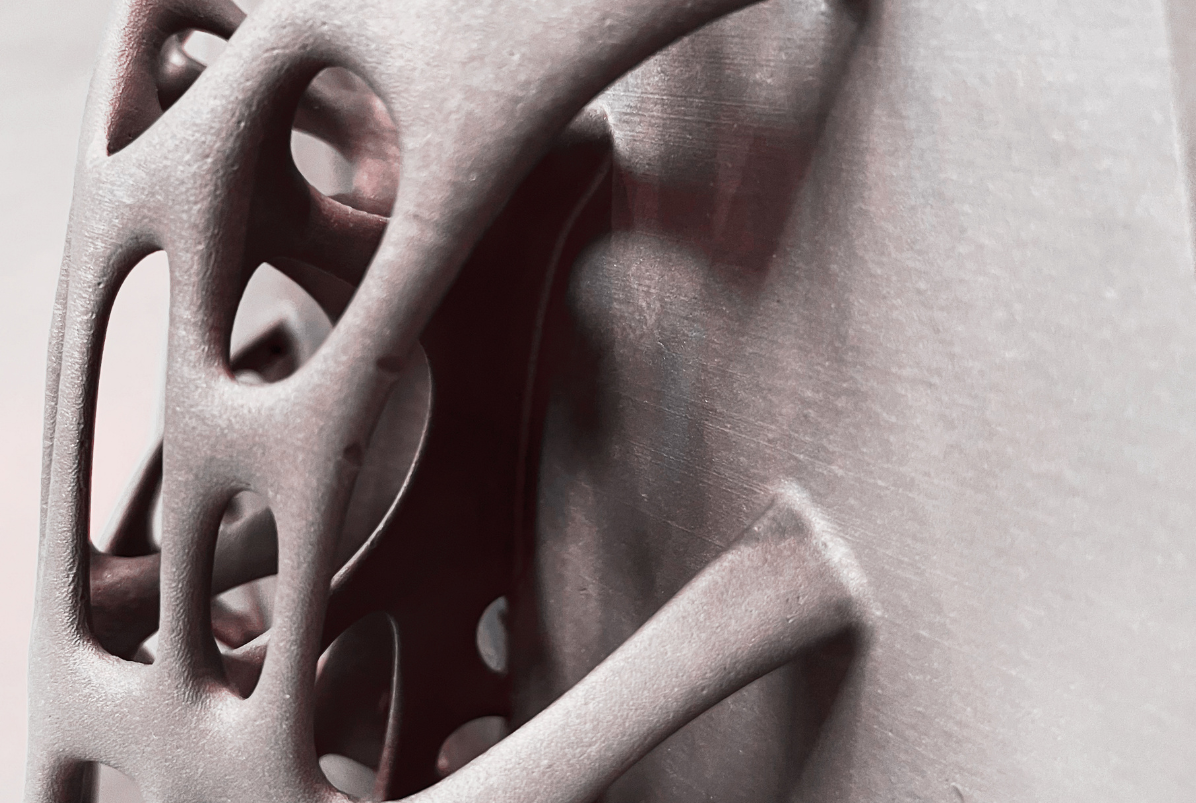
- Because they’re using 3D-printed molds, Fabri can also play with new (perhaps more organic, or lighter, or more streamlined) shapes or geometries for different parts, while still using a traditional casting process. Think of it as bringing the best of the old (casting) to the best of the new (innovative design).
Metalheads: And as for what they’re printing—the company started out primarily in aluminum parts and has since expanded into copper and steel alloys.
- RTX and Lockheed aren’t just investing for shits and gigs—Davis said they’ve already shipped parts to both. It’s worth noting that both companies are some of the largest buyers of cast parts in the country.
- They’ve also worked with NASA on casting as part of the organization’s “Text-to-Spaceship and Evolved Structures” research.
- Right now, their R&D facility can churn out hundreds (to maybe thousands) of parts. This money will help them scale that way up—the goal, Davis said, is to open a new foundry a year to make up for a loss in US foundry capacity.
- Davis and his team are betting there will be, like, massive demand for what they’re selling. “Metal casting…is in like 90% of all manufactured goods,” he said. “It’s the foundation of most supply chains that need metal things. If it’s metal, somebody melted it at some point. Investment casting is the highest end of those processes, and the one that’s most in need for critical industries like aerospace, defense, energy, [and] medical devices.”
Money, honey: And it sounds like there is some cash money coming in to fund all that. Davis says they’re planning a Series A within the next three to six months, and Alex Poulin—a partner at Lavrock Ventures who led the deal—seems pretty pumped about the whole thing.
“While traditional foundries struggle with labor shortages and precision demands, Fabri’s automation creates scalable competitive advantages for US aerospace and defense manufacturers,” he told Tectonic. “This is infrastructure-level innovation that strengthens our entire supply chain while delivering strong commercial returns, exactly what we look for at Lavrock.”
See? Manufacturing really is so hot right now.