All those drones, interceptors, and other autonomous systems y’all are churning out like hotcakes are well and good, but they’re not much use if they (to put it delicately) crap out when they get to the battlefield.
Luckily, a new London- and Berlin-based company is here to help with that.
This morning, autonomy testing and validation startup Agon emerged from stealth with a cool $30M in funding to build out its “synthetic battle arena where autonomous weapon systems learn to fight.”
- Think of it as a virtual testing ground where you can try out AI-powered autonomous systems before actually fielding them. Whole lot cheaper and less heartbreaking when things crash in a synthetic environment.
- Backers include Lakestar, 201 Ventures, D3, Lux, and XYZ. The funding was raised across two rounds—a $7M pre-seed and a $23M seed.
“We’re moving to a new era of warfare, one that is moving away from platform supremacy to algorithmic supremacy. We’ve seen drones redefining the battlefield, but I think we’re only in the foothills of the autonomy journey,” CEO and co-founder Tristam Constant told Tectonic. “The future battlefield is going to belong to the side whose systems can coordinate, communicate, and adapt faster than the adversary…[that will] require increasingly more capable AI that can adapt at an increasingly faster rate.”
The company was officially founded earlier this year by Constant (formerly of Applied Intuition, Anduril, and the British Army) and Junaid Hussain (co-founder of Cambridge Aerospace and Iconic, among other companies).
- Constant and Hussain have assembled an all-star team including alumni from Anduril, Applied Intuition, Google, Helsing, Palantir, Amazon, Havok, and Unity. Hell of a starting roster.
75 Hard: Now, we spend a lot of time around here talking about autonomous systems, but we don’t spend nearly as much time talking about the simulation, data, and testing infrastructure that trains them and makes sure they, like, work. That changes today.
In case you weren’t aware (we know you are), all AI models (and, thus, the systems they power) need to be trained with tons (and we mean tons) of data.
- That training is all the more critical for defense systems, where the difference between a well and poorly trained model means life or death—quite literally.
- Currently, a lot of that training relies on real-world data—AI for an autonomous weapon can’t just scrape the internet or troll X. Instead, these models ingest hours and hours of real-world testing and mission data, or get tested in bespoke simulated environments.
- But the problem is, it’s pretty tricky to keep that data completely up to date, or to make sure those simulated environments (and the adversaries within them) reflect current battlefield realities.
“Our ability to develop and train autonomous systems is way too slow, and it’s way too expensive, and we also struggle to adapt at the pace of the evolving threat,” Constant said. “Ukraine’s a great example of this, and more recently the war in Iran. Threat evolution is a constant. It’s a cat and mouse game.”
To keep up, you’ve got to pretty much constantly test and train your models. But that ain’t easy in the real world.
“You look around at Europe, there is almost nowhere where you can actually develop and even test swarming drones, particularly with payloads…other than the front line in Ukraine, which is a terrible testing location,” he added. “Now, nothing’s going to replace that battlefield fidelity, but it’s certainly not going to allow you to test and develop at the kind of speed and scale that’s required for developing autonomy.”
Personal trainer: Enter: Agon.
The company has built a common training ground (or battle arena, if you prefer) that basically short-cuts all that data collection and simulated environment building for defense tech companies. Per Constant, it’s a “horizontal infrastructure layer that drone manufacturers can build upon for looking to build and train autonomy for all domains and for defense institutions and the military.”
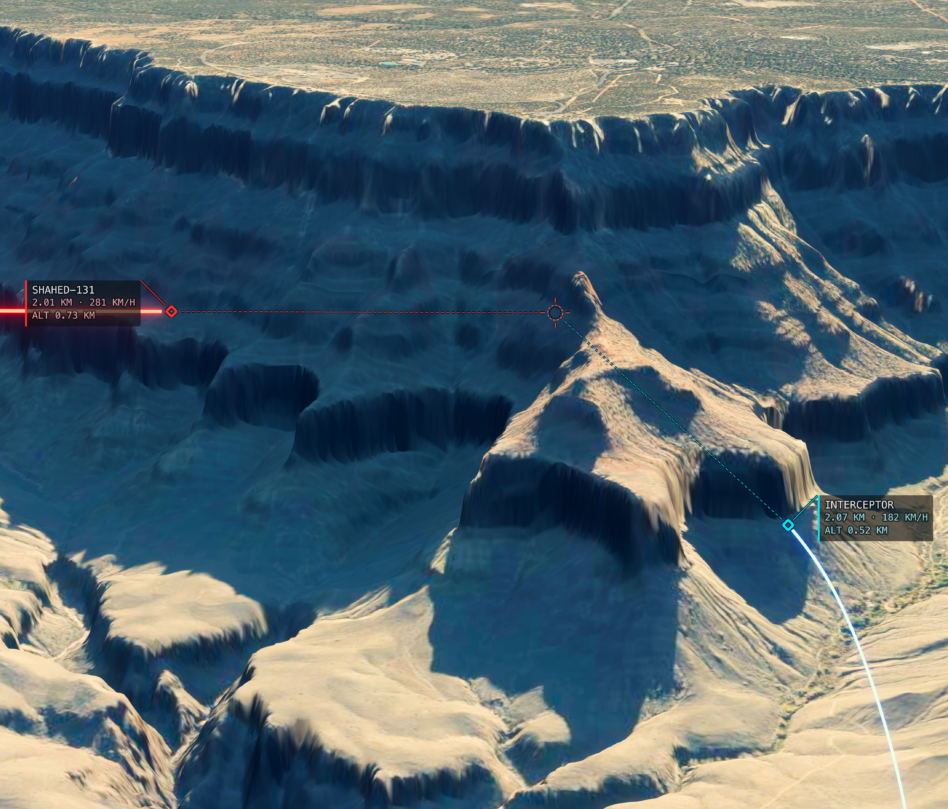
- A really critical point here is that Agon says it deploys “adaptive [virtual] adversaries drawn from live conflict intelligence, at a scale and fidelity that the real world cannot provide.” By updating those in-arena adversaries pretty much constantly, they say they can train autonomous systems on conditions closer to those on the real-live battlefield.
- Think of it as red-teaming, but super-charged—the adversary adapts, changes tactics, learns, and can be modified to represent how Russian Shaheds, Iranian loitering munitions, or future autonomous swarms might behave.
- Constant says they’re building the platform for a world in which collaborative autonomy and multi-agent autonomy are the norm—the current testing and validation stack, he said, “is not optimized for the scale required for artificial intelligence, and that demand is only going to go up.”
“We’re moving to a new era where tactics and strategies in machine-speed autonomous warfare are not going to be defined by human controllers,” he added. “They’re going to be defined and trained by AI, and so that’s where we’re focused—training those superior capabilities.”
It’s a gym, but for drones and futuristic autonomous systems. Cute.
Play the game: Now, if this all sounds a whole lot like a video game, that’s no coincidence—Agon’s chairman is David Helgason, founder of Unity Technologies.
- Unity is the world’s largest gaming engine—essentially an environment where games get built. (Those gears turning yet?)
- Constant said their business model isn’t too different—if Unity is the go-to place to build games, Agon wants to be the go-to environment to test and validate autonomy in.
“There’s a lot of similarities between what we’re building and the gaming industry,” he added, especially in terms of trying to use compute as efficiently as possible. “The critical difference, though, is that what we’re building is grounded in physics, and that really matters in a way that is totally irrelevant in the world of gaming.”
Sucks when your drone falls out of the sky in the real world because you calculated gravity wrong in the fake one. Fair enough.
Get reps in: So, how is Agon going to use this money? Right now, Constant said the team is working with design partners (companies that build drones and other autonomous systems) to validate the product and make sure the training environment, well, works.
- While the platform will ultimately be multi-domain, he said they’re kicking things off on air defense. They’ve already “hit a stage where we can see some really impressive results for what we’re building,” he said.
- They’ve “got a number of site design partnerships…[and they’re] looking to continue to develop that product in partnership with them,” Constant added.
- They’re also looking to grow the team in both London and Berlin, but Constant couldn’t give us exact numbers.
“There is no platform-agnostic defense AI player, and that’s what we’re looking to build and invest in,” he said. “[We’ve raised this capital] to invest in developing that capability at our own cost, because we believe it’s going to be a critical requirement for the future of deterrence in Europe.”