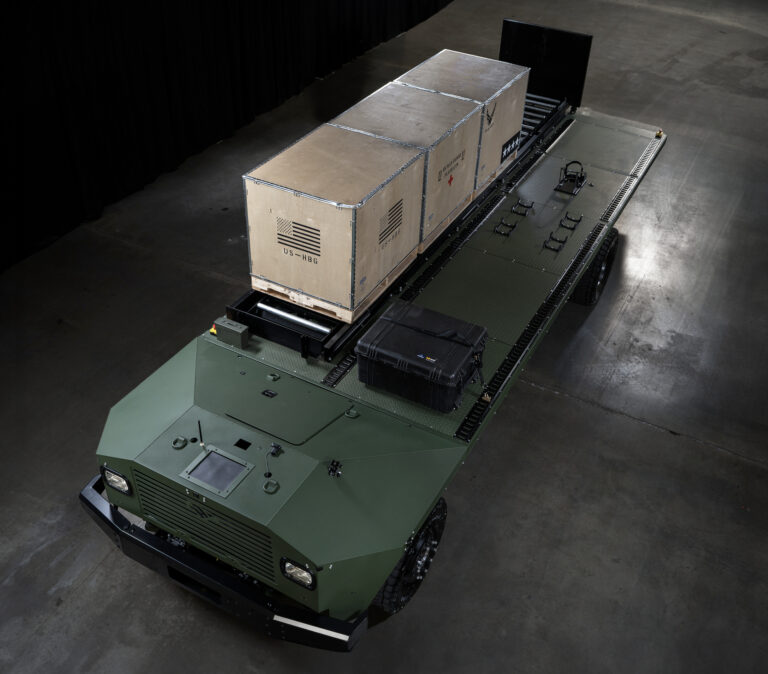
Harbinger is a new name in the defense tech scene, but the California-based electric truck startup has made a big push into our world over the past few months, especially on the white-hot unmanned ground vehicle (UGV) scene.
Now, the company has a whole lot of cash in the bank to keep its pedal to the metal in expanding its work with the military after raising a $240M Series D co-led by Tiger Global, Capricorn’s Technology Impact Fund, and Ridgeline.
- Fidelity Management & Research Company, Greycroft, PanaceaVC, FedEx, and others participated in the round.
- The Series D, announced yesterday, brings the company’s total capital raised to over $650M since it was founded in 2021.
To date, the California-based startup has been mainly commercial—they build super-scalable electric and hybrid unmanned ground vehicles for shipping, with customers including mom-and-pop shipping company FedEx.
- FedEx also led the company’s $160M Series C last year and just placed an order for 2,000 Harbinger trucks valued at over $300M.
Driving into defense: That initial focus on its commercial biz made the push into defense pretty seamless. Harbinger’s electric and hybrid UGV chassis is already commercially proven, and production lines are running hot. Defense-ifying the platform is a whole lot faster (and cheaper) than designing them for the military from scratch.
“We have a major structural advantage because we’re approaching these businesses from the initial launch point of auto, which is a famously punishingly difficult segment to survive in, let alone make money at,” CEO John Harris told Tectonic. “We believe that when you build new IP, new capacity, new technology in auto, then bring it to other businesses, you have this giant structural advantage in cost of scalability, and it allows you to build better businesses.”
Hot start: The company boarded the defense tech train back in June with the formal launch of its defense business, Harbinger Praesidia, after securing funding from In-Q-Tel.
The defense-ified vehicles Harbinger is bringing to the military are based on the commercial ones, but they look a little different from the ones delivering packages for FedEx (mostly because there’s no one behind the wheel). And they’re a bit of a beast.
- It can carry payloads of up to 18,000 pounds, operate in temperatures ranging from -22°F to 131°F and at altitudes up to 12,000 feet, drive over 500 miles on the hybrid engine or 105 miles fully electric, and hit speeds of 65mph. It’s built to run off-road and in any type of weather (snow included).
- It can also export up to 350 kilowatts of power to external systems, making it a big ‘ole generator on wheels to help power operations in austere environments.
That’s caught the eye of some friends in high places, both in the defense world and with the Pentagon.
- Before launching Praesidia, Harbinger inked a partnership with German defense giant Rheinmetall’s US arm in May to develop a family of robotic and uncrewed ground vehicles for the military based on their commercial variant.
- In August, the Army tapped the company—alongside prime integrator American Rheinmetall, autonomy hotshot Forterra, and human-machine interface startup Primordial Labs—to develop autonomous logistics ground vehicles for the service’s Project Sustainment initiative.
Commercial customers are still Harbinger’s bread and butter, but a big focus of the new funding is expanding further into the defense space.
“Defense is a market that, as a whole, is big, but ground-based autonomy is still very new, and so I think it still has huge growth potential…as the US now works to catch up with the advances shown in ground-based autonomy in Ukraine,” Harris said. “Vehicles in the unmanned segment, in particular, are still pretty niche within US DoW, but it has much more potential for rapid growth.”
“We went from having no defense offerings here 10 months ago to a partnership with Rheinmetall and [making] initial deliveries there, and an Army contract for Project Sustainment—all in the span of well under a year,” he added. “This funding just allows us to keep doubling down on these interesting new verticals.”