Looks like the Army’s keeping its foot on the gas in its push for more ground autonomy.
On Friday, American Rheinmetall announced that it’s snagged a contract to serve as the prime integrator for a team of companies—Harbinger, Forterra, and Primordial Labs—that will develop autonomous logistics ground vehicles for the Army’s Project Sustainment initiative.
- The Army’s Capability Program Executive (CPE) Mission Autonomy awarded the 18-month contract through the National Advanced Mobility Consortium (NAMC). The contract value wasn’t disclosed.
- Project Sustainment, which absorbed the Army’s Medium Multipurpose Equipment Transport (M-MET) program after CPE Mission Autonomy was stood up in March, is designed to “remove soldiers from high-risk delivery routes while delivering essential supplies directly to the tactical edge,” according to the Army.
- Five companies—AM General, American Rheinmetall, Carnegie Robotics, HDT Robotics (BLADE), and Stratom—were downselected for the program last month.
Ghost riding: American Rheinmetall needs no introduction, but Harbinger might, at least on the defense side of things.
To date, the California-based startup has been mainly commercial—they build super-scalable electric and hybrid unmanned ground vehicles for shipping, with customers including mom-and-pop shipping company FedEx. (FedEx also led the company’s $160M Series C last year.)
But, like half of California, the company boarded the defense tech train back in June with the launch of its defense business, Harbinger Praesidia, after securing funding from In-Q-Tel.
- This contract with Rheinmetall has also been a long(ish) time coming. Harbinger announced a partnership with the German defense giant’s US arm in May, focused on developing a family of robotic and uncrewed ground vehicles for the military based on their commercial variant.
- Harbinger’s electric and hybrid UGV chassis is already commercially proven and they’ve got production lines running hot. They’ve just got to deliver them to Rheinmetall to defense-ify the platform—that’s a whole lot faster (and cheaper) than designing them for defense from scratch.
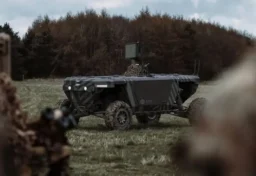
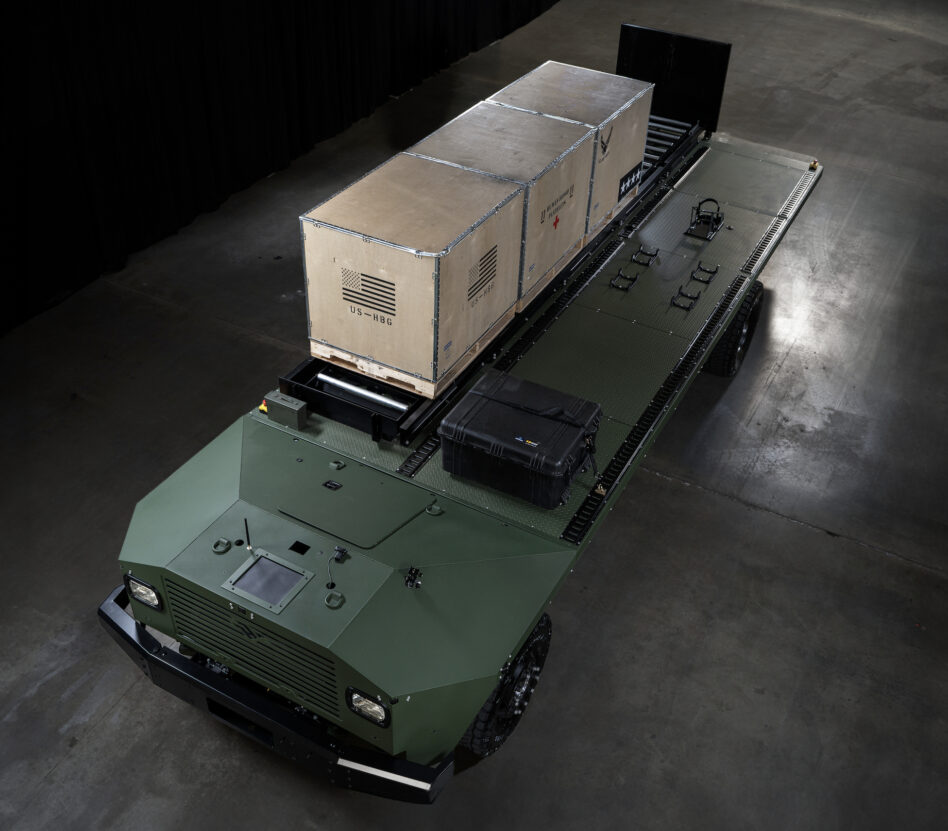
Beast mode: The core platform that Harbinger’s delivering for the Project Sustainment initiative (as those who saw it parked outside of Reindustrialize in Detroit can attest) is a bit of a beast.
- It can carry payloads of up to 18,000 pounds, operate in temperatures ranging from -22°F to 131°F and at altitudes up to 12,000 feet, drive over 500 miles on the hybrid engine or 105 miles fully electric, and hit speeds of 65mph. It’s built to run off-road and in any type of weather (snow included).
- It can also export up to 350 kilowatts of power to external systems, making it a big ‘ole generator on wheels to help power operations in austere environments.
No hands: The UGV can be driven remotely, but, to keep up with the times (and the Army’s appetite for autonomy), it is designed to integrate with third-party software to enable full autonomy. That’s where Forterra and Primordial Labs come into the equation on the Project Sustainment contract.
- Forterra (which also needs no introduction, if you’ve been reading Tectonic) is providing the autonomy stack for the Harbinger vehicle to “enable distributed, mission-aware, and resilient military operations in contested environments,” per Rheinmetall.
- Primordial Labs, a defense-focused human-machine interface startup, is providing Anura, its software platform that turns robotic systems into “battlefield teammates” by using natural language commands to control and task unmanned systems.
Next steps: The vehicles delivered for Project Sustainment will be integrated with an operational unit during a Transformation in Contact assessment in the second quarter of FY2027, according to CPE Mission Autonomy.
Teamwork really does make the dream work.