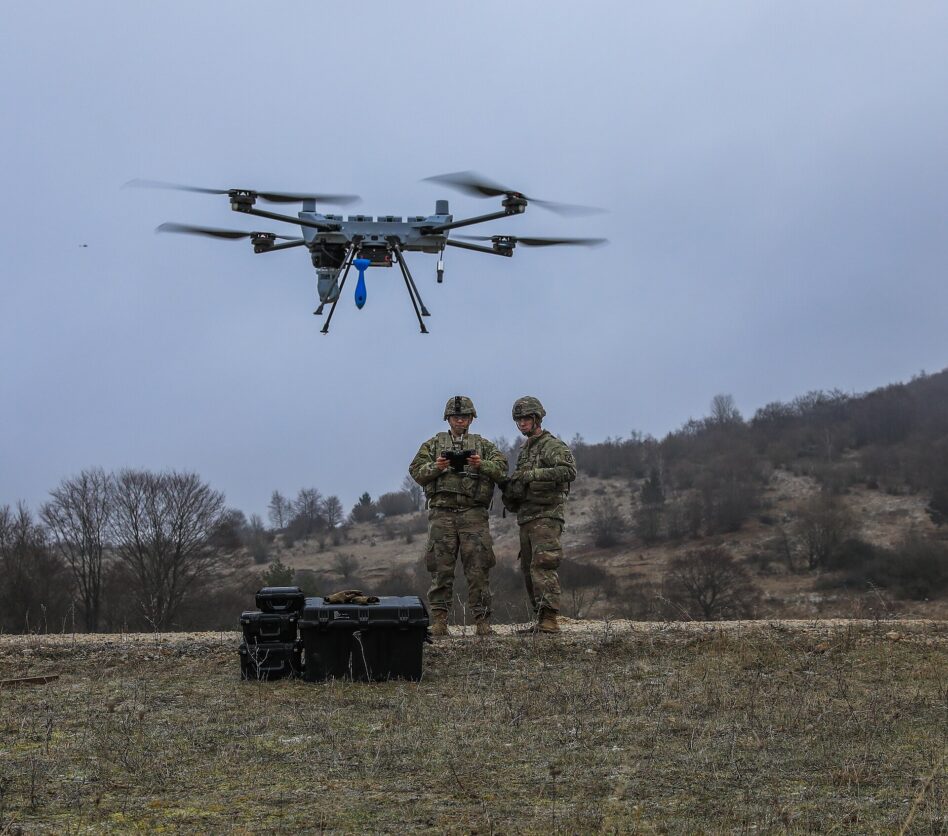
The dudes and dudettes over at Performance Drone Works (PDW) certainly had a lot to celebrate this weekend.
On Friday, the Pentagon’s Office of Strategic Capital (OSC) announced a conditional loan commitment of up to $820M to the Huntsville, AL-based company to “establish high-volume domestic manufacturing capacity for critical drone components.”
- This isn’t cash in hand—it’s more of a very-high-value promise. OSC is basically saying they will dole out all that cash to PDW if the company meets “financial, legal, technical, and other due diligence requirements.”
“The vision is the ability to produce at least a million drones a year within two years,” PDW CEO James Slider told Tectonic. “That means…4 million motors. It means a million flight computers…You’re talking millions and millions of all these different components, which means we need to create scaled production lines of each component, and then scaled final assembly lines for various types of drones.”
Drone dominance, here we come.
Daddy Warbucks: Now, before we get into the nitty-gritty on PDW and their plan for this cash money, let’s talk about the OSC loan program for a second.
- The idea of the whole thing is pretty simple—rather than using pricey VC money to build out the defense-industrial capacity, the Pentagon is betting it can use cheap government financing to do the trick.
- The low-cost loans help companies scale up, which then (hopefully) unlocks private capital and big ol’ contracts.
- And if all goes according to plan, they’ll have, like, a ton of money to play with—the FY2027 budget request includes over $200B for OSC through a combination of discretionary funding and reconciliation, which the Pentagon says could support roughly $200-210B in direct loans assuming an average credit subsidy rate of about 10 percent.
To note: These are the same kinds of loans that have been given to MP Materials, Vulcan Elements, and Phoenix Tailings, among others.
Racing green: As for PDW—they’re a fun one. The company was actually founded in 2018 out of the Drone Racing League (F1 for drones, zoom zoom), then reincorporated as Performance Drone Works in 2020.
They’ve got two main products, both on the Group 1-2 side of things:
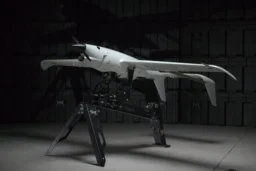
- C100 Heavy-Lift Quadcopter: PDW’s flagship product, a Blue UAS-approved medium-range and modular reconnaissance quadcopter with a 10lb payload and a range of about 6-9 miles.
- AM-FPV (Autonomous Micro FPV Drone): A tiny short-range FPV drone built for ISR and strike. It’s super small, super speedy, and easily packable.
Good on paper: And they’ve proved pretty popular—according to the company, they “support every branch of the U.S. Military as well as federal, local and international public safety entities.”
- They’ve proven particularly popular with the Army—back in 2024, they were selected for the service’s “Company-Level Small UAS” program and have scored three contracts through the Army’s Transformation in Contact (TiC) program. Most recently, they closed a $20.9M deal for the C100 late last year.
- The Army’s also got a Basic Ordering Agreement (BOA) with PDW that runs through 2031. That basically makes ordering their stuff a whole lot easier.
- They’ve also raised a total of $162.37M, most recently a $110M Series B, according to Pitchbook data.
Bits and pieces: But this new mega-loan isn’t focused on the fully assembled drones PDW has become old hat at churning out—it’s about all the components that make them up.
“PDW’s mission has always been putting tactical air power in the hands of operators, and underneath that is a broader mandate to create supply chain security,” Slider said. “You can’t reliably field robotic solutions or drones at scale without securing your underlying supply chain.”
He and his company will spend the next few years building out their 90,000-square-foot facility in Huntsville and (potentially) another factory or two to “create the industrial production mechanisms to produce drone components at scale in the US—that sits across propulsion, vision, control mechanisms, and hardware.”
- The idea is that they become a supplier for the entire drone industry—not just for their UAVs.
- In the next 2-2.5 years, per Slider, they’ll be focused on the “creation of the factories, the development of the component lines, and then the availability of them to the broader ecosystem.”
- They’ll also hire hundreds of people and set up new production lines “all across engineering, production, operations. “
- PDW is also working with partners and suppliers (like rare earths companies and battery producers) to make sure they can stand up an end-to-end domestic supply chain.
“Motors, batteries, and optics are all at risk, and there are great companies doing great work in the US to bring those raw materials and components onshore,” Slider said. “It’s just a matter of linking arms and creating alliances to create verticalized supply.”
“The US doesn’t currently produce drones like our adversaries,” he added. “Our adversaries are producing drones in the millions, and they’re doing it through highly industrialized mass production processes that are vertically integrated.”
Get money: And lest you thought this would be the last of the OSC drone loans (say that five times fast), fear not.
According to reporting by the Wall Street Journal, the Pentagon is looking to make more of these kinds of investments in other drone companies, including Neros and Donald Trump Jr.-linked Unusual Machines.
Sounds like we’re really putting our money where our mouth is, huh?