Well, looks like the whole “doubling down on the unsexy side of defense” thing is paying off.
Yesterday, defense logistics startup Rune Technologies announced that it’s scored a $4.1M contract from the US Army through the Army Applications Laboratory (AAL) to “expand Rune’s TyrOS deployment across the 1st Cavalry Division.”
While the award may seem small-ish (in a world of $99M enterprise agreements), it’s got an interesting twist—the idea of the contract is to “connect logistics demand directly to unmanned aircraft and ground vehicles for autonomous resupply.”
- The award comes on the heels of Rune successfully demonstrating that TyrOS could “[build] a demand picture, [generate] a course of action, and [task] an unmanned aircraft to execute” at Pegasus Charge 3 with 1st Cav.
“A division can have all the unmanned platforms it wants. Without knowing what its units need and when, autonomy only solves half the problem,” David Tuttle, co-founder and CEO of Rune Technologies, said in a statement. “We’ve demonstrated the capability in the field. This effort takes it across every echelon of the division and into daily use.”
Ya know, some days, it really does feel like the future is here, friends.
Picks and shovels: Now, before we jump into logistics (everyone’s favorite topic), let’s chat for a second about Rune.
- The company was founded back in 2024 (by Tuttle and Peter Goldsborough) to create a better, AI-powered solution that could replace all of the pen-and-paper, whiteboards, and Excel spreadsheets that have long dominated the less-than-sexy world of military logistics. (Their words, not ours.)
- The solution they came up with is called TyrOS—a software platform that uses predictive AI and tons of data to track and optimize the movement of gear, fuel, food, medical equipment, and parts across theaters and domains.
- The idea is pretty simple—the company wants to help operators and planners better understand where supplies are needed and get them there faster. After all, a couple of hours makes a huge difference on the frontline.
- And the services (and investors) seem to like it. The company has a five-year, $99M contract with the Army for the software, and has raised about $30M (most recently a $24M Series A).
- They’ve also worked with the Air Force, the Marines, and on NGC2 (on both teams—sneaky).
No hands: But knowing where something is needed only gets you so far—there’s also the whole issue of how to get it there. That’s where—at least according to Rune—drones come in.
- We actually first covered Rune’s push into unmanned delivery a few weeks back when it teamed up with Havoc. They inked a deal with the autonomy to build TyrOS onto Havoc’s UAVs “to deliver autonomous sustainment solutions built specifically for contested and denied environments.”
- Funnily enough, that team-up happened after the two companies demo’d for 1st Cav.
Scale up: Now, this contract takes that same concept and applies it across the division.
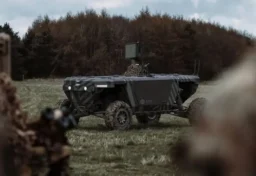
- TyrOS will be integrated onto unmanned vehicles across the force based on demand, and regardless of manufacturer. For now, they’re focusing on “unmanned aircraft and ground vehicles.”
- They will also “integrate vehicle and equipment data to improve maintenance and aviation readiness, and digitize preventive maintenance checks and services (PMCS).” In other words, the vehicles won’t just be for transport of supplies, but will also be built into TyrOS readiness and logistics software.
- In particular, Rune says this will “advance mission autonomy and automated casualty evacuation by connecting battlefield demand, patient status, treatment capacity, evacuation routes, and available manned and unmanned platforms to plan and execute casualty movement across multiple levels of care.”
“When you look at Ukraine today, the vast majority of tactical resupply is happening via automated or autonomous systems. I think that is the future,” Tuttle told Tectonic when they announced the Havoc partnership. “Even if we can take out one C-130 from having to do intra-theater transport…it frees them up to do other [more valuable] things…It’s about efficient asset allocation [and] efficient manpower allocation.”