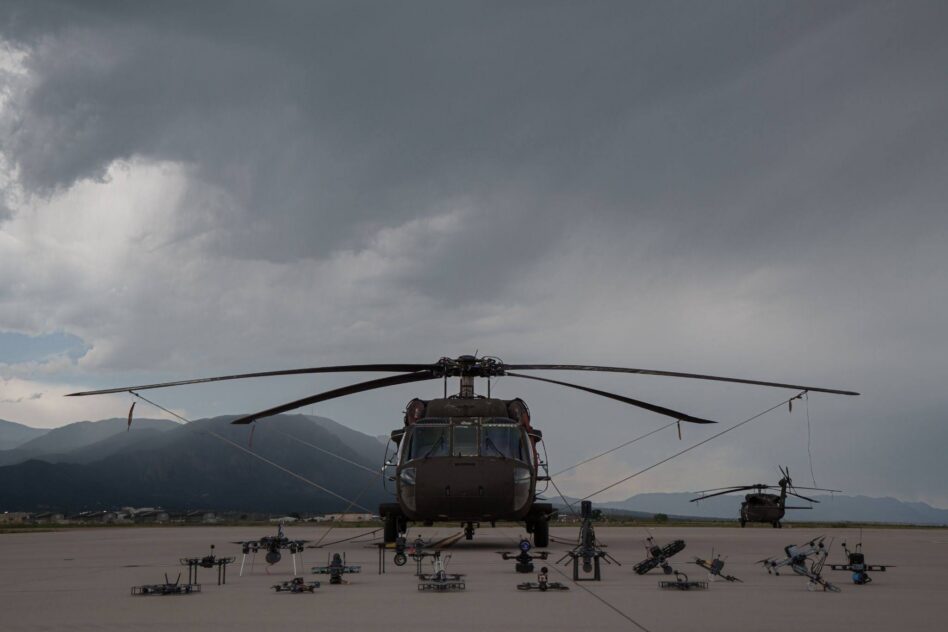
The Drone Dominance Program’s Gauntlet 2 competition is in the rearview mirror, but for the winners, the orders are just starting to ramp up.
Yesterday, Michigan-based drone startup Swarm Defense announced that it received a 4,000-drone order with a “minimum value of $25 million, including munitions,” after placing fifth in the Deep Strike evaluation in the second round of the Pentagon’s signature $1B drone testing and procurement initiative.
Drone dollars: They aren’t the only ones. The DDP plans to order 60,000 small FPV drones from the top five companies in each Gauntlet 2 category. That includes a whopping 14,000 from Neros, which placed third in the Deep Strike category and first in the Close Quarters Battle one, and at least 5,000 from UK-Ukrainian Skycutter, which placed fourth in Deep Strike, execs from both companies told Tectonic. Those quantities have not been previously reported.
- Utah-based Vector snagged a 5,000-drone order, and other top performers in Gauntlet 2—XTEND, Perennial Autonomy (the Deep Strike category winner), Hyperscale, ModalAI, and the US arm of Croatia’s Orqa FPV—are also set to ink big deals.
- The total values for most of those orders are still pending contract negotiations, but based on the roughly $5,000-per-drone unit price (which will drop to $2,300 by the end of the program), those drone dollars get pretty serious. Neros’ Gauntlet 2 order alone could hit $70M, adding to the 4,400 (~$22M) it delivered for Gauntlet 1.
- Ultimately, the DDP says it’ll place orders for 150,000 small-UAS from the top five companies at the end of the four-stage competition, bringing the total number of drones procured and distributed to combat units to 340,000.
“Gauntlet 2 was the Drone Dominance Program’s most demanding test to date. Operators pushed participants to their limits, flying 1,858 sorties across 23 platforms from 19 companies,” the DIU, which is running the competition, said in a post on X. “Vendors rose to the challenge with improved capabilities. Each of the 11 platforms evaluated at long distance made it to 15 km. (In Gauntlet 1, only 24 percent% of drones managed to reach 10 km).”
- The competition, held at Fort Carson, CO, tested whether drones could find, track, and strike (AKA find-fix-finish) targets in realistic combat conditions, including GPS- and comms-denied environments.
- There were two tracks—long-range strike (defined as up to 20 km, which is a tad short for long-range, but whatever) and tactical assault/CQB (urban/confined environments).
- The next stage, Gauntlet 2.5, focuses on “reusable bomber/dropper platforms,” according to the DDP, which’ll “award approximately $32M in initial prototype orders with additional orders planned in subsequent DDP phases.”
Redemption: Like any competition, not everyone will be a winner (sad, we know), but companies that don’t get selected in each gauntlet are still able to compete for successive ones. For Swarm Defense, which spun out of “the largest American light-show drone manufacturer,” Firefly Drone Shows, Gauntlet 2 was a shot at redemption after it didn’t make the cut in the first round.
“The Drone Dominance Program has placed its confidence in both our aircraft and our ability to deliver them at scale,” Swarm CEO Kyle Dorosz said. “Our engineers and production team earned this opportunity through constant testing and improvement, and I’m proud of what they’ve accomplished.”
“We appreciate the program’s trust,” he added. “Our focus now is on delivering for the service members who will rely on these systems.”
Training day: Companies—especially Neros, which was first to deliver on its 2,000-drone order after the first round, earning it a 2,000-drone bonus order—have proved that they can ramp up manufacturing and deliveries through the demanding program. But for America to really “unleash drone dominance,” as Secretary Hegseth called for when he announced the program, it comes down to the operators flying ‘em.
“We’re in the process of receiving another 30,000 drones currently,” the director of the DDP for the Army, Col. Gregory Merkl, told reporters last week. “That is absolutely enough to get them down to every squad level.”
“Where we still have some work to do, candidly, is getting everybody trained at the appropriate level,” he added. “I think if you look across the force, you have that capability in every platoon. We still have a little bit of work to do in terms of getting the qualified pilots down to the squad level.”
Wonder where they might find people with a lot of drone-flying experience to help ’em out on that front.