Maybe the AI bubble isn’t popping just yet—at least not here in defense tech land.
This morning, AI-for-national-security startup Smack Technologies announced that it’s raised a $61M Series B led by Costanoa Ventures and First In.
- Point72 Ventures, Geodesic Capital, Nomi Capital, Felicis, Scribble Ventures, Fortitude Ventures, Bloomberg Beta, and Palumni VC also participated in the round.
- Total funding now stands at over $90M.
The company says it will use the money to “build the proprietary hardware necessary to deploy Alpha, its tactical AI platform, directly to the edge” and “expand their Decision Dominance platforms across the Joint Force.”
In real-people terms? They’re going to build hardware that operators can wear and use to run the company’s AI even in the most out-there environments where comms are, erm, limited.
- They’ll also build out and mature all of their models, including Omega (which works more at the command level).
“Our focus has been [on] building that type of small, domain-specific model…that will work in compute-constrained environments at the edge, where you have limited cloud connectivity, limited compute,” CEO and co-founder Andy Markoff told reporters, including Tectonic.
“What these funds enable us to do is rapidly expand the scope of our models across both warfighting functions and domains, and deploy it across the Joint Force quickly…[and] build the hardware required to deploy our models to the tactical edge,” he added.
Father, son, holy spirit: Smack has been going pretty biblical on the whole AI-for-the-edge thing since it was founded back in 2024 by Markoff and Clint Alanis (COO)—both former MARSOC operators. (Alpha and omega, get it?)
The company’s tech basically does the whole LLM-AI thing (and the orchestration thing) but specifically for national security and warfighting.
“While large language models are a great tool and they absolutely have a place in military operations, they’re very limited in the scope of the military problems that they can solve,” Markoff said. “The lesson you’re trying to learn is the relationship [between] munitions, effectors, sensors, platforms, both on the friendly and adversary side in time and space, and then the signatures that those platforms would be emitting in time and space.”
“The only way to really build that training dataset is through an environment that encodes both the physics of modern warfare along with human domain expertise that lives in domain experts’ heads,” he added.
So far, they’ve got two main products:
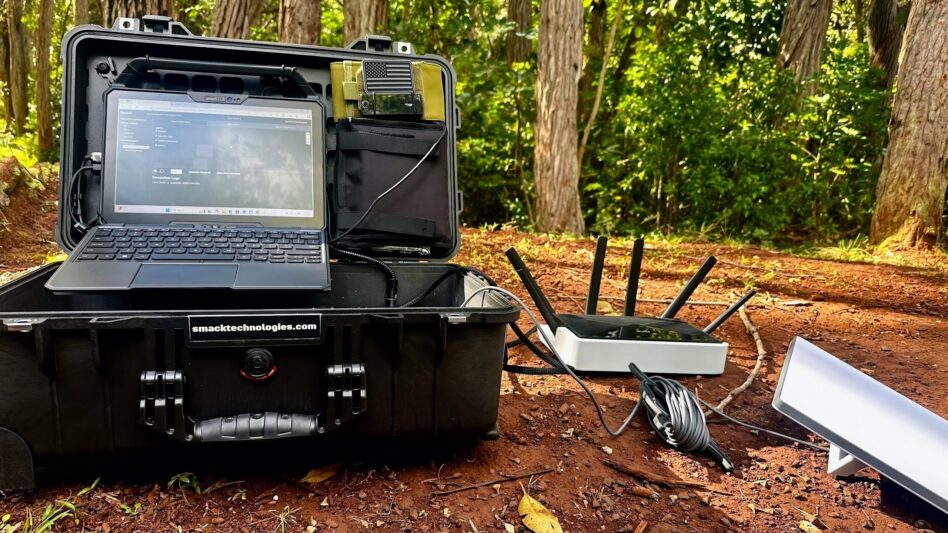
- Omega: Smack’s command-level AI stack that combines multimodal data fusion, analysis, and reasoning to speed up the Orient and Decide stages of the Observe, Orient, Decide, Act (OODA) Loop, according to Markoff. It’s built to run on desktops in operations centers.
- Alpha: The company’s edge-level AI model designed to run on tablets and edge devices to offer immediate decision-making support in the field. A lot of the focus of this round is on Alpha—and building a body-worn tablet that Alpha can run on.
Everything the company produces is “purpose-built to reason through the physics, resource constraints, and operational complexity of warfare.” That’s how they give operators what they call “decision dominance” or the ability to “turn information and capabilities into action the fastest,” per the company.
Symphony No. 5: And it seems to be piquing some interest—the company already has prototype agreements with the Navy, the Joint Fires Network, and the Marine Corps Warfighting Lab, totaling about $7M, per Markoff.
- They also just raised a $32M seed-slash-Series A back in March. Money moves.
- Markoff said they’re also “in discussions with Pentagon officials about how to rapidly deploy our technology across the entirety of the Joint Force.”
Outfit of the day: The hardware push with this latest round is going to be around two main platforms, Markoff said:
- First, the company is looking at building a payload that can pop onto other vendors’ platforms (like, say, a drone) to provide an “orchestration layer on top of autonomous systems.”
- They’re also looking at wearables. The team wants to build tools so that “soldiers and marines, et cetera, can make decisions off of kit that they can wear on their body,” Markoff said.
“Think of [having] the model and COTS compute that could fit in a radio pouch with a screen that you could display on your forearm,” he added. Sounds pretty nifty.
Brass tacks: Markoff and his team see making AI available even to frontline operators as pretty critical to, like, the future of war.
“We are not going to have mass, especially in the Pacific Theater, for quite some time, and so we have to make the best use of the limited resources we have,” he said. “God forbid that [a conflict in the Pacific] happens. It will be the most decentralized conflict that we’ve ever [had]— most of the decisions that we make today in air-conditioned operations centers are going to need to be made at the front lines before the information ever even makes it to the operations center…so you need these small, domain-specific models that can be deployed [there].”