The crazy kids over at Valinor have rolled out yet another new product, and this time, they’re quite literally saving lives.
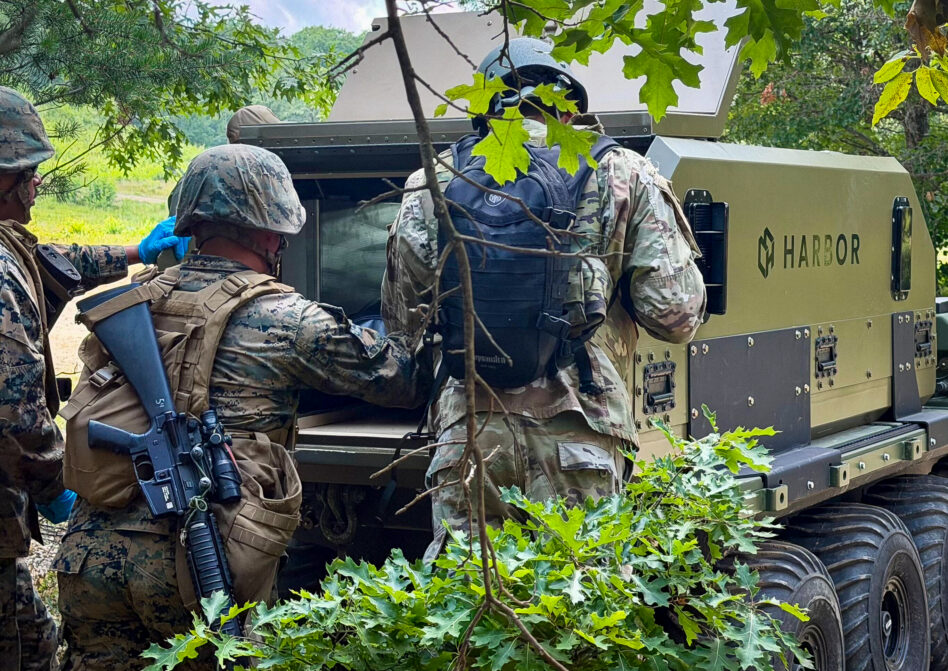
Yesterday, the new-age defense tech holding company unveiled a new product they are calling HarborPOD—a “UXV-agnostic payload built for unmanned CASEVAC and logistics resupply.”
- Basically, it is a high-tech pod that can be put on a USV or UGV and used to bring injured service members out of a combat zone.
- The injured person inside the pod can be hooked up to vital signs monitors, and it has real-time video and audio feeds. That means that as they’re making their way to a medical center, doctors there know what to expect.
- The unmanned nature of it all means casualties can be brought back from closer to the front, and fewer medics’ lives are put at risk.
“With the proliferation of unmanned vehicles and the limited number of medics, especially as we look to the future fight and what things could look like in large-scale combat operations, you’re not going to have medics all over the battlefield,” Valinor Chief Growth Officer Kurt Freshley told Tectonic. “What HarborPod does is give the military the flexibility to turn different platforms into casualty evacuation platforms.”
Hold on: Now, before we dive too deep into Harbor (get it), a bit about Valinor.
- The company was founded by Palantir alum Julie Bush late last year and set out to build an “operational holding company” for the new age of defense.
- So, what exactly does that mean? Basically, the company employs what it calls a “hubs and spokes” model where a central “hub” provides go-to-market, financing, prototyping infrastructure, and legal help to its “spokes,” the subsidiary “product-companies” focused on individual technologies.
And the company has been on a tear for the year-ish since it was set up. They’ve spun out five different product sub-companies, including:
- Dispatch: A mobile small drone charging dock that can be plugged into different military platforms in remote environments.
- Streamline: A secure data capture tool designed for disconnected environments and distributed teams.
- Reflex: A next-generation smart optics system with advanced vision models that “embeds intelligence at the point-of-capture.”
- Condor: A speedy and attritable air- and ground-launched small UAS. The Army’s Europe and Africa component has purchased ten of these for flight testing and evaluation earlier this year.
All in the family: They’ve also got a big daddy Harbor hospital-in-a-box, which is kind of like a big brother to HarborPOD.
- Harbor (the parent product) is a containerized and modernized field hospital in a shipping container.
- It comes in two variants: a Critical Care Unit (CCU) for intensive treatment and an Acute Care Unit (ACU) to monitor up to 12 patients.
- Earlier this year, Valinor scored a contract with the Marine Corps for Harbor.
Mini-me: Think of HarborPOD as the conduit from the battlefield to a full-scale Harbor (or any other medical treatment center, for that matter). Here’s how it works:
- Freshley described it as “a small containerized solution that can hold one patient on a litter and can be mounted to unmanned ground vehicles, unmanned surface vessels, and in the future, unmanned aerial vehicles.”
- Each POD contains wireless vital-sign monitoring, two-way audio and video, patient tracking and status updates, class VIII forecasting and logistics support, and interoperability with different C2s and partner platforms, per the company.
- The container is hardened against blasts and gunshots, and is also climate-controlled for the patient inside.
- Each pod can carry one servicemember with full kit—Freshley said that payload capacity is well over 300 lbs.
- He also said that there are multiple points of entry and that the setup is designed to be super intuitive—that means that pretty much anyone on the battlefield can load someone into the pod, hook them up to the vitals monitors, and send them on their way.
“It’s really just like putting a patient in the back of your car,” he said. “The technology is all set up to not require any configuration.”
And it’s not, like, prohibitively expensive—Freshley said that the pods are designed to be about $150K a piece, including software and hardware.
Feed it back: The pod has already been tested with the Marine Corps, and Freshley said they’re in conversation with “the Army, Navy, and, obviously, the Marine Corps.”
- HarborPOD was used at an exercise called Northern Strike in Michigan, and is now at T-REX in North Dakota.
- Freshley said that users said it was super useful to be able to monitor casualties en route, appreciated that they had thought of things like climate control for the patient, and that medics said that a lot of lives could have been saved had they had something like this earlier.
“This really demonstrates how the future fight can be unmanned and how we can proliferate the battlefield with more of these robots while also taking into account the humans that will be out there,” he said. “There will be humans involved in these wars, but there’s going to be a very limited number of the specialty individuals, like medics. This really plans for the scenario where, in a large-scale combat operation, you’re not going to have a bunch of medics out on the battlefield anymore.”
“[They] are going to be back in the rear at specialized echelons of care, and this unlocks those scenarios..where any asset can be turned into a casualty evacuation asset,” he added.