Looks like the operators are going high-tech, y’all.
This morning, peer-to-peer data transfer company Ditto announced in an exclusive release to Tectonic that it scored a $17M APFIT contract with USSOCOM to “[field the] Ditto platform across USSOCOM, enabling real-time data sharing between humans and autonomous systems operating at the tactical edge.”
In real terms? The company’s platform makes sure that all the devices and robots you’ve got deployed in comms-denied, edgy environments can talk to each other—even without signal. And now it’s scaling all the way up across SOCOM.
Order up: Now, Ditto actually didn’t start out as a defense company. The company was founded back in 2021 to address a commercial problem—making sure devices could communicate (like in restaurants, airlines, retail, and hospitality) even without reliable connectivity.
“What we do is we enable edge devices—whether that’s a mobile device or a robotic system—to communicate with other devices using peer-to-peer transport networks versus transferring data through the cloud,” Founder and CEO Adam Fish told Tectonic.
The company quickly realized that that’s super applicable to defense.
- If there’s one thing you’ve learned from Tectonic over the past few years, we hope it’s this: All those fun shiny pieces of kit y’all are building are pretty useless if they can’t communicate with each other (or operators) when they’re jammed.
- There are a few ways to get around this rather thorny comms problem, including building mesh networks that let devices talk directly to each other instead of relying on a central server or cloud connection.
Bawk bawk: That’s where Ditto comes in. Its software lets devices find each other, exchange data locally, and sync that data across the network—even when individual devices are dropping in and out of connectivity. That’s just as useful on the frontline as it is in a Chick-fil-A with crappy wifi. (Yes, that is one of the company’s clients.)
- In practice, that means data can hop from device to device until it gets where it needs to go, rather than every device needing its own reliable connection back to the cloud.
- When connectivity returns, Ditto automatically reconciles and syncs the data across the network.
Fish compared it to AirDrop on an iPhone—but supercharged.
“Most people have tried [AirDrop] or done the bump thing to share your contact,” he said. “That is like a consumer experience of what Ditto provides, where you’re transferring data from one device to the other, just standing next to each other.”
Going green: And the company has raised a pretty serious amount of cash to make this all work.
- They kicked things off with a $9M seed in 2021, then a $45M Series A in 2023, led by Acrew Capital, with participation from USIT, True Ventures and Amity Ventures.
- In March 2025, Ditto raised an $82M Series B led by Acrew and Top Tier Capital Partners, alongside Thomas Tull’s US Innovative Technology Fund (among others). That round valued the company at a cool $462M.
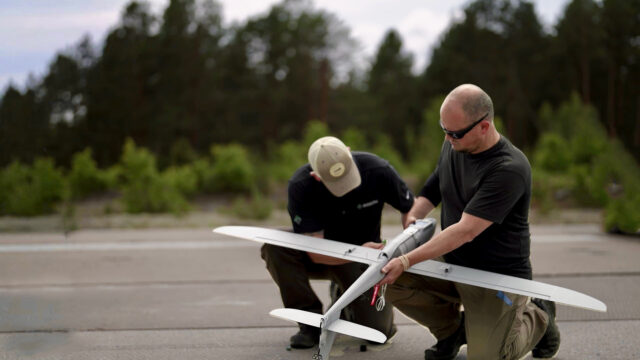
With SOCOM, Ditto’s work will be a lot less “connecting POS systems” and a lot more “making sure drones and comms systems and sensors stay linked even when connectivity goes down.”
“We saw that [our tech] had clear applicability to the hardest environments where the military operates, where they’re contending not with just things failing, but actually an adversary trying to break your systems,” Fish said. “Enabling military devices at the edge to talk to each other can be the difference between life and death.”
They’ve already been working with “tier one elements” of SOCOM (especially USASOC) for “several years,” per Fish, but this contract scales that work across the organization.
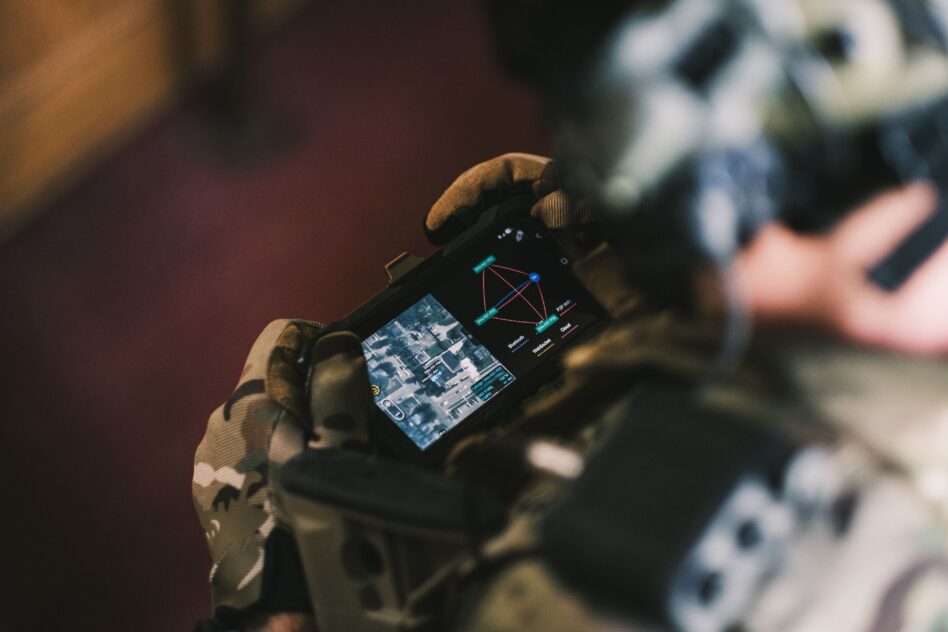
- They started from “the bottom up,” he said, building Ditto as a plugin for ATAK.
- Users were then able to “magically” connect their devices (Fish’s terminology), and demand across the organization grew.
“[This capability] is huge because the last thing a soldier wants to be thinking about in a high-stress situation is, like, did I plug in my Ethernet cable?” Fish said. “This [APFIT] is enabling them to now just outfit all the elements of SOCOM and broaden it into more devices, especially drones and robotic systems as well.”
Fish added that Ditto’s software can actually improve comms on the frontline—not just maintain them.
“The typical way data or information is transferred on the battlefield is through voice communication…and there’s a lot of potential loss with that,” he said. “And as anyone who’s played the game of telephone knows, things change [and degrade] as more humans are in the loop.”
“Ditto devices just kept all that data in sync reliably, especially in an environment where it was, you know, adversarial,” he added.
Big ups: From here, as per, the name of the game is scale—on both the defense and commercial sides of the Ditto house.
“Special forces are involved in everything going on right now,” Fish said. “From a technology point of view, they set the tempo and adopt the newest stuff. We are already seeing how this is going to translate into not only a broader adoption through the conventional forces in the U.S. but also allied nations as well.”
Tip of the spear, and all that.