The defense tech unicorn club just got its newest member.
On Friday, Austin-based counter-drone startup Allen Control Systems announced a $200M Series B led by Smash Capital at a whopping $2.2B post-money valuation—a massive jump from its $170M Series A valuation last year.
- ACS raised a $30M Series A last March, and its existing backers, including Craft Ventures, Rally Ventures, and Inspired Capital, doubled down in the latest round.
The drone-downing dollars really do just keep on coming.
Ribbit ribbit: A whole lot of companies have come up with a whole lot of creative ways to take down hostile drones, but Allen Control Systems—founded in 2022 by Mike Wior, Steve Simoni, and Luke Allen—thinks shooting them down is the most effective (and cheapest) solution.
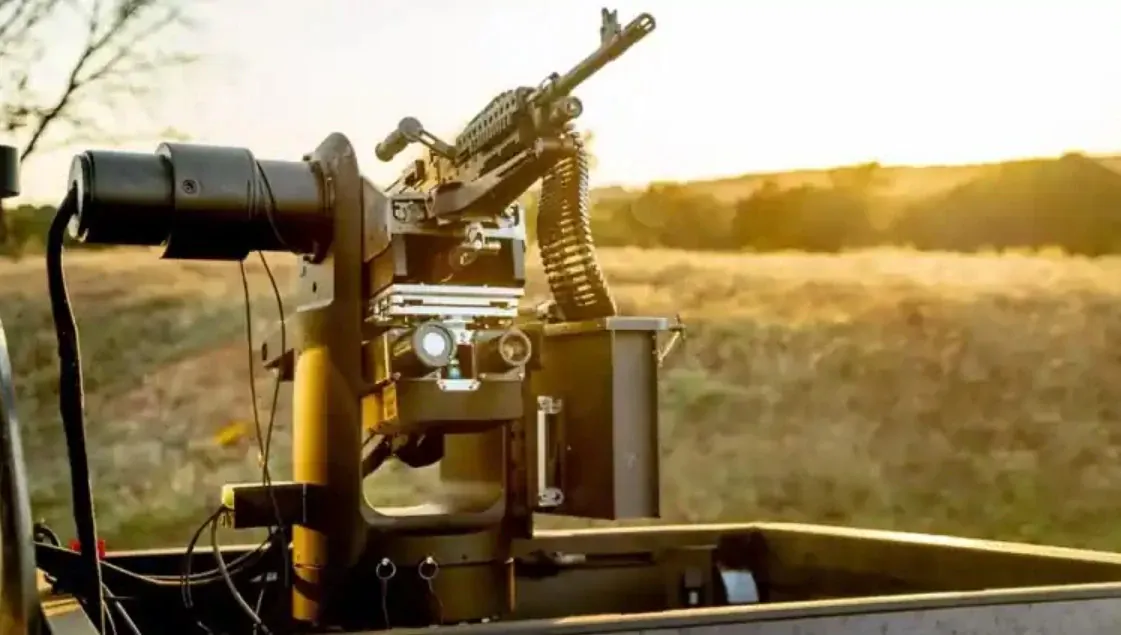
The company’s flagship product is the Bullfrog, an AI-powered robotic machine gun turret that can be fitted on trucks, boats, or fixed sites to target and destroy enemy drones.
- The weapon uses AI and computer vision to identify and track targets, then the robotic turret swings the gun around and fires. ACS says Bullfrog can take down UAS ranging from small quadcopters to Group 3 drones.
- “If [Bullfrog] can shoot a seven-inch, fast-maneuvering drone, we can absolutely target critical components on a larger drone,” ACS CEO Mike Wior told Tectonic, and it has “demonstrated success taking down Group 3 drones.”
- The system is fairly cheap on the cost-per-kill front because it uses standard-issue bullets and an M240 machine gun rather than rockets or missiles, and can be deployed on a range of vehicles. They teamed up with Red Cat’s maritime division, Blue Ops, to put Bullfrog on a USV in March.
Pow pow: That’s proven pretty popular. ACS has won over $120M in contracts with both US and foreign customers for Bullfrog, and the main goal with the raise is to boost production to keep up with skyrocketing demand for inexpensive drone-downing tech.
- They’ve secured contracts for Bullfrog with USSOCOM, Navy, Army, and allied militaries, including the UAE and South Korea.
- The Bullfrog platform itself has been a winner, but their secret sauce is the gimbal, which Wior said the US military has taken a strong interest in because of “its ability to kind of wield any kind of different effector or sensor autonomously” for “much more than just counter-UAS” use cases.
- “As we start looking at broader investments in unmanned systems, Bullfrog is being looked at as the replacement of the soldier that would normally be on the vehicle,” he added.
“The war has accelerated our speed to market, and we are accelerating how quickly we’re releasing Bullfrog and shipping it overseas,” Wior said. “We needed to get some money together to get the supply chain flywheel spinning and start pumping these things out.”
- He couldn’t comment on ACS’ production numbers, but said that they’re “looking to release thousands of these in the next 12 months.”
- They’re opening a 300,000-square-foot factory in Austin and expanding their facility in Alabama as well.
Hot commodity: When ACS gets that production flywheel spinning, they’ll have customers eagerly waiting. They’re seeing a ton of demand from foreign customers, particularly in the Middle East, and have signed “several contracts in the last 30 to 60 days” to deploy it overseas, including one through the Pentagon’s JIATF-401 counter-drone task force, Wior said.
“We’re thrilled with the engagement that we’ve been getting from the US government, and we’ve had a couple of industry studies that were done on behalf of the military that ranked us head-and-shoulders above the other counter-UAS options out there,” he added. “We’re the only ones that are doing it the way we’re doing it, so it’s a perfect crossroads of tailwinds for us right now.”