You know what sucks? When you’re trying to run an inference model at the edge, and your targeting or planning software completely craps out because, well, you simply don’t have the compute.
Happens to the best of us. But luckily, Armada is back with yet another solution for the rather pesky problem of AI and large-scale compute at the edge.
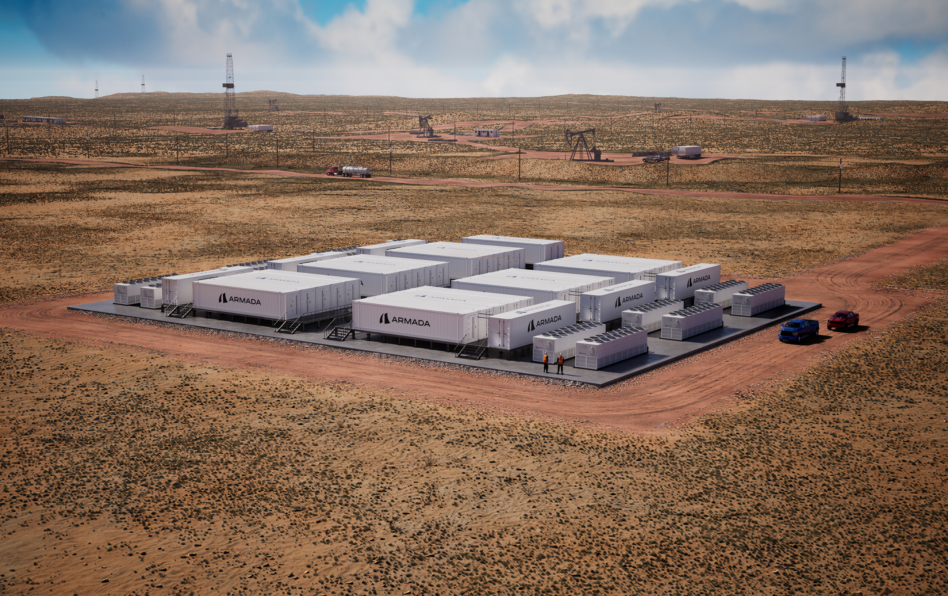
This morning, the San Francisco-based company unveiled the latest (and greatest, capacity-wise) of its Galleon data-centers-at-the-edge—Orion, a “modular data center” that packs up to 10 megawatts of power.
“Orion is our largest and most powerful Galleon yet,” CEO and co-founder Dan Wright told Tectonic. “It really supports this big AI build-out that’s happening, and the need to have more substantial compute in different locations around the world.”
Everything is computer: Armada has been a mainstay in the defense-slash-deep tech ecosystem for donkey’s years—at least in defense tech terms. The company was founded in 2022 by Wright and Jon Runyan and set out to bring AI and compute to the furthest-out-there environments, including war zones.
The solution they landed on is a family of data-centers-in-a-box called Galleon, which range from suitcase-sized to (now) mini-data-center-sized. Here’s what they’ve got on offer:
- Beacon: A briefcase-sized unit.
- Cruiser: A 20-foot container with “3 racks of compute,” designed to be “compact [and] agile,” designed for environments where space is an issue and able to be transported “in the back of a C-17 or a C-130,” per the company.
- Triton: A 40-foot container containing “5 racks of compute.”
- Leviathan: A “megawatt-scale” Galleon variant, made up of two 45-foot containers (one for compute and one for power distribution) and a 20-foot container for cooling.
And as with most things data center and compute these days, they’ve raised a heck ton of money: They’ve pulled in over $455M in funding, most recently a $230M Series B at a $2B pre-money valuation. Cha-ching.
Hubba hubba: Orion is basically a 10X level up from Leviathan, and (unlike most of the company’s other offerings) is not in a shipping container or Pelican case. Instead, it’s a pre-built data center customers can set up within existing structures (like, say, a production facility or a forward operating base) or put in its own standalone structure. Here’s what we know about it:
- Each unit has 10MW of capacity with the ability to “scale rapidly to hundreds of megawatts across distributed sites,” according to the company.
- Each unit “packs compute, networking, power, and cooling into a prefabricated six-module core, supporting up to 2,880 GPUs across 40 racks with the ability to achieve greater than N+1 redundancy,” per Armada.
- The units are compatible with Nvidia Blackwell (the company’s mega-powerful data center-level chip) “with a Vera Rubin-ready architecture.”
- An Orion can be delivered within months of deposit, which is a heck of a lot better than the lead time on some other data centers out there.
Land of the giants: So, why build something of this scale?
“Over the course of the last few years, we’ve deployed our Galleons all over the world,” Wright said. “But most of those use cases have been focused on inference, taking models that have been trained in the cloud and running them.”
Orion lets you do all the nitty-gritty model building and training itself outside of the cloud. “[It] allows us to support, in addition to inference, fine-tuning of models to proprietary datasets in a way that preserves sovereignty, but allows companies and states and organizations to scale AI, you know, significantly,” he added.
Reinvent the wheel: If the other Galleons are kind of like AI “spokes” that can bring compute out to super-edgy locations, Wright said Orion is like the easily-deployed “hub” they can all connect to.
“What a lot of our customers want is…. To use some of our smaller form factors for inference, just like we’ve been doing, but they also want a larger hub or maybe hubs in different locations around the world,” Wright said. “And because [Orion] is part of a unified platform, we handle all the orchestration to make that possible, and just make it as easy as using the cloud, but at the edge.”