You know the interceptor game is heating up when everyone’s favorite defense tech giant enters the ring.
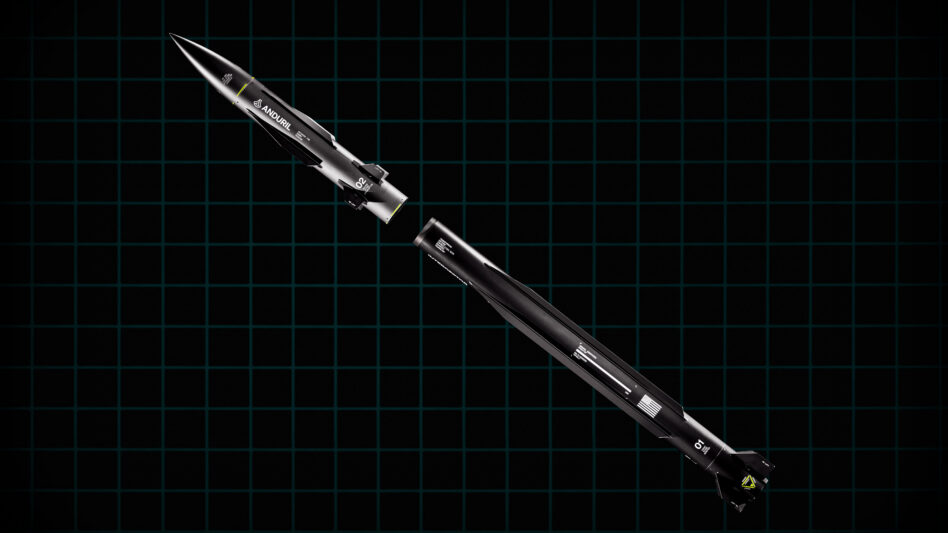
Yesterday—to kick off AUSA—Anduril announced a new “family of highly-configurable, mass-producible surface-to-air interceptor missiles” called Steelfin, designed to counter a whole range of aerial threats (all the way up to cruise, ballistic, and hypersonic missiles).
- The idea is that Steelfin is way faster to produce and lower-cost than traditional systems (like the PAC-3). That’s good news when, like, we’re pretty much out of the expensive ones.
- The secret sauce, per Anduril, is a “common two-stage architecture” that allows the company to “configure interceptor performance for different missions while repurposing many of the same components, production processes, and architecture.”
“We’re watching every single day as the U.S. military [and] allied militaries are struggling against [adversaries] that have made significant investments in a very large volume of offensive capabilities…and our military and our allies’ militaries are struggling with a set of legacy interceptors that are not scalable and are not able to match the volume of the threat that they’re facing,” Anduril President & Chief Strategy Officer Chris Brose told reporters, including Tectonic.
“Steelfin is an open and modular defensive…two-stage interceptor that provides maximum optionality to go against [that] range of different threats,” he added.
Low in stock: Now, we don’t need to tell you that, especially since the beginning of Operation Epic Fury, the US and its allies have a bit of an interceptor problem.
- Traditionally, the Pentagon (and allied militaries) have relied on ultra-exquisite systems like Patriots and THAADs to take down aerial threats. These systems (and the interceptors they use) are quite good at what they do—but they’re also really, really pricey, and there is a massive production backlog on the interceptors themselves.
- It doesn’t help that the US is burning through interceptors at a pretty much unprecedented rate. CSIS estimates that, as of July, US Patriot inventories had fallen below 1,000 interceptors, while THAAD stocks stood at about 250.
- And production can’t really keep up. The US is throwing mega-bucks at the problem (talking ‘bout things like that $35B Lockheed contract to quadruple THAAD capacity) but replenishment—at least per CSIS estimates—will take years.
“[We’re watching] years of production in defensive weapons be expended in weeks and months against the threats that we’re facing in Europe [and the] Middle East,” Brose said.
Bargain hunting: The thesis underpinning things like Steelfin—and, tbh, low-cost interceptor programs across the Pentagon—is that there needs to be a quicker-to-produce, less-tragic-to-deploy-and-use-at-scale interceptor. After all, sucks to use a $4M PAC-3 on a $30K Shahed or Geran.
- The Army rolled out the Low Cost Interceptor program this summer, aiming to develop affordable missiles that cost under $250,000 (ideally targeting around $100,000) to counter inexpensive drones and cruise missiles.
- The Navy’s got its Naval Affordable Interceptor program as well as the Navy Modular Missile program, which both prioritize lower-cost, modular systems that can be rolled out quickly and at scale—all while using existing launch infrastructure.
- There’s also the MDA’s low-cost interceptor program, and DIU’s Counter NEXT effort to find lower-cost interceptors for larger threats (Group 3 and above).
Worth noting: Anduril was tapped for Counter NEXT, and this summer was named as a finalist for the Army’s xTech Apex Intercept competition with Steelfin.
Step-by-step: Now, what’s cool about Steelfin is that it’s got a two-stage architecture that not only makes it mission-flexible, but also (at least in theory) a lot easier and cheaper to produce. Here’s how it’s all set up:
- First, there’s the booster. This is the rocket motor bit that gets the missile off the ground and moving toward its target. Anduril can swap in different boosters (including its own SRMs and those from other suppliers) depending on the mission. Anduril Senior Director of Missiles Steve Milano said they’re looking at 10-inch, 18-inch, and 21-inch configurations, as well as smaller ones for containerized launchers.
- Then there’s the interceptor itself. This is the bit that separates from the booster and actually takes down the incoming threat. It uses a common airframe, electronics, and flight-control system across different Steelfin variants, but the company can swap out seekers, avionics, control sections, and kill mechanisms depending on what’s needed.
“[That means that] when the threat evolves, we’re not completely redesigning the system,” Milano said.
- Steelfin is designed to launch from existing systems, including Patriot’s M903A2 launcher, the Navy’s Mk 41 VLS, the Army’s Typhon system, and containerized launchers.
- It’s also designed to integrate with existing fire-control systems, including Aegis and the Army’s IBCS.
Worth noting: Lockheed also unveiled a more flexible, lower-cost variant of the PAC-3 (called the PAC-3 Edge) at AUSA this week.
All in the family: While Anduril didn’t get too far into exact specs of each Steelfin variant, the company did give reporters a sense of capability range.
- At the high end, Anduril will have a more exquisite Steelfin it says will sit above the Patriot PAC-3 in capability, but below THAAD. Milano said this flavor of Steelfin would be able to complete 100 percent of a PAC-3/THAAD mission at “a fraction of the cost).
- In the middle, they’re pitching a Steelfin designed for PAC-3-type missions, and Anduril says it will have 80 percent of the capability at less than half the cost.
- Finally, they say they’ll have a cheaper variant aimed at missions currently handled by missiles like the Navy’s SM-2.
Bargain basement: Now, this ain’t cheap-cheap—most of these estimates still put Steelfin at about $1M or so. Milano said that for the range of threats the system is designed to counter, it’s unlikely to get cheaper than that.
“You’re designing something that needs to be able to engage a Shahed, but also a ballistic missile and a hypersonic glide body that’s potentially non-maneuvering,” he added. “This weapon system gives you a lot more flexibility, but comes with certain cost parameters driven by the capability.”
Brose said Anduril is already “on contract with multiple different customers to work on [Steelfin and] to develop and compete for programs.”
- The company plans to start flight testing different Steelfin variants in 2027.
- They will produce most of these systems out of the company’s Arsenal One mega-factory in Ohio, aiming for full-rate production towards the end of 2028 (or early 2029), Milano said.
Let the Lockheed-Anduril race begin.