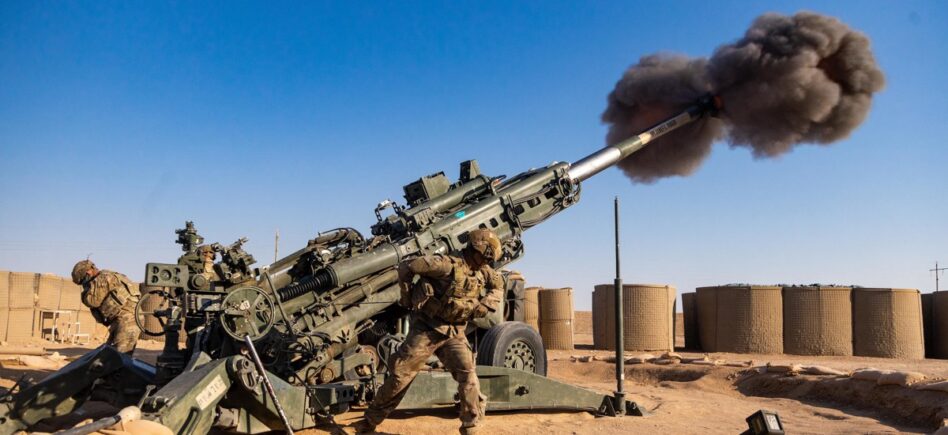
The 155mm shell has been a staple in the US military’s artillery arsenal since World War I, but America has had a bit of a hard time, to put it lightly, ramping up production of the over-century-old munition to keep up with booming demand from US and allied customers.
Firehawk is on a mission to turn that around with some new-age additive manufacturing, and the Army is taking notice.
The energetics and rocket motor-maker (and newly minted unicorn) secured a $14.5M firm-fixed-price contract from the Army Applications Laboratory (AAL) to “further develop” its base-bleed propulsion technology—a device at the back of an artillery shell that boosts the range by up to 35 percent—for 155mm shells, the company announced today.
- The award follows a slew of contracts the Dallas-based startup has won for 155mm artillery base bleeds, including a $24M deal with the Pentagon’s Industrial Base Analysis and Sustainment (IBAS) program in August.
Looks like Firehawk isn’t resting on its laurels after raising a $150M Series D at a $1.4B valuation.
Boom fuel: Firehawk is a familiar name in these parts, but as a quick refresher, the company—founded in 2019—has cut the months-long traditional cast-and-cure propellant production cycles down to mere minutes through a thermoplastic-based manufacturing process using 3D printing and super-fast curing.
- That’s earned them contracts to build solid rocket motors (SRMs) for and assemble Hydra-70 rockets, precision-guided Guided Multiple Launch Rocket Systems (GMLRS), and develop propulsion systems for larger boom-and-zoom platforms with the Army, AFRL, and other customers.
- It’s also secured them partnerships with the biggest of the big dogs in the artillery game, including General Dynamics Ordnance and Tactical Systems (GDOTS), Hanwha, and Czech defense giant CSG.
- The latter two are also Firehawk investors, while GDOTS—the largest producer of 155mm artillery in the country, despite some very public setbacks on that front—is the end customer for much of the propellant Firehawk produces.
Under the $14.5M AAL contract, Firehawk will mature the base-bleed propellant and conduct a “propellant-grain manufacturing trial and trade study” for next-generation rocket-assisted projectiles (NG RAP). The aim is to validate the thermoplastic formulations and their performance in “extreme environments of artillery launch,” and to move the artillery motors toward full qualification.
And for all those saying cheap drones have made old-school artillery obsolete on the modern battlefield, Firehawk’s pipeline—and militaries currently fighting land wars, especially Ukraine—would like a word.
CEO Will Edwards told Tectonic that the company will “do over nine figures [in revenue] next year,” and they’re building out a production facility that they say will make it the largest producer of artillery motors in the US once it’s fully up and running in late 2027, with an expected annual output of 3M pounds of propellant.
“We started Firehawk to fundamentally change how energetics are produced in the United States,” Edwards said. “We’re focused on the layer that powers the arsenal and optimizing how that layer is made for a world that needs far more of it.”