How was your summer? Probably not as good as Seasats’.
In the past month, the Navy and Marine Corps placed over $24M in orders for the San Diego-based startup’s small but seaworthy Lightfish unmanned surface vessels, Seasats revealed exclusively to Tectonic—and that’s “committed funding,” not “ceiling values.”
As we said, they’re having a pretty good summer out on the water.
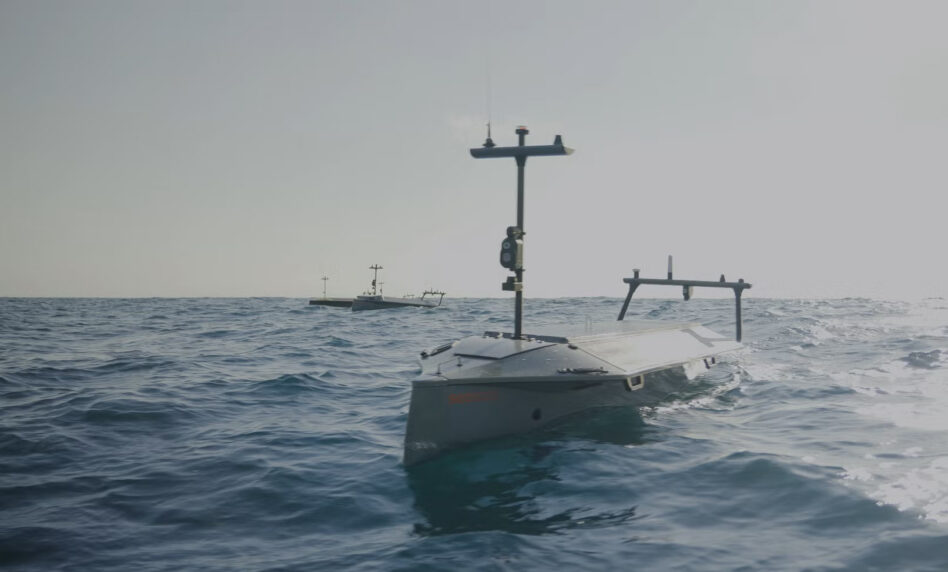
Making a splash: We’ve covered Seasats before, but as a refresher, the startup has made quite a splash in the increasingly competitive unmanned surface vessel space, especially with their ever-popular Lightfish.
The USV has developed quite the habit of running into Chinese warships—like, we’re losing count of how many times it’s happened—on its voyages through the Pacific Ocean, and it looks like the Navy’s taken quite a liking to what they’re bringing to the table.
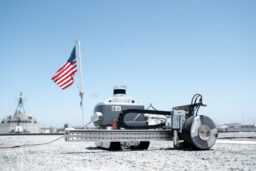
- The 11-foot-long, 3-foot-wide lightweight Lightfish—small enough to be launched and recovered by two people from a boat ramp or the back of a pickup truck—is designed primarily for maritime ISR and sensing.
- Despite its small size and low cost (around $250,000), the solar- and backup-generator-powered USV can be at sea for up to six months in Sea State 6+.
- Those aren’t PowerPoint numbers: It’s completed some serious long-distance journeys, including a 7,500-mile+ trans-Pacific voyage last year (snapping an up-close and personal pic of a Chinese destroyer near Guam along the way) and the first autonomous transit of the Taiwan Strait in July, during which it filmed yet another Chinese destroyer operating in the Philippines’ exclusive economic zone.
Seasats also has a larger, speedier USV called the Quickfish, and an even bigger one, the Heavyfish, in development.
Fishy business: All that Chinese warship-spotting and globetrotting has translated into some serious traction with the Navy.
- Last October, the company was awarded an $89M-ceiling IDIQ from the Navy to deliver the Lightfish to the Marine Corps.
- They followed that up in January with a joint $24M contract with the Navy and Marines under the APFIT program to speed up production.
And it looks like that traction is just starting to pick up.
Across Seasats’ $24M past month, they inked “nine significant orders” from the Navy, the Marines, and other US military customers, a portion of which “were granted under our $89M Phase III SBIR IDIQ,” Seasats CEO Mike Flanigan told Tectonic.
- Using some back-of-the-napkin math, that translates to roughly 100 USVs ordered in August.
- Maritime domain awareness and ISR are “the predominant use cases in this tranche of orders,” but Flanigan couldn’t comment on specific customers or where the Lightfish are being deployed.
- Not too shabby for a company that’s raised a (relatively, these days) modest $40M in venture capital funding, including a $20M Series A earlier this year.
“This isn’t funding to explore the use of autonomous systems years from now. These are customers putting real dollars behind capability they can deploy today,” Flanigan said. “We’re seeing demand grow across the US government because small, long-endurance USVs solve an increasingly relevant problem: how do we maintain persistent awareness at sea, at scale, and at range.”
In case it’s unclear, there are plenty of fish in the sea because Seasats keeps putting them there.