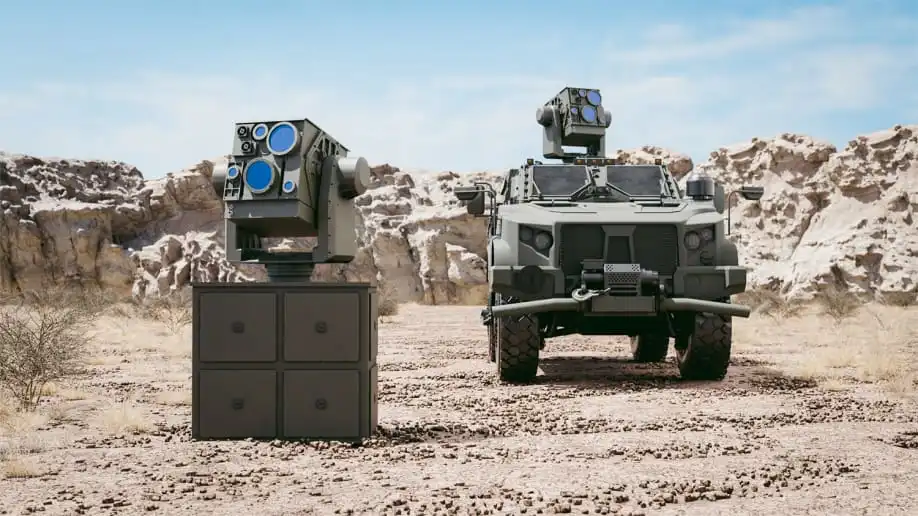
Well, jeez. Turns out when you build the most science fiction-y of all science fiction weapons, you become very popular very quickly.
Late yesterday, the US Army announced that it’s awarded a $464.8M OTA to defense jack-of-all-trades AV (the artist formerly known as AeroVironment, NASDAQ: $AVAV) for dozens of AV’s LOCUST X3 cUAS systems.
- The contract was issued by PAE Fires for the Enduring-High Energy Laser (E-HEL) program.
“This award marks a defining moment not only for AV, but for the future of modern defense,” Wahid Nawabi, chair, president, and CEO of AV said in a statement. “The transition of directed energy from experimentation to an enduring, fielded capability reflects years of collaboration, innovation, and operational success alongside the US Army.”
This is the Army’s first-ever production contract for directed energy systems. AV says it will deliver the LOCUSTs “over the next few years in support of multi-year fielding requirements.”
Pew-pew, indeed.
Fry up: First, a bit of background on what, exactly, a laser weapon is for the less nerdy among us.
These systems—also known as directed-energy weapons—basically concentrate a high-powered beam of energy on a target to damage or destroy it. Because they don’t need, like, ammunition, they’ve got a theoretically “infinite magazine” (provided they’ve got enough power).
- Laser weapons are certainly hype-y: Directed energy was named one of the Pentagon’s six ‘Critical Technology Areas’ last year, and the department requested over $2B in directed energy R&D funding in its FY27 budget.
- Defense Secretary Pete Hegseth has called the systems a “transformative capability,” especially in the face of massive, low-cost drone swarms.
The eighth plague: LOCUST was actually first developed by BlueHalo (AV snapped up the company for a cool $4.1B last year).
- The Army first received two LOCUSTs in 2022 through the Palletized High Energy Laser (P-HEL) program. AV then delivered two more integrated onto Infantry Squad Vehicles last September, and another two mounted on Joint Light Tactical Vehicles (JLTV) in December under the Army Multi-Purpose High Energy Laser (AMP-HEL) program.
- The LOCUST X3 packs 30 kW of power and is designed to take down Group 1 to 3 drones.
- These are the very weapons that were used last week to down cartel drones along the US-Mexico border and may have been responsible for shutting down the El Paso, TX airport earlier this year (oops).
- After that kerfuffle, AV revealed in an exclusive to Tectonic in May that LOCUST was given the seal of approval by the FAA and the Pentagon for use on US soil.
- It’s also been tested and approved by JIATF-401 and PAE Fires at White Sands.
Big time, baby: This contract takes these one-off-y deployments and brings LOCUST into the big leagues.
Per AV, LOCUST X3 will be “integrated with various platforms, such as the Army’s Joint Light Tactical Vehicle (JLTV), with options for palletized configurations, while analyzing the potential to integrate on an Infantry Squad Vehicle (ISV) in the near future.”
- Per the Army’s statement, the system is “designed for operational flexibility, capable of deployment from fixed bases, semi-fixed tactical sites, and mobile combat vehicles.”
- The systems will be produced at scale out of AV’s new-and-improved Albuquerque, NM facility.
“This program represents the culmination of years of operational lessons learned and rapid prototyping,” John Garrity, VP of directed energy systems at AV, said in a statement. “E-HEL is not a future capability; it is a production-ready system, built on proven technology, and designed to meet the demands of today’s fight while scaling for tomorrow’s threats.”