Speaking of critical technology areas—it’s been a while since we talked about contested logistics.
Luckily, our friends from the unsexy side of defense are back with some news to bring the conversation back to the top of your inbox.
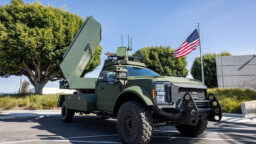
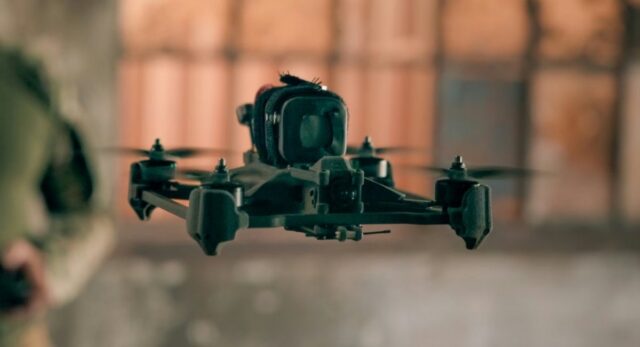
This morning, defense sustainment startup Rune and drone hotshot Havoc announced in an exclusive to Tectonic that they have officially partnered and integrated Rune’s TyrOS onto Havoc’s UAVs “to deliver autonomous sustainment solutions built specifically for contested and denied environments.”
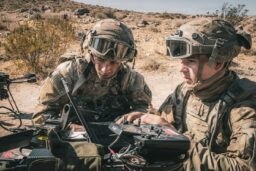
The partnership comes after the two companies demo’d an end-to-end autonomous logistics chain during xTechOverwatch’s Pegasus Charge III exercise at Fort Hood, TX in August.
“Logistics win or lose wars, right? That’s the thing that everyone throughout history has known,” Havoc CEO Paul Lwin told Tectonic. “The perfect use case for…autonomous systems right now is to transfer supplies between two points and free up the main assets to do more critical things. Now, with Rune…[we will] be able to predict where our platforms are needed and where supplies are going to be needed ahead of time.”
“Automating the logistics chain will make sure that our warfighters are more lethal…that they have the tools [and] the supplies they need to be effective,” he added.
Holding hands: Now, Havoc and Rune should both be familiar to regular Tectonic readers, but here’s a bit of a refresher.
Havoc was founded in 2024 and started out building maritime USVs, but has since gone cross-domain with UAVs.
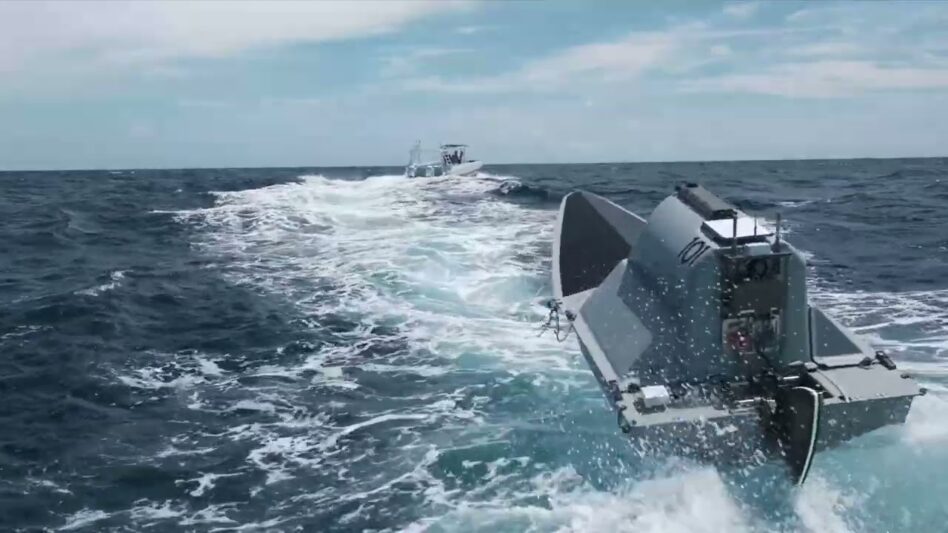
- The company’s first and flagship product is its 14-foot Rampage drone-boat, but they’ve since expanded all the way up to a 100-foot autonomous vessel built with PacMar, and a 200-foot vessel they’re building with Hanwha.
- Back in March 2026, the company snapped up heavy-lift drone maker Mavrik, officially expanding into the aerial domain.
- And they’ve raised a ton of cash money to do it—the company has raised about $200M, most recently a $100M Series A in May.
Unsexy side: If Havoc is on the flashy go-fast boats and drones side of things, Rune is pretty much on the opposite, nuts-and-bolts end of the spectrum.
Co-founders David Tuttle (CEO) and Peter Goldsborough (CTO) founded the company back in 2024 to create AI-powered software that could replace the whiteboards, Excel spreadsheets, and pen-and-paper planning that logisticians have relied on for years.
- Their flagship software is called TyrOS, and is built to operate on everything from low-connectivity edge devices to the command level. It uses predictive AI and tons of data to track and optimize the movement of gear, fuel, food, and parts more quickly across domains than legacy sustainment systems.
- The company has a five-year, $99M contract with the Army for the software, and has raised about $30M (most recently a $24M Series A).
Tuttle told Tectonic that integrating the software onto autonomous systems was a natural next step for the company—basically, if they already have all the data telling them where stuff is and where it needs to go, they might as well get robots to do it.
“It was a natural partnership,” he said. “We both found ourselves at 1st Cavalry Division…and we were able to knock this out very quickly to prove that this is maybe not ‘the future.’ It’s today.”
Up in the air: At Fort Hood, the two companies were able to demo an autonomous logistics chain on an airfield, but now—both Tuttle and Lwin said—the plan is to scale this way, way up. Ultimately, this needs to work in places like the Indo-Pacific.
- When we say autonomous-logistics chain, we mean the software ID’s where something was needed and when, and the drone took it from source to where it needed to be.
“What we showed was kind of a toy scenario,” Lwin said. “Now [we need] to get embedded in exercises and move real supplies…The lessons we’re learning from the Iran conflict, especially with the USS Abraham Lincoln, is that logistics matter. It doesn’t matter if we have an aircraft carrier with 120 awesome fighter jets. If we can’t resupply it, that will become a problem.”
Scale up: Tuttle thinks that integrated solutions like theirs can solve issues like the ones we’re seeing in CENTCOM and what we could see in the Indo-Pacific.
“When you look at Ukraine today, the vast majority of tactical resupply is happening via automated or autonomous systems. I think that is the future,” he said. “Even if we can take out one C-130 from having to do intra-theater transport…it frees them up to do other [more valuable] things…It’s about efficient asset allocation [and] efficient manpower allocation.”
Out at sea: Next up, the companies say they’ll build TyrOS onto Havoc’s other platforms—including its ships. After all, there is a whole heck of a lot of water in the Indo-Pacific.
“I’m excited to [integrate in other domains] to demonstrate to the Army and the other services,” Tuttle said. “This is just as applicable in marine littoral or maritime scenarios.”