We told you. Lasers really are so hot right now.
This morning, German directed-energy startup Ground A announced that it raised a €9.1M ($10M) pre-seed round, just eight-ish months after the company was founded.
- The round was led by Vsquared Ventures with participation from companies including Quantum Systems (interesting) and investors GRIF, Robin Capital, ABACON, Leblon Capital, and OVNI Capital.
- Interestingly, a whole lot of German defense tech heavyweights—including Quantum Systems’ Florian Seibel and Sven Kruck, and Arx Robotics’ Stefan Roebel—joined the company’s board. Dare we say there might be some partnerships on the horizon?
Ground A co-founder and CEO Tobias Brune told Tectonic that they’ll use the money to finalize their flagship laser cUAS system—the GA 1000—and start scaling up production. The goal is to start commercializing the product in the next few months, then go out for another round to scale manufacturing further.
Worth noting again: The company got a prototype of the system up and running within just a few months of founding.
What’s that they say about German engineering?
Pew pew: Now, by this point—if you’re keeping up with Tectonic—you’ll know that everyone and their mom is trying to build and field laser weapons (also known as directed-energy systems).
- As a quick refresher: Rather than taking down things like drones with, say, an interceptor or a stream of bullets, lasers direct a very concentrated beam of light at incoming threats and, well, basically, fry them.
- Because they don’t need ammunition, they’ve got a theoretically “infinite magazine” (provided they’ve got enough power).
At the front: Ground A didn’t set out (at least not for now) to build the mother of all super-huge laser systems. Instead, Brune said, GA 1000 is a “last-mile” solution—a system that can take down an explosive-laden FPV coming at you fast out of a forest in eastern Ukraine (for example).
“It’s not one very expensive machine,” Brune said. “Rather, [we want to be] capable of delivering several systems that can bring down, in the last miles, fast-flying objects. I would say we can bring down drones in Groups 1 to 3 in the last mile.”
“In the Ukraine war, 90% of casualties are due to these drones,” he added. “You need to see them, to react, target, and bring them down…in real time, in a few seconds. That’s a challenge we are solving.”
Right on target: Here’s how the whole thing works:
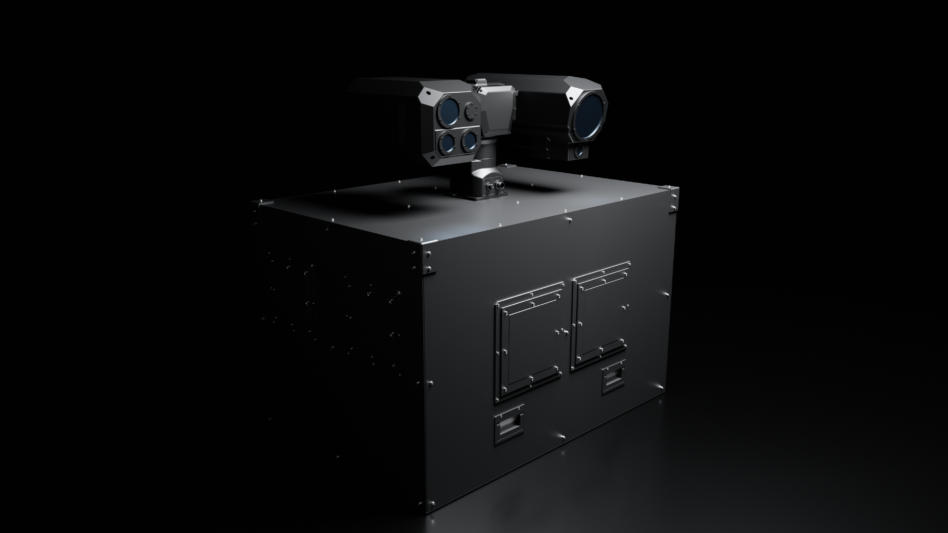
- GA 1000 is the size of a Euro-standard pallet, weighs less than 450lbs, and can be carried by four people, per Brune.
- The whole thing packs power in the “single-kilowatt figures” and costs in the “lower single-digit millions” per system, he added.
- It can be a stand-alone system or mounted on UGVs, tanks, pick-up trucks, and other vehicles.
- Back in April, Brune said they demo’d the system in Berlin and were able to shoot down drones at “several hundred meters.”
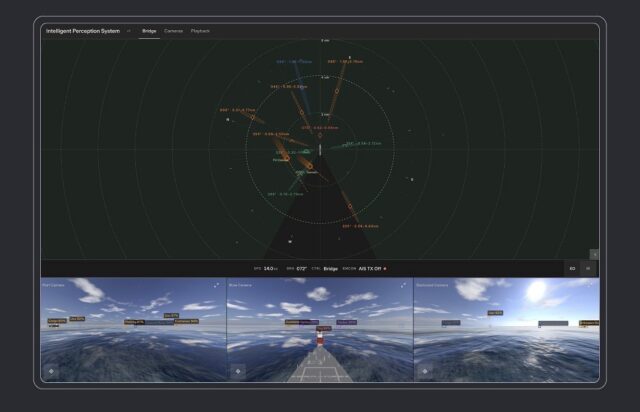
And the company isn’t just building the laser here—they’ve also built the whole detection and targeting system in-house that, like, makes the whole thing work. Per Brune, their integrated system of “radar, multiple sensor types, computer vision, and…proprietary AI” can not only spot drones, but can keep the system on target for the second or so necessary to fry the drones with a laser.
“Just to give you a perspective, we can detect a swarm of bees at a two-kilometer distance, and I can count the bees,” he said. Fun.
Buzz-buzz: Brune said that the company’s commercialization push with this round will have three branches:
- First, they’ll scale through partnerships—in other words, with companies who have kit compatible with the GA 1000. Brune said they’ve already got orders for their systems to build onto ground vehicles—we’ll hazard a guess that it’s not a coincidence that both Quantum Systems and Arx Robotics are on their cap table.
- Second, they’ll start selling GA 1000 as a stand-alone system, “delivering directly to critical cities in Ukraine or other countries,” per Brune.
- And third, they’ll look at selling to governments to protect critical infrastructure. Brune cited the recent drone attack in Leipzig as a situation in which the GA 1000 could have been helpful.
- After their next round (date TBD, we asked), they will also look at going cross-domain—after all, a lot of people want to fry threats at sea (or even in space), too.
Brune sees these laser systems not only as new and novel, but also as a way to better utilize existing, expensive-as-heck capabilities.
“We really see such a critical mismatch in defeating drones. Unfortunately, we see in Ukraine that all the expensive military equipment like tanks…have a utilization [rate] often of about 1% because they need to hide them after one shot,” he said. “A lot of expensive equipment…can’t be fully utilized because you can’t protect them. [With our systems], you can still use your military equipment without [it] getting destroyed by a self-built $500 drone.”