The drone-boat world is getting busier and busier, but a partnership between one of the world’s largest shipbuilders and a new, relatively unknown American maritime autonomy company is betting they can rise to the top.
After formally teaming up in April, Hanwha Defense USA, the US subsidiary of Korean defense giant Hanwha, and super sneaky autonomous maritime company Magnet Defense are set to kick off production of a new medium unmanned surface vessel (MUSV) this fall, execs from both companies told Tectonic and other reporters during a tour of Magnet’s test vessel last week.
Splish splash: Hanwha is a known quantity, but if you haven’t heard of Magnet, you’re probably not alone. The company is a bit of an enigma in the drone boat world.
- Magnet came out of nowhere last December, claiming to have self-funded the construction and testing of a nearly 48-meter unmanned surface vessel—called the M48—with “over 32,000 nautical miles of successful heritage and over 390 total days at sea.” That voyage included a trip from the Panama Canal to Guam through “Sea State 9 conditions.”
- The company’s CEO and co-founder, Marc Bell, is even more of an enigma. Bell previously co-founded and led Terran Orbital, a satellite manufacturer that sold to Lockheed Martin in 2024 for $450M, and before that, produced—of all things—musicals, including Jersey Boys. As we said, an unorthodox company.
- In January, Magnet acquired Louisiana-based shipbuilding company Metal Shark and its 125,000 square feet of manufacturing space to give it “immediate production depth and execution capacity.”
- And in April, Magnet inked a deal with Hanwha Defense USA, the US subsidiary of Korean defense giant Hanwha, to scale production of the USV and integrate it with Hanwha’s payloads.
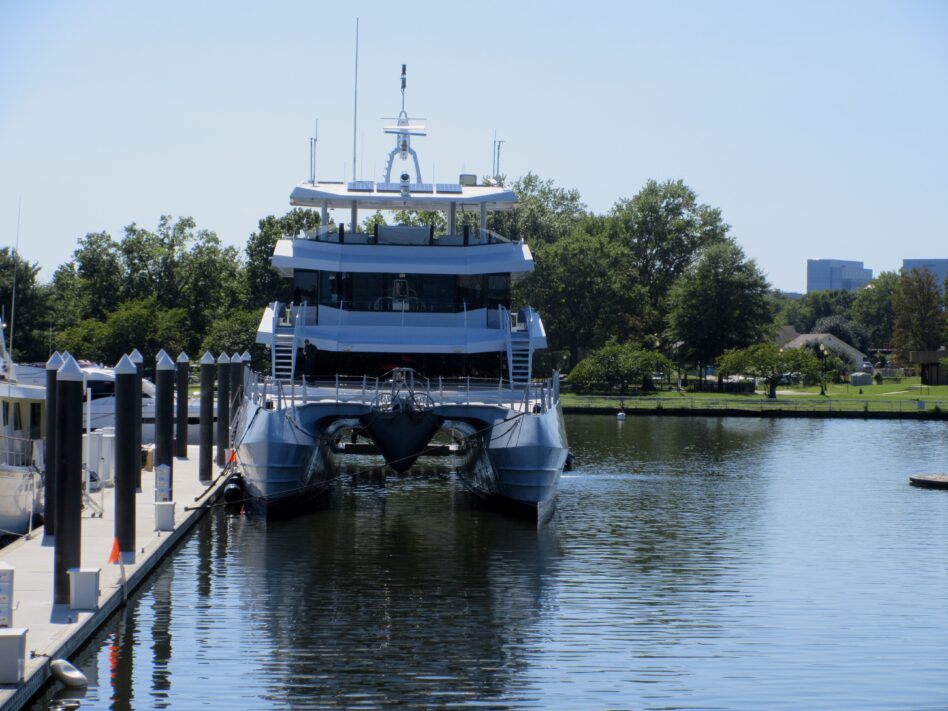
Big boat: Tectonic got an inside look at Magnet and Hanwha’s M48 USV during a tour of the vessel in DC last week.
- The vessel Hanwha and Magnet are set to produce will have the same catamaran hull design and in-house autonomy stack as the test USV, but without the cabin and other human-centric infrastructure needed for the test voyage. It’ll also be about 10 meters shorter and called the H38.
- According to Magnet’s co-founder and CTO George Wallner, the H38 will have a range of 17,000 nautical miles and a flat deck suited for a range of payloads, potentially including containerized missile systems, which they’ll test with Hanwha early next year.
- That catamaran design is built to cut through big waves and ensure stability in rough seas, making it a “cost-effective, survivable, capable platform suitable for launching kinetics,” Wallner said.
- The Magnet-built M48—with the cabin “superstructure”—costs $30M, but Hanwha’s SVP for Missiles, Kevin Schoonover, told reporters that the H38 would cost “about half” that.
“One of the reasons we looked very hard at this specific vessel is because of the catamaran architecture—it’s very stable, and if you look at every other company that’s [building] an MUSV right now, you’re going to find they are not in that position,” Schoonover said. “As an expert in weapon systems, missiles, and kinetics, I need to have a stable launcher. If I don’t have a stable launcher, I’m not going to be able to hit my target.”
Off to the races: They’re already gearing up to build that MUSV in the coming months and test it for a whole bunch of different missions starting early next year.
“We’ll be beginning construction of the [H38] next month, and we’ll be testing our payloads on other platforms this fall, and on the H38 in January,” Hanwha Defense USA CEO Michael Coulter told Tectonic and other reporters onboard the M48. “The customer is asking for disruptive capability, commercial practice, what’s already in use and working really well, and capability—not platforms—so we think it’s a unique solution for them.”
The team has their eyes on a number of programs, including the Navy’s MUSV marketplace, but they’re not putting all their eggs in one basket.
“The marketplace is evolving, and so we’re still waiting to hear more information about how that’s going to play out,” Coulter said. “We have meetings and discussions with the Navy related to where they want to go, but our main focus is leaning forward and bringing the capability not just as a vessel, but as a complete system that has all the hooks to be able to switch and swap [payloads], whether it’s directed energy or a missile system.”
“I think more importantly, we want to prove it,” he added. “If we see a solicitation and get an opportunity to bid on that, obviously we’ll go execute that. I can’t speak for the Navy and [whether] they’re going to give us a contract, but of course, we want to, and we’d like to be part of that.”