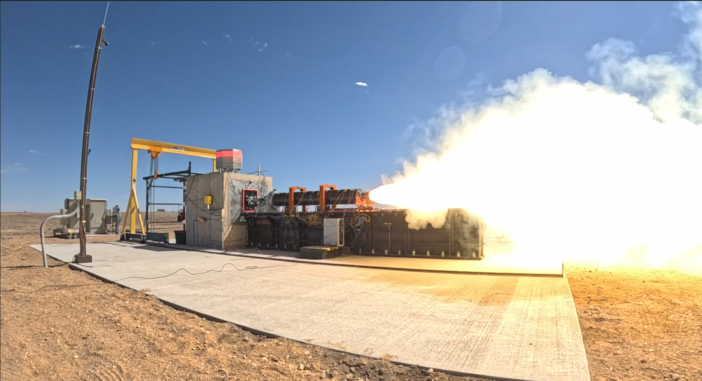
After years of inertia, the long-consolidated and constrained solid rocket motor (SRM) industry seems to be finally being dragged into the future by a few startups, some fancy advanced manufacturing tech, and a military desperate to shore up its shrinking munitions stockpile.
And now, it looks like the Navy is making a serious bet on one of those shiny startups—Ursa Major.
Late yesterday, the Colorado-based hypersonics and SRM hotshot announced that it’s scored two new contracts—totaling $137M—with the Navy to design, develop, and qualify SRMs for the service’s Compact Air-to-Air Missile (CAAM) and the Naval Modular Missile (NMM) programs.
- The CAAM program (a $91M win for Ursa) is designed to fit onto F-35s and future aircraft (including, potentially, collaborative combat aircraft) for short-range air-to-air engagements as part of what the Navy calls “inner boundary weapons.”
- The Navy hasn’t said much about the NMM (which Ursa was awarded $46M to develop an SRM for), but it’s expected to come in a few different variants, including a terminal-stage interceptor, medium-range, and long-range missiles. Ursa’s working on the medium-range NMM, which it says will be compatible with “existing Navy shipboard launch systems.”
Motor madness: Ursa Major’s work on the CAAM and NMM programs is new, but this isn’t the company’s first rodeo with the Navy.
- In July, Ursa Major was tapped to take its 13.5-inch-diameter, 3D-printed MK 104 SRM (which powers the Navy’s workhorse Standard Missile family) through a critical design review and static-fire tests under a $10M deal.
- They’ve also designed and developed SRMs ranging from 2.75-inch (for BAE’s APKWS guided missile) to 24-inch diameter rocket motors used for space launch.
- For the CAMM and NMM missile programs, Ursa Major is designing and qualifying low-cost 7-inch and 10-inch SRMs, respectively.
“This is a natural extension of what we have been doing on the MK 104, in terms of leveraging our capability in scaling manufacturing to bring products to market as quickly as possible—quicker than has been traditionally done,” Ursa Major’s president of Solid Missile Systems, Jason Meredith, told Tectonic. “Not only for the design and the development phase, but also going into qualification.”
Propulsion printer: While Ursa hasn’t worked on these exact diameters for the Navy yet, they’ve been investing in designing and developing them independently in anticipation of a call-up.
“These two specific diameters are areas that we have been doing development work on both from a design and a manufacturing standpoint, so we felt like that we had positioned ourselves well to be able to work with the Navy on these programs,” Meredith said. “We’re very excited to be selected to do that work and carry it forward.”
Part of the reason that Ursa’s been able to work on motors of all shapes and sizes—including the two under these new contracts—comes down to some fancy additive manufacturing tech. Ursa’s 3D-printing process, called Lynx, uses metallic 3D printing and other technologies to produce different SRM systems on the same production line.
Working on the CAAM and NMM missiles simultaneously (under a roughly three-year development timeline for both, according to Meredith) using Lynx demonstrates “the flexibility that we have and the confidence that these organizations have in Ursa Major,” he said. “That comes from a lot of testing that we have done, as well as demonstrating that we’re willing to work with [the Navy] to figure out ways to move faster.”
When you’re gearing up to go public in a $2.2B SPAC deal, $137M in fresh contracts certainly helps get investors excited.