AUSA is upon us, and if the Army’s announcement last week creating a new autonomous systems command (called FASCOM) is any indication, drones taking center stage is a safe bet.
Forterra and Hypercraft have a little something up their sleeve on that front.
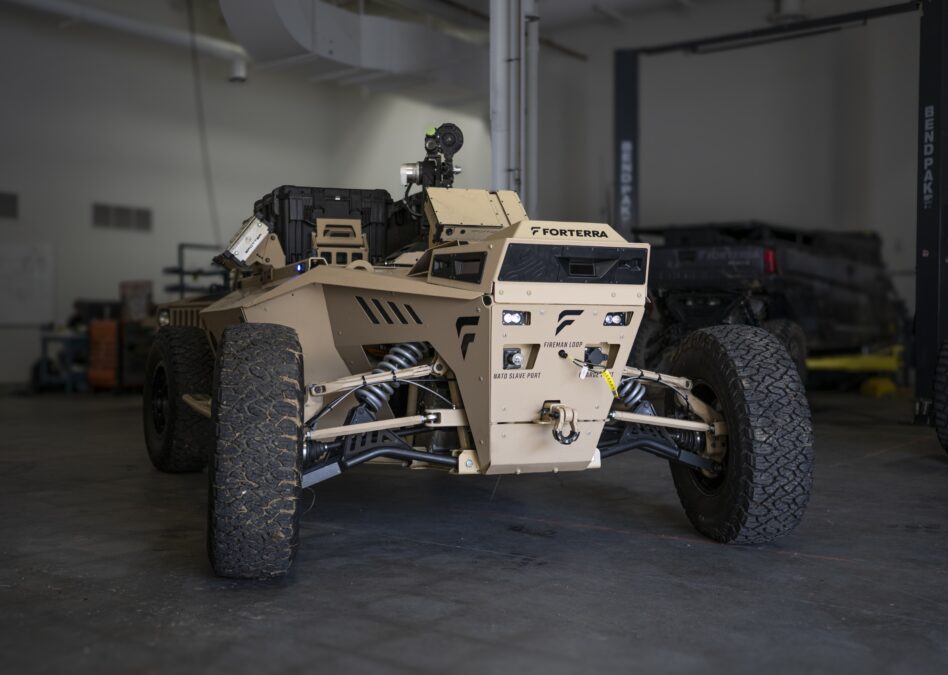
Next week, the ground autonomy hotshot and the Utah-based ground vehicle startup are unveiling an autonomous off-road ground vehicle that pairs Forterra’s AutoDrive autonomy stack with Hypercraft’s Razorback UGV, with an eye on contested logistics missions (so hot right now).
On the ground: By this point, Forterra needs little introduction, so we’ll keep it brief. The company was founded in 2002 as Robotic Research Autonomous Industries and rebranded as Forterra in early 2024. But unlike other ground-autonomy companies, it doesn’t build the vehicles itself.
Forterra’s flagship product is vehicle autonomy software called AutoDrive, which it bills as a “full-stack solution,” including hardware, software, and sensing. The idea is that it can turn pretty much any vehicle into a drone, and Forterra’s done so on quite a few.
- AutoDrive has been integrated into a whole range of vehicles from big-time producers, including Polaris (counting over 100 Ranger 1500s deployed in Ukraine), General Dynamics, Oshkosh (on a JLTV under a $92M contract for the Marine Corps’ ROGUE-Fires system), Ford’s F-250 pickup for the Army, and more.
- To date, Forterra says AutoDrive has been deployed on more than 1,100 missions, integrated into over 50 different vehicles, and is on contract for over 258 systems.
Hyped up: Hypercraft is a bit more under the radar, but their Razorback UGV—the focal point of the partnership with Forterra—is a beast.
- Hypercraft started as a commercial electric-powertrain company before pushing into defense and complete unmanned vehicles, unveiling its flagship product, Razorback, earlier this year.
- The over 13-foot-long vehicle is built for off-road driving (at speed) and offers up to 4,000 lbs of payload capacity, 500 miles of range, and up to 38 kW of exportable power.
- Like Forterra, Hypercraft focuses on its strengths, designing Razorback to adapt easily to different third-party sensors, autonomy packages, radios, weapons, and mission payloads (including Fortem’s c-UAS radar system).
That plug-and-play design from the get-go made the partnership with Forterra an easy choice.
“Platforms can be designed for autonomy from the start—they don’t always have to be retrofitted post-production, meaning most unmanned ground vehicles are manned trucks with autonomy bolted on after the fact,” Forterra Chief Growth Officer Scott Sanders told Tectonic. “But Hypercraft built Razorback for autonomy from day one, and we’ve spent 20 years making autonomy work off-road, so the partnership was an easy call.”
Unsexy is the new sexy: Contested logistics is having a moment, and that’s what Forterra and Hypercraft have their eyes on with this team-up.
“We’re going after contested logistics and other missions where a driver is the most exposed person on the battlefield,” Sanders said. “Razorback and AutoDrive combine to deliver a platform that can go further, over more complicated terrain, and power platforms in ways that traditional UGVs cannot.”
But more broadly, Hypercraft aligns closely with Forterra’s partner-choosing rationale and ethos, which is guided by three questions: “Are you solving a real operational problem? Can your technology scale to production? And do you understand that autonomy isn’t just software?” Sanders added. “It touches the vehicle, sensors, compute, comms, and the operator. Get any of those wrong, and the system doesn’t get fielded.”
To Forterra, “Hypercraft checks all three.”