Ukrainian defense tech companies really are making some money moves, y’all.
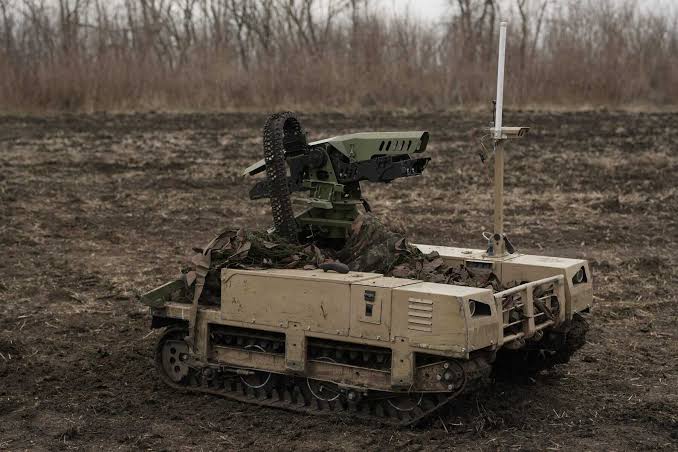
Yesterday, Canadian defense hotshot Dominion Dynamics announced that it’s teaming up with Ukrainian UGV company Tencore to manufacture the latter’s TerMIT UGV in Canada and integrate Dominion’s autonomy stack (called AuraNet) onboard.
The idea is to use Canada’s production capacity (and Dominion’s autonomy bona fides) to bring AuraNet (and more UGVs) to Ukraine’s frontline.
“When Prime Minister Carney and President Zelenskyy committed our countries to build together, they gave industry a mission,” Dominion Dynamics founder and CEO Eliot Pence said in a statement. “Canada has the workforce and the suppliers to build at scale. This agreement is how two companies start turning that commitment into vehicles, and we intend to move fast.”
Initial production of TerMITs in Canada is planned for next year.
- Dominion is also planning an “Arctic-hardened” version of TerMIT for sale to Canadian operators and NATO allies.
Up North: Dominion Dynamics—Canada’s defense neoprime, in their words—has had quite the year. The company was only founded by Pence last year, but has already raised over $120M in financing to build, well, basically, Canada’s version of Anduril—but with a keen focus on the Arctic, for obvious reasons.
- Most recently, the company closed a $100M Series A led by Georgian (Canada’s largest VC)in June.
- In the year-and-a-half-ish since the company was founded, they’ve had three “financing events,” per Pence.
Speed skating: In its relatively short existence, the company has churned out a whole range of stuff, from software all the way up to a tiny-drone-fighter bid for Canada’s equivalent of the CCA program. That includes:
- AuraNet: The company’s flagship software platform that connects sensors, autonomous systems, and operators into a shared operating picture in low- or no-connectivity environments. That’s what’ll be built onto TerMIT.
- Taku: An autonomous surveillance tower for persistent sensing and communications.
- Echo: An under-ice sensing tower/hydrophone system designed to pick up sneaky things like Russian subs.
- Flint: A software-defined radio (SDR) for tactical comms.
- Warden: An autonomous ground vehicle (UGV) for remote operations and sensing.
- Scout: Dominion’s bid for Canada’s ACP (similar to CCA) program. Rather than a small-scale fighter like Anduril’s Fury, Pence told Tectonic back in June to think of it as a swarm of smaller drones that could deliver the same capabilities. Dominion has said it’s investing $50M in the program.
Laser focus: If Dominion has gone far and wide with its product portfolio, Tencore has gained a deep, deep expertise in one very specific area—battle-hardened UGVs.
- The company was founded in Ukraine in 2024 and started churning out UGVs (baby tanks) to the front line real quick.
- According to the company, they’ve already deployed 5,000 TerMITs to Ukrainian military units.
- They also raised about $4M from MITS Capital back in summer 2025.
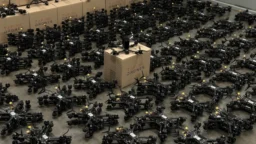
Baby tank: Think of TerMIT as a small, electric-powered, tracked, unmanned ground vehicle (again, baby tank-like) that can be quickly configured to carry out a whole range of missions.
- Most of the company’s vehicles are used for things like resupply, ISR, and CASEVAC. However, the UGV can be configured to carry out kinetic missions (like, with a gun tower or a grenade launcher) as well.
- The tank is quick to produce and modify (like, with a screwdriver), has a range of about 40 km, and can carry a payload of 350-400kg.
- It’s also been configured more recently with some autonomy to keep chugging along even when it’s jammed.
Mr. Worldwide: And this isn’t the company’s first international partnership.
- The company formed a joint German venture with Quantum Systems (Quantum Tencore Industries, or QTI) back in April, and the team was tapped to manufacture 2,000 TerMITS in Germany for Ukraine in June.
- They’ve also got an MoU with Insta in Finland (to localize production) and Shark Robotics in France.
The main idea here is to move as quickly as possible to (hopefully) start churning out TerMITs armed with AuraNet, like, ASAP.
“The biggest lesson from Ukraine is speed,” TENCORE co-founder Roman Tkachenko said in a statement. ”Battlefield requirements change in weeks, so production, operational feedback and engineering have to run as a loop: build, deploy, learn, change, scale. Canada gives us the manufacturing base, suppliers and reliable power to run that loop alongside allies who need these vehicles.”
Worth noting: This is an MoU. The two companies say they are still working towards “definitive agreements” (i.e., money and numbers). Stay tuned.