In case you missed it: Last month, Tectonic spent a week in Kyiv, Ukraine, meeting the people at the heart of the country’s defense tech industry (and the operators using the kit they build).
In part one of our dispatch from Kyiv (published Tuesday, if you haven’t checked it out yet), we focused mostly on what we heard about the tech and the fight itself: Interceptors, deep strike, logistics, autonomy, comms, and all the other fun stuff.
But there was another very important theme that came up in most of our conversations—the country’s defense tech industry itself is going through some pretty massive changes.
For context: Ukraine’s defense tech sector has gone from largely state-owned and small-ish to massive and industry-leading in the four years since Russia’s full-scale invasion of the country in 2022.
- The Kyiv School of Economics (KSE) estimates that the country’s defense technology market (key word—pay attention) stood at about $6.8B in 2025.
- The Ukrainian MoD says that defense industrial capacity (again, key word) grew from $1B in 2022 to about $35B in 2025. Quick maths—that’s about a 35X increase. And capacity for this year is expected to grow to about $55B.
- And tech output is only growing—KSE estimates that in-country UAV production increased by 137 percent, UGVs by 488 percent, and EW systems by 215 percent from 2024 to 2025. And again, that’s only on the up and up.
But there are some, erm, issues.
- The bottleneck is mostly, well, money. Ukraine isn’t buying everything these companies are producing—but selling that excess kit abroad is trickier than it looks.
- And foreign investors can’t just pump VC money into the country in the way they would elsewhere—financial mechanisms, IP restrictions, and wartime capital transfer limits all make bringing private capital in tricky (though there has been an increase—the MoD says foreign entities put $6.1B into Ukrainian defense production in 2025, versus roughly $600M in 2024).
- That means that for a lot of Ukrainian companies, their sole buyer (and funder) is the Ukrainian military—and if the war ends (which, of course, we’re all hoping for), a lot of that capital inflow could, as they say, go to zero.
So, we thought we’d tell you a bit more about what we heard about the industry, how it’s changing, and what the future of Ukraine’s defense tech landscape might look like.
And again—this is not an end-all-be-all, Big Five-style analysis of the industry after a few days in Kyiv. These are just the things we found ourselves thinking a lot about after a week of conversations with defense tech leaders and operators.
So, let’s jump on in.
First off, the great consolidation is coming.
Ukraine’s defense tech industry spent the first few years after the full-scale invasion in a pretty understandable mode: Everyone build everything needed immediately, and get it to the frontline as quickly as possible.
That worked very, very well—as we talked about on Tuesday, that’s put the country at pretty much the tippy-top of defense tech innovation and helped create a whole new way of fighting.
- According to Brave1, it currently has a whole 2,500 companies in its defense tech “cluster” building more than 5,000 different products. To break it down, that includes over 500 UAV manufacturers, 300 EW/SIGINT companies, and 200 UGV manufacturers.
- That proliferation extends to the military and procurement, as well. A lot of Ukrainian units have their own small engineering/workshop teams close to the front that are modifying, assembling and testing equipment in response to what is happening right in front of them.
- Individual units (not to mention brigades and corps) can also act as direct customers—through an MoD program called DOT-Chain Defence, brigades receive allocated budgets and can choose the drones, UGVs, EW and other equipment they actually want from a digital marketplace.
- Plus, there’s the whole Brave1 marketplace and e-points system. Units earn points for verified battlefield results and spend them on equipment they choose from the group’s capability marketplace. According to the MoD, more than 400 combat units had ordered UAH 33B+ of equipment and 500,000+ drones through the system by June of this year.
And, we cannot emphasize this enough, this distributed model has worked—operators, for the most part, have been able to get what they need, and companies have, for the most part, built to that need.
- But it’s also resulted in a lot of duplication—there are hundreds of different FPVs, for example, and most units have a favorite.
But now, as the industry matures, things are starting to change. MITS Capital’s Perry Boyle put it pretty simply: “The private defense industry in Ukraine is a relatively new industry…we’ve gone through this industry phase of company proliferation, and now we’re about to enter a phase of consolidation.”
One of Ukraine’s strengths, he added, is that “1500 different combat commands can purchase whatever they deem necessary…[but] that also results in a lack of scale and a lack of standardization.”
- We’re already starting to see this change. The blockbuster example is in recently US-listed autonomy company Swarmer’s acquisition of Ukrainian UGV giant Ratel for $224M. (Erik Prince also told Tectonic earlier this week that they’re planning more acquisitions.)
- But there are others doing it, too. Drone giant Vyriy Industries has rolled up five different drone and component companies, and TAF Industries acquired a majority stake in the Teslia UGV platform earlier this year, by way of example.
A lot of people we spoke to contrasted Ukraine’s defense industry with Russia’s—Russia (with the help of Iran and North Korea) has thrown all of its R&D and manufacturing might behind a few key products (like the Shahed/Geran and Iskander), and augmented with COTS Chinese drones. That’s allowed them to iterate quickly, resulting in things like jet-powered Geran 4s and 5s.
- Many argued that Ukraine should move closer to this approach—larger companies rolling up smaller (battle-proven) companies and tech, allowing them to streamline products and scale up production.
“You can’t have all these independent combat commands reinventing the wheel all the time. It’s not efficient,” Boyle said.
But building in Ukraine still looks very, very different.
Here in the US and Europe, we like factories big, vertically integrated, efficient, and consolidated.
In Ukraine, that can get you blown up.
- TAF Industries CEO Volodymyr Zinovskyi told us his company simply can’t operate one mega-factory: “In Ukraine, we can’t build huge factories to produce a huge amount…because of the risks.”
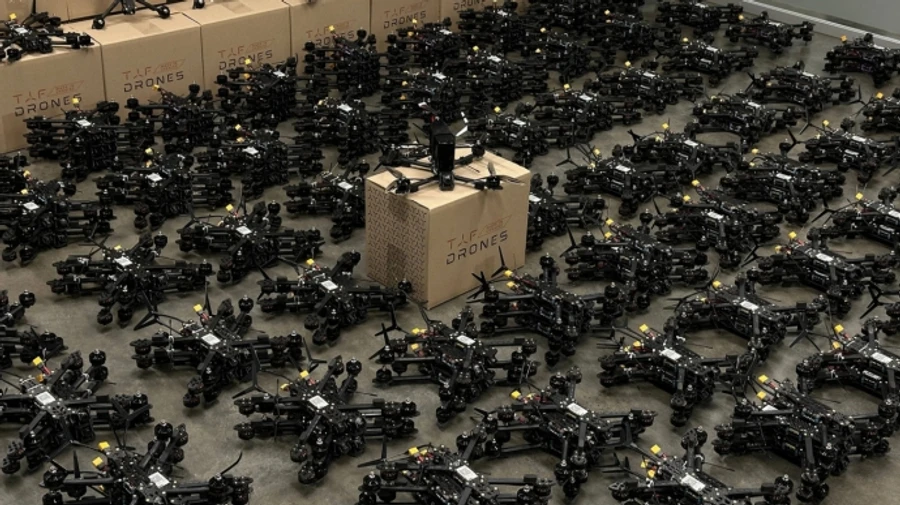
- Instead, TAF has built a network of smaller facilities—although “smaller” is doing some work here. Zinovskyi said one of those facilities can produce 20,000 drones per month.
- The work itself gets split up, too. “One of the facilities will do the electronic work. Another facility will do the body…Another facility [will do the] final assembly,” he said.
- Some facilities are underground. Others are hidden in plain sight. Zinovskyi said people living around some of them don’t even know drones are being produced there.
“If you read books about making a business, about building a manufacturing company, everything will tell you about consolidation, about making things vertically integrated, making huge hubs to reduce your costs and optimize,” Zinovskyi said. But in Ukraine, the threat of a missile or drone strike (just look at the past few weeks) means you have to do the opposite.
So, yes, industry is consolidating—but by the sounds of it, production is very much not.
And, sorry, “battle-tested” doesn’t mean a whole lot anymore.
We teased this one in part one, but it’s worth coming back to from the company side. Pretty much everyone in defense tech wants to say their stuff is “battle-tested in Ukraine.”
The Ukrainians are, erm, less impressed.
- “Battle-tested in Ukraine stands for nothing,” The Fourth Law CEO Yaroslav Azhnyuk told us. “Like, anyone can battle test anything in Ukraine.”
- His preferred standard is considerably higher: “We should replace [the phrase] with ‘adopted by Ukrainian defense forces.’”
- An operator with Khartiia Corps made basically the same point from the other end. If a foreign company comes to Ukraine, he said, “It cannot just be for the stamp, ‘Tested in Ukraine.’”
- And sending something to a range isn’t enough either. “It cannot be only in a polygon. I’m sorry, but battlefield testing is something else,” he added.
Put starkly: It’s not enough to send five drones to Ukraine. It’s about sending hundreds (or thousands), getting feedback, and making them actually work for what operators need. Then, it’s about whether thousands more actually get ordered.
- This is why, as we mentioned Tuesday, Azhnyuk said Ukraine’s edge is the “productized feedback loop,” and why Tencore’s Roman Tkachenko described the military as “part of [his] R&D team.”
- If you send a couple of drones to be tried out on the frontline, many people told us, they don’t work properly, and then you don’t fix them to make them work based on feedback, it’s very unlikely your company will be particularly popular in-country.
Also, Ukraine has a bit of a single-buyer problem.
Now, let’s get back to some of those industry problems.
Ukraine has gone extremely hard on the buy Ukrainian thing, and with good reason.
- 76 percent of centralized weapons and military-equipment procurement spending went to Ukrainian manufacturers in 2025, up from 46 percent in 2024.
- The Defence Procurement Agency says 82 percent of the weapons, equipment and ammunition it contracted in 2025 came from Ukrainian manufacturers, representing nearly UAH 430B ($9.58B) in procurement.
Plus, defense exports were effectively banned until this summer, which means domestic producers could really only sell domestically.
But now, that’s created a bit of a dependence.
- Right now, as the war continues to rage, Ukraine needs as much kit as it can get. But many we spoke to told us that if the war (as everyone hopes) comes to an end, that market will shrink real quick.
- That could mean doom for a lot of the companies who’ve built their companies around selling kit to the MoD.
- Airlogix CEO Vitalii Kolesnichenko also said this creates issues with foreign investors. “The only customer of yours is Ukraine, and for some of them it’s a red flag,” he said.
Plus, it’s worth noting that Ukraine is already having some money troubles—it’s not a given that the wartime funding tap will always be free-flowing.
- Per the government, the country’s total war-related funding needs this year amounted to $155B, and $27 billion of that remains unfunded. The EU and other allies have started to step up to fill the gap, but if it’s not closed—that will mean less funding to buy drones and other equipment. (Zelenskyy has said the country will face “serious challenges” with drones this winter if more funding doesn’t come through soon.)
- And the country already dedicates an enormous portion of its budget to defense—Ukraine devoted roughly 27 percent of its GDP to security and defense in its original 2026 budget. A lot of the money it needs for other state functions it gets from foreign aid.
So, a lot of the leaders we spoke to were looking to find new markets to sell that excess kit and (in an ideal world) route those proceeds to more capabilities for the Ukrainian frontline.
Which brings us to the export market.
For most of the full-scale war, Ukrainian defense companies could only build for Ukraine. Recently, that has started to change.
- In July, Ukraine formally launched a mechanism for controlled exports of domestically produced weapons and defense technologies.
- But it isn’t exactly free trade. The government says every export contract has to strengthen Ukraine’s defense-industrial base and increase production for the Armed Forces (which, again, fair enough).
- Under the mechanism, 20 percent% of proceeds from finished defense products and technologies and 30 percent from components go into a special state fund for Ukraine’s defense industry.
Many of the leaders we spoke to said that while export is now a possibility in theory, it’s less accessible in practice.
- Many said they’d struggled to get export licenses, even as the government opens export offices across Europe.
- Most agreed that in order to sustain the defense industry (and the country, for that matter), opening up exports further is imperative. “Ukraine should shift from permission to promotion of exports,” Boyle said.
- After all, to sustain the industry after fighting stops, you’ll need other markets.
“The worst thing that can happen with Ukrainian defense tech is that it disappears after the end of the war,” TAF’s Zinovskyi said.
“Right now, [Ukrainian defense tech] is driven by the Ukrainian economy,” he added. “But now, I think that the Ukrainian economy has to be driven by Ukrainian defense tech.”
Unfortunately, investing in Ukraine is still kind of hard.
Here’s one of the stranger things about Ukrainian defense tech.
A lot of Ukrainian companies have real products, real revenue, huge production volumes, and thousands of hours of actual combat use.
And yet they can still be considerably harder for a major Western VC to invest in than a pre-revenue startup in El Segundo.
“Ukrainian companies are making more revenue than Western companies are raising in funding,” The Fourth Law’s Azhnyuk told us.
So why isn’t Western VC flooding in?
A few reasons.
- The companies weren’t necessarily built for VC. Boyle said MITS can work with Ukrainian companies “before they’re investable by standard U.S. or European venture capitalists.” Ukrainian corporate structures, financial systems, and governance, he said, aren’t always aligned with what Western VCs require.
- And that isn’t theoretical. Deloitte has found that some smaller Ukrainian defense firms still lack formal boards, clean ownership structures, standardized financial reporting, or even conventional corporate structures. Some operate as groups of individual entrepreneurs working together rather than as a normal company. That makes sense when you’re building quickly for wartime needs, but less so when you’re trying to get a fat check from abroad.
- The financing instruments get funky. SAFEs are being used in Ukrainian defense tech, but they’re easier for Western investors to navigate when there’s a US or European holding company involved. Instead of investing directly into the Ukrainian company, the investor signs a SAFE with the foreign entity, which can later convert into equity.
- Then there’s the IP. Deloitte found that only a minority of firms it examined had properly registered or easily transferable IP rights. That’s a rather large issue if what you’re buying (or investing in) is a technology company.
- It gets even more complicated when the state paid for some of the development, soldiers helped develop the product, or the technology is subject to export controls. Basically, if the state owns the IP (which in most of the aforementioned cases it does), companies may need a government license to commercialize it, and that license can restrict where the technology is manufactured, how it’s transferred, and who else gets access.
- Plus, there’s getting your money back out. Ukraine still maintains wartime capital controls. Companies can repatriate dividends accrued in 2023–2025, but under the standard regime the ceiling is €1M per issuer per month.
This is leading to the great move abroad.
There seems to be one mega-loophole that everyone is using to get around all this—opening offices or forming joint ventures abroad. Here’s how it works:
- Companies open a foreign subsidiary or JV, usually pairing Ukrainian IP and know-how with Western capital and manufacturing.
- They then send the technology to the foreign entity and manufacture products there, rather than exporting finished weapons from Ukraine.
- The foreign entity can pursue local military contracts through a more familiar procurement system.
- Western investors can invest into a familiar US or European corporate structure—that money (or some of it) can then flow to Ukraine, as well.
- Overseas factories can also send production back to Ukraine (look at Germany)—so it’s not just taking stuff out of the country.
- To be fair, the government is kinda in on this–the Build with Ukraine initiative formally encourages foreign partners to partner with Ukrainian companies to build abroad, for Ukraine (and its partners).
And when we say everyone is going abroad, we kinda mean it:
- Airlogix has JVs with Auterion in Germany and Sentinel in Canada to produce Ukrainian-designed drones abroad.
- Frontline Robotics and Quantum Systems are producing Ukrainian-designed drones in Germany through Quantum Frontline Industries.
- Tencore and Quantum Systems launched Quantum Tencore Industries, which is producing TerMIT UGVs in Germany—including an initial order for 2,000 systems.
- WIY Drones and Quantum Systems formed another German JV to produce WIY’s Strila interceptor.
- TAF is pursuing overseas production with Wingcopter and THYRA in Germany and Summa Defence in Finland.
- UFORCE has expanded its R&D footprint outside Ukraine, including development work in the UK and Portugal.
- And this is becoming institutionalized: The EU-Ukraine Drone Alliance now includes Tencore, TAF, UFORCE, Skyfall, Vyriy, and other Ukrainian manufacturers alongside European defense companies.
That doesn’t mean companies (including foreign ones) aren’t localizing production in-country—the Build in Ukraine initiative (launched last year) is designed to bring foreign companies, capital, and production into Ukraine. And, as of early 2026, the government said 25 foreign defense companies were localizing operations in the country.
But the trend seems to stand—one investor told us that, essentially, the only way to get serious foreign money into Ukrainian companies is to invest in their entities abroad.